Even in the black market, nature abhors a vacuum.
The void left by drug lord Ibrahim Abdalla Akasha’s assassination in May, 2000 was filled by his sons, Ibrahim and Baktash.
The senior Akasha had ruled the East African drug trade, with networks spanning the Middle East and Europe, for at least 20 years.
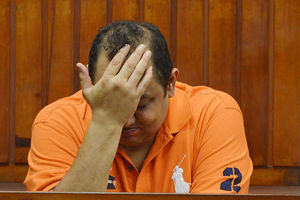
Baktash Akasha Abdalla at the Mombasa Law Courts during the hearing of his extradition case on December 1, 2016.
Photo credit: File
The junior Ibrahim and his brother Baktash would inherit control of that segment of the black market for nearly the same time as their father. They were extradited to the US in August, 2018.
Enter Swaleh Yusuf Ahmed, alias Candy Rain or “Kandereni ”. Candy Rain’s era would last until March 2024 when his body was found in Kilifi, nine days after being picked up by individuals who identified themselves as police officers seeking to question him. Those three reigns largely involved trafficking heroin. The Akasha sons had, however, diversified into methamphetamine. It was methamphetamine that spelt their doom as the Drug Enforcement Agency cracked down on the supply of methamphetamine in the US, leading to the arrest of the brothers. Since Candy Rain’s death, detectives in the Coast region have been working to suppress the activities of new drug traffickers.
Police sources indicate that the distribution and use of hard drugs, especially heroin and cocaine, have declined after the collapse of these networks. However, new cartels have emerged, introducing users to “Skank”, smuggled through Tanzania from the Kingdom of Eswatini in large quantities.
“Skank” is a slang term for a cheap, low-grade form of marijuana with a strong smell and weak to strong potency. Authorities fear that it is gradually replacing heroin, which has become scarce due to strict border controls.
Swaleh Yusuf Ahmed in Mombasa Magistrate's Court on January 24, 2019.
Photo credit: File | Nation Media Group
Detectives say the drug is shipped by sea from South Africa to Dar es Salaam, then transported by road into Kenya. Authorities say the drug is intoxicating youths and school-going children, thereby eroding social values.
Detectives have also noted a rise in the supply of cannabis sativa from Tanzania and Uganda through the porous Isebania and Malaba borders. This has flooded the market, especially in Malindi, Diani, and Mombasa, where use has doubled. Several people have been arrested with bhang, mainly in Mombasa and Kilifi counties.
Sources say that due to the scarcity and high prices of hard drugs, users have turned to prescription pills and powders to achieve a similar effect. The National Authority for the Campaign Against Alcohol and Drug Abuse (Nacada) says diazepam is the most misused prescription drug, followed by benzhexol, flunitrazepam, amitriptyline, carbamazepine, codeine syrup, tramadol, biperiden, haloperidol, propofol, and olanzapine.
An assessment of emerging drug use trends in Kenya as contained in the National Policy for the Prevention, Management and Control of Alcohol, Drugs and Substance Abuse 2025, reveals a worrying surge in the abuse of cannabis edibles, commonly found as “weed cookies,” “weed mabuyu,” “weed sweets,” and “weed candies, which makes detection and intervention harder. Despite these challenges, detectives have dismantled several cartels. A number of suspects are facing charges.
They include Ms Mwanasomo Mohammed, 52, who is accused of trafficking two kilogrammes of heroin worth Sh6 million. She was jointly charged with Mr Said Aboobakar, 53. In 2021, anti-narcotic officers arrested her at Moi International Airport in Mombasa upon her arrival in the country with the drugs.
Another suspect, Ms Zahra Ali Akharazi, was charged at the Shanzu Law Courts alongside New Zealand national Mr Selby Dean Freeman for trafficking cocaine worth Sh47,000. The State says that Mr Freeman is wanted in Malaysia for a 2012 trafficking case. Together with Alfin Allaudin Akbrelali Alibhai and Nigerian national, Abdul Lateef Ibrahim, they were accused of trafficking 11.9 grams of cocaine and 355.3 grams of cannabis worth Sh47,600 and Sh71,060, respectively.
Ms Nuru Murshid Mahfudh, 29, appearing at Shanzu Law Courts on May 23, 2022.
Photo credit: Wachira Mwangi | Nation Media Group
In another case, Ms Nuru Murshid Mahfudh, 29, was linked to trafficking after 36,764 grams of cocaine worth Sh110 million was found in her home in Kisauni.
The State has also secured convictions. Ms Fatuma Sicobo Mohamed is serving a 15-year prison term for trafficking 2,466.4 grams of heroin worth over Sh7.3 million. She was initially sentenced to life imprisonment, but the High Court reduced it to 15 years and imposed a one-year term if she fails to pay a Sh22.1 million fine. The Court of Appeal later upheld the ruling.
Fatuma Sicobo Mohamed who was in 2019 charged with trafficking heroin worth Sh7.3million has been jailed for life by a Shanzu court.
Tanzanian national Maimuna Jumanne Amir is serving a 45-year prison term after being found with 5,389 grams of heroin at Moi International Airport. Another convict, Fatuma Ahmed Ali, was sentenced to 40 years in prison and fined Sh825.6 million for trafficking narcotics worth Sh275 million. She was charged alongside her slain accomplice, Swaleh, who was removed from the case following his mysterious death while the trial was underway.
Heroin and cocaine worth more than Sh400 million was destroyed in Mombasa in February this year. This included 91,738 grams of heroin valued at Sh275.2 million seized from Ms Ali and Swaleh. In addition, Swaleh was also found with cocaine worth Sh3.9 million. He was believed to have led a cartel operating in Mombasa and Kilifi counties. Police regarded him as a prime target and the next major threat in the fight against drugs along the Coast. While the Akashas were associated with heroin and methamphetamine trafficking, Swaleh was accused of dealing in heroin and cocaine as well as belonging to a network that supplied drugs across the region.
Since Swaleh’s death last year , no major arrests for heroin and cocaine trafficking were recorded until two suspects were arrested in Mombasa and escorted to Nairobi over cocaine seized at Heathrow Airport in London, and now the Iranians are accused of being behind the Sh8.2 billion heroin haul.
Detectives have linked the two suspects to British national Jesse Bryan Da Mata Dos Santos, who was arrested on May 14, with 20 kilograms of cocaine. His arrest followed a multi-agency operation involving local security authorities and international law enforcement.
Dos Santos first entered Kenya in late 2024, posing as a tourist with a backpack. He stayed at a hotel in Mlolongo, Machakos County, and frequently visited Jomo Kenyatta International Airport (JKIA) cargo section and entertainment venues near the airport.
He later left for the United Kingdom without notice and returned in May 2025, appearing more familiar with the country.
In Nairobi’s Kilimani area, he associated with Nigerian nationals, moving between Airbnb apartments while partying. An undercover female officer, posing as a call girl, seduced him and obtained information that became actionable intelligence.
Authorities tracked his movements through JKIA and his dealings with an international syndicate. Although evidence existed to arrest him locally, agencies allowed him to travel to the United Kingdom so British authorities could dismantle the wider network.
Arresting him in Nairobi, detectives believe, risked alerting accomplices and inviting interference through corrupt channels. By allowing him to travel, detectives say he walked directly into British custody, where conviction and tougher sentencing were more likely than in Kenya’s often slow judicial process.
Packages of substances weighing 1,035.986 kilograms suspected to be methamphetamine valued at Sh8.2 billion at the Mombasa Port on October 25, 2025.
Photo credit: Pool
Investigations exposed a sophisticated syndicate with international links and an established source. Detectives are pursuing other members of the network.
Kenya’s slow judicial process is illustrated by long-running cases. Nigerian national Augustine Obinwanne Igwilo, arrested in 2017 with 40 kilograms of heroin, was sentenced in 2021, and his appeal concluded in 2024. Tanzanian national Salim Nassoro, arrested in 2016 with a Kenyan accomplice while in possession of five kilograms of heroin, was granted bond and later fled to Tanzania.
Other suspects include Pakistani national Mohamed Saleem and Indian national Mohamed Ashraf Changu, arrested in June 2023 in Ngara with 30 kilograms of cocaine, 1.25 tonnes of ketamine and sodium hydrogen carbonate valued at over half a billion shillings.
Sh1.3 billion heroin case
Another case involved the Sh1.3 billion heroin case against six Pakistani and an Iranian national arrested in Mombasa in 2014 after their ship, AMIN DARYA, also known as AL NOOR, was found carrying narcotics.
This case took too long to conclude, and when it did, the state’s victory was short-lived. A magistrate court imposed life imprisonment on the convicts in 2023, but in June this year, the High Court overturned their life sentences, citing bungled investigations, confusion within the Navy, and unlawful destruction of the vessel.
The freed foreigners were Yousuf Yaqoob, Yakoob Ibrahim, Saleem Muhammad, Bhatti Abdul Ghafour, Baksh Moula, Pak Abdolghaffer, and Muhammed Saleh.
Five Pakistani Nationals who are part of the 11 suspects charged with trafficking 377.2kg of heroine (from left) Yousuf Yaqoob, Yakoob Ibrahim, Saleem Muhammad, Bhatti Abdul Ghafour and Baksh Moula during the hearing of their case in this photo taken on 23rd January 2017. The said drugs were found on the ship on which the suspects were sailors on July 3, 2014 before the ship was blown up by President Uhuru Kenyatta.
Photo credit: File/ Nation Media Group
Kenya’s strategic location and airline links have made it a transit route for traffickers, causing leakage into the domestic market.
The document, National Policy 2025, adopted by the Cabinet in July, indicated that the country has recorded increased seizures of synthetic drugs such as methamphetamine.