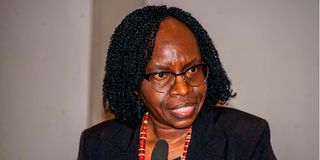
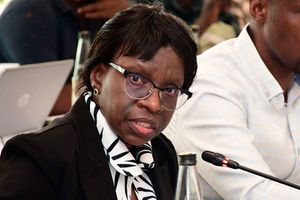
Auditor-General Nancy Gathungu has revealed that inadequate funding and lack of financial autonomy are the main reasons Kenya's Office of the Auditor-General (OAG) ranks poorly in the World Bank’s global independence index—especially when compared to its counterparts in Uganda and South Africa.
In a report submitted to Parliament, Ms Gathungu highlighted the challenges her office faces, aligning her concerns with a broader parliamentary report that paints a troubling picture of institutions meant to safeguard Kenya’s public finances—describing the situation as “a troubling paradox at the heart of Kenya’s governance system.”
Quoting the World Bank’s Supreme Audit Institutions (SAIs) Independence Index 2021, Ms Gathungu told the Budget and Appropriations Committee (BAC) that Kenya’s OAG lacks financial autonomy and has no guaranteed recourse when budgetary allocations fall short.
“Our lower ranking is attributed to a lack of financial autonomy. We do not have guaranteed recourse in the event of inadequate budgetary allocations,” she stated.
According to the report, while the number of entities audited by the OAG has increased significantly in recent years, funding from the exchequer has not kept pace, crippling its ability to meet its constitutional oversight obligations.
In the 2018/19 financial year, the OAG audited 1,341 entities. That number rose to 1,440 in 2019/20, 1,584 in 2020/21, and 1,764 in 2021/22. By 2024/25, the OAG was expected to audit 12,013 entities, including national government agencies and all 47 county governments.
In the 2024/25 financial year, the OAG had a target audit scope of 12,013 clients that included national government agencies and the 47 county governments.
During the 2024/25 fiscal period, the OAG was expected to produce 1,110 audit reports for national government entities and 1,005 audit reports for county government agencies.
The others were National Government-Constituency Development Fund (NG-CDF) with 290 audit reports expected from OAG, 40 audit reports for specialized Audit Services and education and health institutions where the OAG has to produce 9,568 audit reports.
However, on July 4, 2024, the Public Sector Accounting Standards Board (PSASB), through the National Treasury, released a circular for financial reporting, significantly expanding the OAG audit scope to 12,900 entities.
The circular brought on board additional entities, which include 34 County Equalization Funds (CEFs) and 924 County Technical and Vocational Training Institutes (CTVETs).
Despite the increased audit scope, the OAG has been starved of funding to enable the office to recruit enough staff to audit its clients.
This, as the National Assembly Committee on the Implementation of the Constitution (CIOC) chaired by Runyenjes MP Eric Karemba, revealed a troubling financial situation not just at the OAG but also at the Controller of Budget (CoB) and the Commission on Revenue Allocation (CRA).
“The chronic underfunding of these institutions represents perhaps the most insidious threat to constitutional governance,” states CIOC’s second report on the status of implementation of the constitution.
The report represents CIOC’s assessment of how OAG, COB and CRA are discharging their constitutional mandate and the impediments they face, as Ms Gathungu warned that inadequate funding from the exchequer affects the mandate of her office in providing the required oversight in the use of public funds.
“Adequate funding of the OAG will enhance our capacity to provide timely and value-added reports to parliament and our stakeholders and ultimately enhance effective oversight over the use and management of public resources,” she says.
Auditor-General Nancy Gathungu.
Photo credit: Dennis Onsongo | Nation Media Group
Although the international best practices recommend at least 0.5 percent of national revenue towards the SAIs, the OAG Kenya gets a budgetary allocation of 0.2 percent, “consistently falling short of this standard while expecting these institutions to deliver miracles with inadequate resources.”
The OAG’s allocation for operations over the last five years has risen from Sh5.5 billion in the financial year 2020/21 to Sh8.35 billion in the 2025/26 financial year.
The allocation to the OAG in the 2024/25 financial year was Sh8.67 billion, a marginal increase compared to the Sh8.12 billion allocated in the financial year- 2023/24.
However, the 2024/25 budget suffered cuts that reduced it to about Sh8.1 billion, further dealing the office a serious funding crisis considering the expenditure commitments already undertaken.
Article 229 (4) of the constitution mandates the OAG to audit the accounts of all entities that receive exchequer financing.
These include the accounts of the national and county governments, parliament and county assemblies, all funds and authorities of national and county governments, the accounts of all courts, public debt and all the institutions, programmes and projects funded from the public funds.
“Ultimately, the mandate of the OAG is not only to contribute to improvements in the public sector but also to influence the direction of economic growth and development of our nation and the delivery of quality and sustainable services to the citizens by oversighting the use and management of public resources,” says Ms Gathungu.
Auditor-General Nancy Gathungu.
Photo credit: Dennis Onsongo | Nation Media Group
In undertaking its work, Article 229 (6) of the constitution mandates the OAG to confirm whether or not public money has been applied lawfully and in an effective way.
Further, section 7 (1) (a-g) of the Public Audit Act 2015 gives the Auditor-General additional functions and responsibilities.
These include confirming whether reasonable precautions have been applied in the collection of revenue and whether all public money has been used and applied to the purposes intended and conforms to the authority for such expenditure.
The CIOC report notes that while the country has established “world class constitutional institutions” with a clear mandate to safeguard public resources and ensure accountability, “we have systematically undermined their capacity to deliver on this mandate.”
“The evidence before us paints a picture of institutions struggling to fulfil their constitutional roles not due to lack of competence or commitment but due to deliberate structural impediments that render them ineffective,” the CIOC report states.
According to Mr Karemba, “when the OAG receives a mere 0.2 percent of the national budget despite being tasked with auditing 100 percent of the public funds, we create a system designed for failure.”
“This is not an oversight or budgetary constraint; it is a deliberate weakening of oversight mechanisms that should concern every Kenyan who believes in accountable governance,” said the Runyenjes MP.
Equally concerning, the CIOC report states, is the absence of enforcement mechanisms that reduce the country’s oversight institutions to “mere commentators rather than guardians of public resources.”
The constitution mandates the Office of the Controller of Budget (OCoB) to raise objections to irregular expenditures with CRA trusted to recommend fiscal responsibility measures and the OAG responsible for flagging financial improprieties.
“But none of these institutions possesses the legal authority to compel compliance. This creates a culture where recommendations are ignored, violations go unpunished and public resources continue to be mismanaged with impunity.”