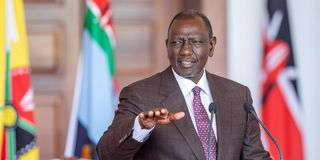
President William Ruto has cautioned judges against excessive dependence on Artificial Intelligence (AI) in refugee and migration adjudication, warning that automated systems risk undermining fairness and human dignity in asylum processes.
While outlining Kenya's progressive approach to migration governance, the President acknowledged AI’s potential to streamline procedures but stressed that technology must remain subordinate to human judgment in matters of justice.
He spoke on Monday at the opening of the 14th International Association of Refugee and Migration Judges ( IARMJ) World Conference in Nairobi.
“Artificial intelligence can help reduce backlogs and improve access to justice, but over-reliance on automated systems could undermine fairness,” said President Ruto before an assembly of hundreds of jurists from across the globe.
“Technology must remain a servant of justice, not its master,” he observed while advocating for progressive reforms in immigration.
President Ruto’s remarks come amid growing global debate on the role of AI in legal systems, particularly in refugee cases, where he noted that algorithmic bias, opaque decision-making, and lack of contextual understanding pose risks.
He emphasized that refugee protection hinges on human dignity—a principle automated systems cannot replicate—and called for transparency, accountability, and judicial oversight in any AI deployment.
President Ruto reaffirmed Kenya’s commitment to refugee rights, citing the country’s hosting of nearly 580,000 asylum seekers—one of the largest refugee populations worldwide.
He highlighted Kenya’s adherence to international conventions, including the 1951 UN Refugee Convention and the 1969 OAU Refugee Convention, as well as the 2021 Refugees Act, which he described as a ‘progressive law’.
This, he said, is because it guarantees refugees’ rights to work, freedom of movement, and protection from forced return (refoulement).
“If Kenya’s open-door policy reflects our heart, then the rule of law is the backbone that sustains it. The judiciary plays a decisive role because often, a single ruling determines whether a refugee is granted safety or returned to danger. This responsibility requires impartiality, diligence, and humanity,” said President Ruto.
Earlier this year, Kenya launched the Shirika Plan (cooperation in English), a transformative initiative converting refugee camps into integrated settlements where displaced persons and host communities coexist economically.
The plan aligns with the Global Compact on Refugees and reflects Africa’s push for self-reliant solutions.
The President underscored the judiciary’s pivotal role in safeguarding refugee rights, noting that a single ruling can determine whether an individual finds safety or faces peril.
He urged judges to uphold impartiality, diligence, and humanity while harmonizing interpretations of refugee law across jurisdictions.
“Judicial independence is the bedrock of this system,” he said. “Courts free from interference ensure asylum procedures are credible, transparent, and just.”
However, he acknowledged systemic challenges, including traumatized refugees and asylum seekers struggling to articulate their claims and gaps in documentation.
To address these, he stated that Kenya is enhancing judicial training in trauma-informed interviewing and improving access to reliable country-of-origin data.
With climate change displacing millions—projected to uproot over 200 million people by 2050—President Ruto called for legal frameworks to evolve beyond traditional refugee definitions.
Kenya has already seen cross-border movements driven by droughts and environmental collapse, necessitating broader protections through complementary measures.
He also warned against asylum system misuse—whether by individuals exploiting loopholes or states manipulating refugee labels politically—and stressed balanced reforms to prevent abuse without compromising fairness.
Ruto proposed "smart solutions" combining rigorous verification with procedural fairness, including enhanced documentation systems and cross-border information sharing.
The President condemned the "predatory networks" profiting from migrant vulnerability while emphasizing that victims should receive protection rather than punishment. Kenya's recent legal reforms have strengthened anti-trafficking measures while ensuring safeguards for survivors.
While celebrating Kenya’s refugee policies, President Ruto urged wealthier nations to share responsibility through financial aid, resettlement programs, and technical cooperation.
“Host communities should not bear the burden alone,” he declared, adding that “solidarity is not charity; it is justice.”
“Kenya is proud of its contribution in hosting refugees and in developing a strong legal framework in this field. But we recognise our limits and call on the international community to share responsibility more equitably,” stated the President.
Closing his address, he reminded the judges that their rulings transcend courtrooms—shaping lives, preserving families, and upholding the integrity of global protection systems.
Other key dignitaries present were Chief Justice Martha Koome, Justice Isaac Lenaola (president of the IARMJ and Judge of the Supreme Court) and Dr Stefanie Rothenberger (Director, Rule of Law Programme, Konrad Adenauer Stiftung).
For her part, Ms Koome emphasized that integrity of the Refugee and Migration systems is the foundation upon which the safety, dignity, and rights of refugees, migrants and host communities depend.
The Chief Justice argued that systems weakened by backlogs, loopholes or inconsistent outcomes quickly lose public trust, adding that closing legal gaps, upholding the independence of adjudicators, and ensuring objective decision-making are essential steps in preserving credibility.
She cited the High Court of Kenya’s landmark judgment delivered in July 2025, where the court affirmed that children born in Kenya to mixed-nationality couples where one parent is Kenyan and the other a refugee are citizens by birth, as a defining example of the judiciary’s role in protecting vulnerable populations.
The ruling struck down discriminatory practices that had effectively rendered many children stateless and reaffirmed the rights to dignity, family unity and equal treatment.
She noted that such jurisprudence demonstrates Kenya’s commitments under national and international law.
The conference, attended by jurists, development partners and international organizations from over 50 countries, continues through the week with discussions on legal innovations, climate migration, and ethical AI use in justice delivery.