The government’s ambitious fertiliser subsidy programme — a centrepiece of President William Ruto’s Bottom-up Economic Transformation Agenda — was hijacked by cartels and unscrupulous traders who exploited loopholes in the system, an anti-graft report has revealed.
Rolled out in 2023 to ease production costs for farmers, the programme was meant to guarantee affordable inputs and boost food security.
Instead, according to a report by the Ethics and Anti-Corruption Commission (EACC), systemic weaknesses opened the door for manipulation, fraud and the supply of substandard fertiliser that left thousands of farmers exposed.
The September report — currently at the office of the Principal Secretary for Agriculture and seen by Daily Nation — details how government agencies bungled oversight, creating opportunities for profiteers to infiltrate the subsidy chain, from registration of farmers to procurement, warehousing, distribution and sales.
The registration of farmers — a critical factor in determining the beneficiaries of the subsidised fertiliser — was riddled with irregularities. The digital registration system, the Kenya Integrated Agricultural Management Information System, accepted multiple registrations from the same farmer on the same piece of land.
The audit shows ward agricultural officers tasked with verifying farmers’ details were not properly facilitated with transport or ICT tools. They were supported financially by farmers to carry out basic duties like visiting farms. This enabled cartels to hoard vouchers while genuine smallholder farmers were locked out.
“There were delays in actioning queries such as changes in identity card numbers and contact details, which meant some farmers could not redeem vouchers. At the same time, others received multiple codes for the same farm,” the report notes.
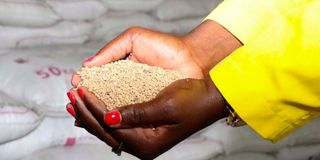
Subsidised fertiliser at the National Cereals and Produce Board in Nakuru January 18, 2025.
Photo credit: Boniface Mwangi | Nation Media Group
A total of 69,070 bags of NPK 10:26:10 fertiliser were supplied by a company the report anonymises as XXX Chemicals Ltd during the March–May 2024 long rains season.
The Kenya Bureau of Standards (Kebs) later confirmed the fertiliser did not meet the declared nutrient levels.By then, 67,761 bags had already been sold to 13,633 farmers.
In a separate case, 27,518 bags of fertiliser supplied by a different firm were seized by Kebs after being found to have a dangerously short shelf life.
Still, the National Cereals and Produce Board (NCPB) wrote to the supplier in January demanding delivery of another consignment of 1,030 bags, raising questions about how such firms continued to win tenders.
“These loopholes enabled suppliers without capacity, or with questionable track records, to flood the market with fertiliser that compromised farmers’ yields and wasted public resources,” the EACC said.
The government was forced to compensate the affected farmers with 46,667 replacement bags worth Sh138.6 million.
But the report says that the records were manipulated; the replacement was reflected as stock in the NCPB system even though the fertiliser was no longer physically available and payment was not made. As a result, the affected farmers did not get the fertiliser.
The implementation of the subsidy programme relied heavily on the NCPB, but the agency lacked critical safeguards.
The 233 bags of counterfeit planting fertiliser worth Sh2.3 million, at the Anti Counterfeit Authority’s office in Eldoret City, Uasin Gishu County on March 20, 2025.
Stock management remained largely manual, with depot clerks using ledger cards to track supplies — an archaic system prone to errors and manipulation.
The report warns that this created fertile ground for theft, fraud and stock variations.
Internal audit teams at NCPB were denied access to the sales system to independently verify the transactions. Depot cashiers also had no access to the Fertiliser Sales Bank Account or the depot PayBill M-Pesa flow statement.
“Lack of access to the account and depot PayBill is a weakness that may lead to loss of public funds through issuance of receipts for deposits that haven’t been made by farmers,” the report notes.
In one case, a cashier at the Sagana depot was dismissed after Sh340,000 disappeared due to falsified entries in the cashbook that were not reflected in the fertiliser sales bank account.
Bags of substandard fertiliser that were seized at the National Cereals and Produce Board depot in Molo, Nakuru County on March 23, 2024.
Photo credit: File | Nation Media Group
The report also notes that the programme’s e-voucher system was applied inconsistently. In Trans Nzoia County, some farmers registered but never received their redemption codes.
Meanwhile, cooperative societies were given bulk vouchers that were not linked to individual farmers — opening the door to double redemptions and hoarding.
Although NCPB set up a contract implementation team as required by procurement law, investigators found no evidence of a contract management plan.As a result, there was no systematic tracking of suppliers’ performance, cost, timelines or quality — costing taxpayers millions of shillings.
This comes even as former NCPB Managing Director Joseph Muna Kimote was acquitted of graft charges linked to a separate Sh209.5 million fake fertiliser scandal last Thursday.