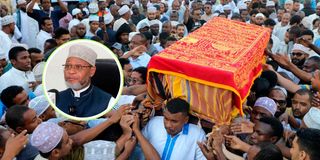
Intense lobbying has begun over who should succeed Chief Kadhi Abdulhalim Hussein with Muslim leaders and scholars divided on whether the position should, for the first time, go to someone outside the Coastal region.
Although the position of Chief Kadhi is not a regional entitlement, differing opinions from various camps may shape who takes over the influential role within the Muslim community.
Sheikh Abdulhalim, who passed away on July 10 and was buried the same day, had served as Chief Kadhi since July 2023.
The late Chief Kadhi Abdulhalim Hussein.
Photo credit: File | Nation Media Group
He had replaced Ahmed Muhdhar who retired in 2022 after leading the Muslim community for 12 years. Mr Muhdhar was the first Chief Kadhi appointed under the 2010 Constitution and retired at the age of 60.
Since independence, Kenya has had six Chief Kadhis.
The first was Abdalla Kassim of the Mazrui family in Mombasa, followed by Swaleh Abdalla from Zanzibar. The longest-serving was Nassor Nahdy of the Nahdy family from Mombasa. He was succeeded by Hammad Kassim (Mazrui), then Mr Muhdhar and finally Sheikh Abdulhalim all from the Malindi region.
The appointment of the Chief Kadhi is guided by Article 170 of the Constitution and the Kadhis’ Courts Act.
Candidates must have a degree in Islamic law and at least 15 years of experience as a distinguished academic or practitioner in Islamic law or related fields.
Sheikh Abdulhalim’s death marks the first time a sitting Chief Kadhi has died in office since the colonial era. His passing has sparked calls from some Muslims for the position to go to someone from other regions outside the Coast.
In an interview with the Daily Nation , Deputy Chief Kadhi Sukhyan Hassan acknowledged the growing concerns but noted that the Judicial Service Commission (JSC) is now responsible for managing the transition even though there are concerns that the law is not clear on succession in such cases.
“The law says the position should be advertised, interviews conducted, and the most competent person appointed as Chief Kadhi. However, some are asking: what is the role of the Deputy Chief Kadhi if he can’t succeed his boss in such situations?” said Mr Hassan.
“The position is not reserved for any region. However, there are concerns that past Chief Kadhis have all come from one region. I don't want to get involved in the politics, but how these concerns are handled will be instrumental to the unity of Muslims,” added Mr Hassan.
He urged respect for the Judicial Service Commission and unity among Muslims as they navigate the search for a new Chief Kadhi.
“We should respect the JSC. And the concerns raised by Muslims which have existed for a long time—should be addressed. While the Kadhis’ Courts have their origin in Coastal Kenya, they have since spread throughout the country. Let’s approach this debate soberly and avoid politics so we can achieve the best for the Muslim community,” he said.
Supreme Council of Kenya Muslims (Supkem) Chairperson Hassan Ole Naado cautioned against politicising the matter and insisted that the appointment process should follow the 2010 Constitution.
“If anyone feels qualified, from any part of the country, they should apply once the position is advertised. If they are the best candidate, they wikl be shortlisted, interviewed and possibly appointed,” said Mr Ole Naado.
“The JSC is the appointing authority and even the late Chief Kadhi went through the proper process. Let’s stop this divisive politics,” he added.
Sheikh Abbas Abdulaziz, Imam of the Mumias Mosque and Supkem Chairperson for Mumias, argued that the push for a Chief Kadhi from outside the Coast stems from a perception that some Muslims are treated as secondary in the faith.
“There’s a belief that Arab Muslims are more educated and well-versed in religion than others which is not true. Skin colour should not determine religious knowledge. Having a Chief Kadhi from outside the Coast could be beneficial,” he said.
However, he expressed concern about candidates from Northern Kenya claiming they often exhibit a sense of entitlement and have clashed with previous Chief Kadhis.
“Let’s remember that the Chief Kadhi is not the religious leader of all Muslims. He is a government official responsible for matters like divorce, marriage and inheritance. We have qualified and neutral kadhis even from the Coast who can serve in this role,” he added.