The High Court has barred former Law Society of Kenya president Nelson Havi from publishing further allegedly defamatory statements about Supreme Court Judge Isaac Lenaola pending the hearing of a defamation suit.
Justice Janet Mulwa found that Mr Lenaola had shown he has an arguable case against Mr Havi and faced continuing harm if the social media publications persisted.
The judge, however, declined to order the immediate deletion of Mr Havi's contested posts on X (formerly Twitter) before the case is heard in full.
Supreme Court Judge Isaac Lenaola.
Photo credit: File | Nation Media Group
The dispute stems from a series of posts and videos published on Mr Havi's X account between September and November 2025.
Mr Lenaola sued, claiming the publications contained allegations that were "entirely false, fabricated and malicious".
He argued that the former LSK president "deliberately bypassed lawful constitutional and statutory mechanisms for lodging complaints against judges in favour of conducting a public campaign on social media."
He also accused Mr Havi of calling for a boycott of his court and mounting a sustained campaign that damaged his professional reputation.
Mr Lenaola argued that the posts had attracted extensive engagement and remained accessible worldwide, exposing him to continuing injury.
He told the court that damages alone would not repair the harm because the publications remained online and further statements were likely unless restrained.
The judge said he has, over many years, built an extensive judicial and professional reputation, which had been subjected to a sustained and coordinated campaign of defamatory publications through the contested posts.
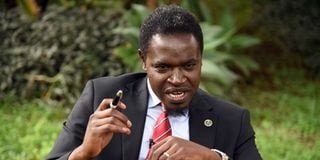
Former Law Society of Kenya president Nelson Havi.
Photo credit: File | Nation Media Group
Mr Havi admitted publishing the statements but denied they were defamatory. He argued they were truthful or amounted to fair comment on matters of public interest concerning the Judiciary.
Justice Mulwa said the court had reviewed the contested publications and found the material before the court justified temporary protection while the case proceeds to trial.
The judge said criticism of judicial officers could fall within constitutional protection for free expression because it involved matters of public interest.
"I agree with the Applicant that the law clearly provides for avenues within which such activity may be undertaken, which does not include persecution before the court of public opinion," Justice Mulwa said.
She added that the contested publications "cannot properly be characterised as an exercise of the constitutional right to freedom of expression" and instead "bear the hallmarks of internet trolling, calculated to malign the applicant's reputation under the guise of online commentary."
The court said no award of damages "could possibly compensate the applicant for such loss of reputation" if the allegations were ultimately found to be false and defamatory.
However, it rejected Mr Lenaola's request for a mandatory order requiring the immediate removal of existing posts, saying such relief is granted only in exceptional cases after a higher legal threshold is met.
"The court is persuaded that the applicant has demonstrated that he is deserving of the reliefs sought while keeping in mind that it would be a grave injustice to interfere with freedom of expression, which interference should be exercised in very extreme circumstances particularly at the interlocutory stage of proceedings," said Justice Mulwa.