Director-General for Health, Dr Patrick Amoth, told the Labour Relations Court that the affected graduates failed to meet strict eligibility requirements for public sector internships, rendering their postings irregular and legally invalid. According to him, allowing unqualified graduates into public health facilities would have endangered patients and undermined trust in the internship system.
This, he said, compelled the Ministry to act swiftly in revoking the postings to protect public safety and uphold regulatory standards.
Director-General of Health Dr Patrick Amoth speaks at Afya House in Nairobi on November 4, 2025.
Photo credit: Evans Habil | Nation Media Group
The details emerged in a ruling by the Employment and Labour Relations Court, which has declined to halt the revocation, stating that interim orders were premature as the dispute awaits a full trial.
The case was filed by the Law Society of Kenya (LSK) on behalf of 306 Bachelor of Science in Nursing graduates whose internship placements were revoked in July 2025, just days after some had reported to hospitals.
The court ruled that the applicants had not demonstrated sufficient harm to justify conservatory orders, adding that the key issue was whether eligibility criteria had been properly applied.
“The applicants had been posted as interns, but their internship was revoked for want of certain eligibility criteria," the judge said, adding that the matter would be conclusively addressed during the main petition hearing.
Formally completed training
Government lawyers informed the court that public health internships are governed by the Public Service Commission Internship Policy and the Ministry of Health Internship Policy for Healthcare Professionals.
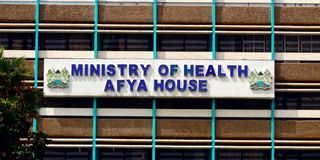
Ministry of Health headquarters at Afya House in Nairobi.
Photo credit: File | Nation Media Group
Under these regulations, an intern must be a graduate who has formally completed training and obtained clearance or provisional registration from the Nursing Council of Kenya before deployment.
Dr Amoth argued that many of the 306 graduates only had letters of completion, not proof of graduation and lacked regulatory clearance when postings were issued.
“Internship offers issued to individuals who do not meet statutory eligibility requirements are irregular and null from the outset,” he stated in court filings.
He maintained that the ministry was legally obligated to revoke such offers upon discovering the irregularities to preserve the internship program’s integrity and protect public interest. Additionally, he dismissed claims of discrimination, stating that verification was applied uniformly and that equality permits differential treatment where circumstances differ.
The ministry also rejected assertions that the revocation violated labour rights, clarifying that internships are training engagements, not employment contracts, and that stipends do not constitute salaries.
“Revoking an irregular internship offer cannot be equated to employment termination or unfair labor practice, as no employment relationship exists,” the government submitted.
It stated that the stipend paid to interns is a facilitative allowance and not a salary or wage, and that interns therefore do not enjoy the employment rights and protections accorded to employees under the Employment Act or Article 41 of the Constitution.
Announced on social media
However, the nursing graduates accused the ministry of acting arbitrarily by announcing the revocation on social media without prior notice, consultation or written justification. They argued that many had already relocated, reported to duty and been accepted at accredited hospitals, including Kenyatta National Hospital, before the decision was reversed.
The applicants claimed the abrupt recall caused financial losses, psychological distress and delayed their professional licensure, violating their constitutional rights to dignity, education, and fair administrative action.
However, the court ruled that denying interim relief would not invalidate the petition, noting that those who eventually meet the criteria could still be considered for future postings.
“If the applicants were indeed treated unfairly, they retain the right to seek reconsideration through this petition,” the judge stated.
The court concluded that maintaining the status quo was preferable, warning that interim orders could disrupt national internship programs and public health services.
The case also involves Health Cabinet Secretary Aden Duale’s decision to suspend Dr Lister Onsongo, CEO of the Nursing Council of Kenya, over the contested internship program.
The court directed parties to proceed with the substantive petition, leaving the legality of the ministry’s decision to be determined after a full hearing.
The case is set for mention on February 24, 2026.