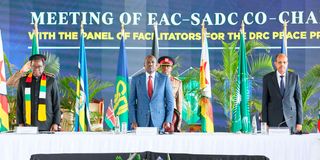
Leaders of two regional blocs in eastern and southern Africa have agreed to merge further peace processes for the Democratic Republic of Congo with the African Union (AU), seeking to eliminate duplication and push for more tangible results.
Uhuru, Ruto meet at State House for DR Congo peace meeting
The decision came from Nairobi, where a meeting of co-chairs of the joint summit of East African Community (EAC) and the Southern African Development Community (SADC) gathered to weigh progress.
And after a meeting between Kenya’s President William Ruto (EAC) and Zimbabwean counterpart Emmerson Mnangagwa (SADC), together with a panel of peace envoys the joint summit had appointed, said they will amalgamate their processes with the African Union.
They decided on the “immediate merger of the EAC-SADC and AU structures to be made up of the AU Mediator, EAC-SADC Panel of Facilitators, to report to the joint summit and the African Union.
They also agreed on the “immediate merger of the technical secretariats of the AUC, EAC and SADC into a Joint Secretariat, led by the AUC in Addis Ababa, to operationalise the joint structure.”
This decision, to be ratified at a joint summit of both blocs next week, means the five envoys appointed by the two blocs will now work hand-in-glove with AU’s mediator for the DR Congo, Togolese President Faure Gnassingbé.
The EAC-SADC summit had earlier this year named former Kenyan President Uhuru Kenyatta, Catherine Samba-Panza of the Central Africa Republic, Sahle-Work Zewde of Ethiopia, Olusegun Obasanjo of Nigeria and Dr Mokgweetsi Eric Masisi of Botswana on the Panel of Facilitators.
Yet this meeting, not attended by representatives of the Congolese government, also raised questions on whether the region was playing catch-up. Last month, the Democratic Republic of Congo and Rwanda who accuse each other of fueling conflict in eastern DRC, signed a peace deal, on the mediation of the US government. Then Kinshasa signed a declaration of principles with M23 rebel group which Congo had said was fueled by Kigali.
The US-mediated peace deal was endorsed by the African Union, whose Commission Chairperson Mahmoud Ali Youssouf also attended the Nairobi meeting on Friday. Qatar has been mediating the Kinshasa-M23 talks, still endorsed by the African Union and the US.
President Ruto said the Nairobi meeting does not interfere with the similar peace talks that were held in Doha, and Washington.
“This process does not in any way competing or in conflict with the other processes in Doha and Washington. We believe that with these talks now, the Washington agreement or the peace accord and Doha agreement the agreement in Qatar find a mechanism of alignment with the Africa-led process,” President Ruto said.
He said the region was stay on the Congo case because of the continual serious humanitarian crisis in the region, which needs the attention of leaders from the African region.
“The situation in DRC continue to be dire. There is a humanitarian situation, there is a serious security situation, and instability that not only affects DRC and Rwanda but also affects our region,” President Ruto said.
Ruto stated that the efforts being made by the international community and AU will bring peace to Eastern DRC, and that the summit has given facilitators and mediators a clear path to follow going forward.
Earlier, the EAC and SADC merged their processes, which had been called Luanda and Nairobi Processes. The latter, mediated by Mr Kenyatta, had focused on pushing for dialogue between armed groups and the government of the DRC. It had struggled to organise meetings. The former was led by Angolan President Joao Lourenço, now Chairman of the African Union, and focused on easing tensions between Kinshasa and Kigali. In spite of reaching no peace deal, Luanda Process had succeeded in securing commitment from both sides to manage their conflict diplomatically. It couldn’t solve the trust deficit though.
A high-level meeting in Nairobi, leaders said coronation was needed to manage the Congo crisis.
“Over the past few months, there is a glimmer of hope shaking up, and giving all of us reasons to believe that this time around, peace could be reached among all stakeholders,” Mr Youssouf said.
The AU Commission Chairperson also said that the AU applaud the Washington agreement between Rwanda and DRC and a declaration of principles signed between M23 and the government of the DRC in Luanda.
“However, there is a need for better coordination and more coherence if we are to succeed in the implementation of the proposed agreement. Besides the Commission, there is also a call to tackle the root causes of the problem in a holistic manner.”
The joint statement read by SADC Secretary-General Elias M Magosi said the team agreed to adopt documents, including terms of reference for the peace facilitators and a plan to establish a secretariat for the special envoys.
This would be the first time the peace envoys will have an office to coordinate their work, having previously struggled for funding.
They also said they will push for an inclusive mediation process, targeting all affected stakeholders in the eastern Congo war.
The Summit said it would work on a “resource mobilisation framework, suggesting the old problem of funds may still linger.
The new team of joint facilitators will report both to the joint EAC-SADC Summit and the African Union, while the technical secretariat will be led by technocrats at the African Union and be based in Addis Ababa.
President Mnangagwa said that the engagement was necessary due to the dire situation in the Eastern DRC.
“The African Union, SADC and the EAC regional blocs are key in delivering a lasting solution to this conflict that has impacted the lives of the people of Eastern DRC for far too long,” President Mnangagwa said, asking leaders to continue with such meetings until peace is restored.
However, DRC was not represented in the meeting, despite being the subject of the summit.
Foreign ministers, including Musalia Mudavadi of Kenya, Prof Amon Murwira of Zimbabwe, among others, attended the summit.