Questions have been raised over whether the over 400,000 teachers employed by the Teachers Service Commission (TSC) got a raw deal in their medical cover amid confusion over whether their monthly pay will be deducted to finance their Social Health Insurance Fund (SHIF) cover or the Public Officers Medical Scheme Fund (POMSF).
Documents presented to Parliament show that, previously, all teachers employed by TSC used to enjoy a medical allowance that would later be converted into a private medical scheme provided by a consortium of insurance service providers and administered by the defunct National Hospital Insurance Fund (NHIF).
The teachers’ employer has published a list of public, private and faith-based health facilities that are available to teachers under the SHA.
This means that TSC teachers are now required to pay out-of-pocket “fees for service” under the POMSF, administered through the SHA, notwithstanding the 2.5 percent SHA statutory deductions from their monthly pay.
Kitutu Chache South MP Anthony Kibagendi, a member of the House’s Committee on Health, warned that unless teachers have private medical insurance, they may be exposed to increased out-of-pocket expenditures to settle medical bills, especially for those with chronic illnesses.
“There is the threat of increased financial burden as individuals who rely on health insurance may face higher out-of-pocket costs, leading to increased financial hardships, especially for low-income families,” says Mr Kibagendi.
Teachers Service Commission Acting CEO Evaleen Mitei.
Photo credit: File | Nation
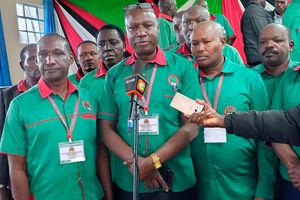
Kenya National Union of Teachers (KNUT) Secretary-General Mr Collins Oyuu. The deputy secretary of the Kenya Union of Post Primary Education Teachers (Kuppet), Moses Nthurima, told the Nation that the medical allowance that teachers used to enjoy will now go to SHA. The teachers will also be subject to the statutory SHA contribution, as they have been since its introduction.
Mr Nthurima said that the teachers’ contribution to SHA will be Sh14 billion, from the medical allowance contribution while the government will add Sh8 billion to the kitty.
Ms Mitei was required to clarify how the deductions under POMSF and service fees align with constitutional requirements and labour protection with the teachers’ union officials required to state whether involved their members before they acceded to SHA transition.
Former Public Service Regulatory Authority (PSRA) Director-General Fazul Mahamed in documents presented to Parliament, questioned the TSC/SHA medical deal.
“It is incomprehensible that a Kenyan teacher is required to pay statutory deductions to SHA and still pay at the point of service under POMSF. That is the very definition of double taxation,” Mr Mahamed, a policy analyst, who has publicly criticised the TSC’s administrative actions, said.
Mr Mahamed further notes that the transition of TSC teachers to SHA was executed without adequate consultation, public participation or protection of teachers’ welfare despite affecting the more than 400,000 teachers and their dependents.
According to Mr Kibagendi, the vulnerable sector of the TSC workforce may also experience worse health outcomes due to decreased access to necessary treatments and preventive care, exposing them to medical facilities that are not sufficiently equipped to handle the range of services the members need.
“A reduction in health insurance coverage may lead to a rise in the number of uninsured individuals, placing additional pressure on emergency services and public health systems,” says Mr Kibagendi.
Mr Mohamed noted that it is not doom and gloom as he challenged the teachers’ unions to ensure that their members and dependents “get a deal that is good.”
“Teachers say that the new arrangement strips them of all the medical privileges they previously enjoyed, either through allowances or the private insurance cover, while imposing new financial burdens with no corresponding benefits,” says Mr Mohamed.
He noted that if private medical insurance is being phased out, then medical allowances must be reinstated to cushion teachers as he blamed the teachers’ employer for violating constitutional principles, including the right to fair administrative action, public participation in policy changes and the economic rights of workers.
“This is economic sabotage disguised as reform. Teachers are being punished for a system they did not design, did not approve, and were not consulted on,” said a KNUT official, who asked not to be named for fear of reprisals.