Principals of public secondary schools have demanded that the government release over Sh18 billion owed to the institutions in capitation funding since the beginning of the calendar year, warning that the shortfall has negatively affected learning.
The principals, speaking through the Kenya Secondary Schools Heads Association (Kessha), accused the government of disbursing inadequate funds, crippling operations. According to their calculations and official data, schools are cumulatively owed Sh7,557,539,328 in unremitted capitation for Term I of 2025 and Sh10,503,142,764 for Term II.
“Schools are facing a major crisis. These financial constraints have severely impacted the smooth running of many institutions, with day schools bearing the brunt of the crisis. The insufficient funding hampers the delivery of essential services, disrupts learning programmes, and strains the ability of school principals to meet basic operational needs,” said Kessha chairperson Willy Kuria.
He added that many schools will struggle to administer mock examinations to Form Four learners who are preparing for the Kenya Certificate of Secondary Education (KCSE) examinations. Other end-of-term examinations will also be affected and some schools may close before the official date of August 1, 2025.
“Teachers are forced to avoid giving complete examination papers and omit practicals. The issue has been quietly building over the past few years as can be vindicated by the previous years’ disbursement figures and affects learning,” Mr Kuria said. He was speaking at a press conference in Murang’a town.
“Some schools will close at the earliest opportunity and, even so, still can’t pay salaries for the staff employed by the boards of management. Others will have their electricity and water disconnected,” he said.
The official observed that schools catering for learners with special needs have also been affected by funding shortfalls despite the fact more money is needed for their wellbeing.
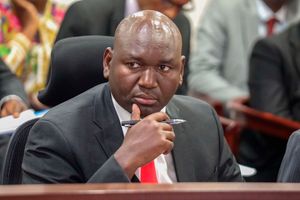
Education Cabinet Secretary Julius Ogamba.
Photo credit: Kevin Odit| Nation Media Group
Mr Kuria was accompanied by the secretary-general of the association, Mr Abdi Noor Haji, who said that principals are under pressure from suppliers to pay pending bills for goods and services rendered. Schools, Mr Haji further said, struggle to fund co-curricular activities due to the inadequate funding.
“The situation is dire and we’re calling upon the government [to meet part of its bargain] because it was our hope that a second tranche will be released before schools close to pay salaries for our staff. The funding shortfalls have limited access to sports, arts, modern agriculture and clubs that enrich students' educational experiences and provided avenues for careers in those areas,” he added. Mr Kuria challenged the government to revert to the cost-sharing model that was in place before 2017 when parents used to contribute a portion of the fees. Every learner in secondary school is entitled to Sh22,244 per year in tuition fees. The Ministry of Education is supposed to disburse the money in three tranches at a ratio of 50:30:20 percent. Mr Kuria said that, since 2022, schools have received inadequate funding in Term II.
“Schools expect a capitation of Sh6,673 but in contrast, schools have, in what appears to be the norm, been receiving far below. In 2022, schools received Sh4,289.24, in 2023, Sh4,150.35 and in 2024 Sh4,505.50. The Sh3,471.60 schools received this year is the lowest,” said Mr Kuria.
He added that the current capitation was last reviewed seven years ago and that it does not reflect the prevailing economic reality since the cost of goods and services has gone up.
“When schools lack adequate resources, performance is greatly affected and this can be attested to by the gradual increase in number of E [mean grade] countrywide in KCSE in the last three years,” he stated.
In 2022, 30,822 candidates scored a mean grade of E in the KCSE. This number shot up to 48,174 in 2023 and dropped slightly to 48,333 in 2024. Most of the poor grades are scored by learners in day schools, which are attended by over 70 percent of learners in secondary school.
“Secondary schools, especially day secondary schools, have struggled to keep abreast with the latest technology, making it difficult for students to access modern learning tools, contributing to wider achievement gaps and perpetuating inequality in education,” said Mr Kuria.
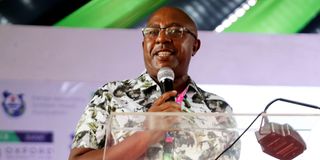
Kenya Secondary Schools Heads Association (Kessha) boss Willy Kuria addressing the press during a past conference in Mombasa.
Photo credit: Kevin Odit | Nation Media Group
The Kessha officials asked the government to factor in a minimum essential package for schools with low enrolment, as had been recommended by the Presidential Working Party on Education Reforms report.
“The essential minimum package is supposed to insulate them and sustain them on everyday basics. We call for vacation of the directive to retain infrastructure funds from capitation. Alternative funds should be sought for infrastructure development in schools,” they stated.
Education Cabinet Secretary Julius Ogamba had not responded to Nation’s request for a response to the claims by the time of going to press.