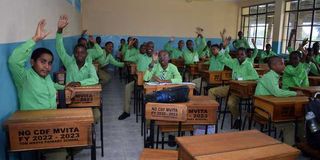
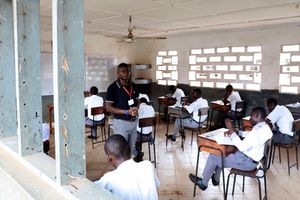
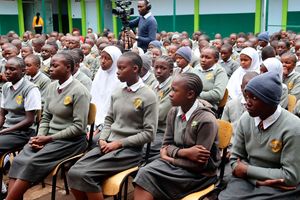
In November, more than 1.2 million Grade 9 learners will sit for the inaugural Kenya Junior School Education Assessment (KJSEA), marking a major milestone in the Competency-Based Education (CBE) system as the country prepares to transition them to Senior School in January 2026.
The pioneer cohort of the CBE system, currently in Junior School, will take the assessment to help align them with career pathways and Senior Schools.
Kenya has adopted three pathways in Senior Schools: Social Sciences, Arts and Sports and Science, Technology, Engineering and Mathematics (STEM). However, national schools will offer all three pathways due to their capacity and infrastructure.
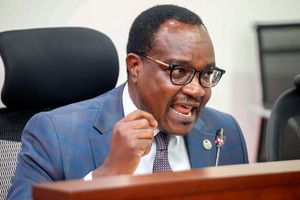
Kenya National Examination Council (Knec) Chief Executive Officer Dr David Njengere said the KJSEA will be a summative test, forming the final part of a multi-layered evaluation that began in Grade 6.
“They already did the Kenya Primary School Education Assessment (KPSEA), which contributed 20 per cent. Another 20 per cent came from School-Based Assessments (SBA) in Grade 7 and 8. The KJSEA will contribute the remaining 60 per cent,” Dr Njengere explained in an exclusive interview with Daily Nation.
Kenya National Examination Council CEO David Njegere.
Photo credit: Wilfred Nyangaresi | Nation Media Group
He added that learners in the Arts and Sports pathways have already built portfolios through activities such as music, drama and athletics, which will complement their final assessments.
“At the recent national music festivals at Sagana State Lodge, we saw incredible talent. For example, a girl from Migori gave an outstanding stage performance. Through her portfolio, she already knows the pathway she is likely to follow,” he said.
Dr Njengere clarified that portfolios are not only about documented achievements but also about interest.
“You may be good in football, but do not want to pursue it as a career. Schools and parents must guide learners and not impose decisions on them,” he cautioned, stressing that career choices must align with both talent and personal interest.
He further warned that forcing learners into unsuitable pathways could frustrate them, explaining that Junior School is designed to help children explore their strengths, while Senior School is where real specialisation begins.
“The mark of a good school should not be judged by the grades learners obtain but by how well it prepares them for pathways suited to their potential,” he said.
On concerns over the credibility of Junior School assessments, Dr Njengere defended the system.
He revealed that when the current Grade 9 learners first did SBA in 2019, Knec received raw scores directly from teachers without external supervision.
“With a population of 1.2 million learners, only 600 scored 20 out of 20. The national average was 9–9.5, with many scoring between 2 and 5. The data shows no evidence of teachers inflating scores,” he said.
“These are raw marks. So when people say teachers are manipulating results, based on what? The evidence doesn’t support it,” Dr Njengere added.
His remarks were in response to school principals who have raised fears that the integrity of the placement process could be compromised.
Through their National Schools Forum, the principals have questioned the reliance on school-based assessments to determine Senior School placement.
“We are concerned about the placement of Grade 9 learners. How will they be placed when 60 per cent of the marks come from assessments administered and scored by schools? We fear the results may lack credibility,” said Kagumo High School Chief Principal Dr Silas Mwirigi.
He argued that teachers may feel pressured to inflate marks so that their students secure slots in prestigious national schools.
“No school wants its learners to fail. The fear is that some may compromise the assessments to get their students into national schools,” Dr Mwirigi warned.
Kakamega Primary School and Junior Secondary School Grade 9 learners during a lesson on January 6, 2025.
Photo credit: Isaac Wale, Nation Media Group
According to the Presidential Working Party on Education Reforms (PWPER), Senior School placement will factor in 20 per cent from KPSEA, 20 per cent from Grade 7 and 8 SBAs, and 60 per cent from KJSEA.
KPSEA, administered in Grade 6, was used only to monitor learning progress, not to place learners in Junior School. The upcoming KJSEA, however, will play a decisive role in determining learners’ pathways and placement in Senior School.
On exam security, Dr Njengere said he does not expect the heavy police presence associated with national exams.
“We have already phased out police officers during KPSEA. We hope to do the same for KJSEA,” he said.
Knec has also piloted digital assessments in primary schools to test the feasibility of administering November’s exams online using digital devices. However, Dr Njengere acknowledged that not all schools are ready.
“Some schools are fully prepared, while others are still struggling. Do we wait for all to be ready, or allow those that are prepared to go digital while others continue with pen and paper? Egypt transitioned successfully—we should start the conversation,” he said.