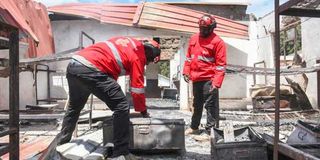
Student dormitories have emerged as the facilities most targeted by learners in Kenya's recurring wave of school fires, with a new analysis showing that nearly eight out of every 10 incidents reported over the last six years involving dormitories.
Target: dormitories 95% in boarding schoolsThe dormitory is the main target. 95% of all documentedschool fires occur in boarding schools — where students sleep, often in overcrowded and unsafe conditions.
Boarding schools — 95%
Day schools — 5%
"The dorm is the main target" — students are most vulnerable at night, in congested sleeping quarters.
The study by research and advisory firm, OdipoDev, which examined 155 school fires reported between January 2020 and June 2026, found that dorms accounted for 78 per cent of all affected structures.
These were followed by classrooms, which accounted for 5.1 per cent of the incidents, stores at 2.3 per cent, and administration blocks at 1.7 per cent, while libraries recorded less than one per cent of the cases.
The findings show over 99 per cent of the incidents occurred in boarding schools, 96 per cent of which were in public institutions and 90 per cent of the fires were classified as confirmed arson.
The scale A recurring crisis At least 155 school fires have been recorded across Kenyabetween January 2020 and June 2026. The majority — 55% —happen in the 2nd academic term , a pattern that has held steady across multiple years.
The trend has reignited questions about why dormitories continue to be singled out whenever unrest erupts in the schools.
Elimu Bora Working Group Policy and Strategy Advisor Boaz Waruku reckons the persistence of school fires points to weaknesses in enforcement of safety regulations and inspection systems.
"The continued occurrence of these fires suggests there is some laxity among those charged with enforcing safety standards and conducting inspections in schools," said Mr Waruku.
He believes the targeting of dormitories may be a way for students to communicate frustration and draw attention to unresolved grievances.
Life coach Peter Nyaga argues that the problem has been compounded by pressure associated with the government's 100 per cent transition policy, which has significantly increased enrolment in public schools.
"Term Two is the longest school term and has historically experienced more cases of unrest. I think some students are inciting others," he said.
The analysis found that 55 per cent of the 155 school fires since 2020 happened in the second academic term. Dr Nyaga said dormitories are especially vulnerable because they contain highly flammable materials.
"Dorms are targeted perhaps because of the flammables in there such as blankets and mattresses, but I believe there is a message that is being passed by the students," he added.
The report dubbed Mapping the flames: What the data tells us about Kenya’s school fire problem links the vulnerability of dormitories to long-standing safety and infrastructure shortcomings in public boarding schools.
The highest fire incidences were recorded in 2021 at 54 with the wave kicking in from October 19 to November 9, as schools reopened for the second term in the post-Covid-19 period.
The analysis shows the wave began in Migori at Osingo Mixed and St Peter’s Abwao before spreading to Kwale, Kericho, Busia, Nakuru, Nairobi, Vihiga, Nyeri, Machakos, Kakamega and Kisii. Over 22 days, 21 schools were recorded, with 16 located within 50 kilometres of another affected institution.
Geographic spread The fire belt Kisii , Meru andNairobi have the highest prevalence of fires.The waves are national in scale, but they often break into local clusters.
Top 10 counties by number of school fire incidents
The second highest school fires incidences were recorded in 2026 at 36, with the wave starting from May 18 to June 7.
The analysis shows the wave began in Siaya at Ambira Boys and Maranda High, about 13 kilometres apart on the same day, before expanding through Kakamega and going national.
At least 42 students have died and 294 others injured in school fires since 2020, according to the analysis.
Injuries 294 students injured294 students have been injured in school fires between 2020 and 2026.Like deaths, injuries are heavily concentrated in a few major incidents.
115
Injuries in 2026
highest annual total
79
Utumishi Girls (2026)
single largest injury count
2021: 99 injuries from just two schools — Ofafa Jericho and Buruburu Girls.2024: 27 of 32 injuries from Hillside Endarasha.2025: 22 of 31 injuries from Amabuko Secondary.
Researchers note that fatalities are often concentrated in a handful of catastrophic incidents, including the Hillside Endarasha tragedy in 2024 and the recent Utumishi Girls Academy fire.
Year 2024 comes in third with a wave that started from August 26 to September 15 and within 21 days, 13 schools had been affected. The wave started at Njia Boys in Meru, then spread through Nyeri, Machakos, Nakuru, Isiolo and Nairobi.
The findings come on the back of a performance audit report by the Auditor-General and an Usawa Agenda report showing widespread non-compliance with fire safety standards, overcrowding and inadequate funding.
Fatalities 42 students killedAt least 42 students have died in school fire incidents since 2020.
Hillside Endarasha (2024)
21
deadliest single incident
Utumishi Girls (2026)
16
16 deaths reported
Deaths are concentrated in a few incidents
Hillside Endarasha Utumishi Girls Other incidents
Auditor General’s report found some schools operating dormitories with reinforced metal window grilles and inward-opening doors despite safety guidelines requiring grille-free windows and outward-opening exits.
Other schools were found to have overcrowded dorms, with double- and triple-decker beds installed in violation of recommended spacing requirements.
The OdipoDev study further notes that 97 per cent of secondary schools surveyed reported that funding was inadequate to match rising student populations, while many lacked sufficient allocations for safety and security measures.
The findings come amid growing calls for authorities to address what students say are underlying causes of unrest.
Cause: arson 90% confirmed arsonNearly 90% of school fires are confirmed arson incidents — with investigations explicitly establishing arson as the cause, charges filed, orofficial conclusions reached.
Confirmed arson — 90% (≈140 incidents)
Suspected arson — ~7% (≈11 incidents)
Unknown / unclassified — ~3% (≈4 incidents)
Earlier this week, senior school captains under the Kenya Students Education and Welfare Forum (KSEWF) petitioned the National Assembly to establish structured student consultation mechanisms at school, county and national levels.
They argued that meaningful dialogue between learners and education stakeholders would help address grievances before they escalate.
In the petition, the forum asked Parliament to recommend the creation of formal consultation forums and compel the National Assembly's Education Committee to conduct public hearings involving students, parents, teachers, school administrators, education experts and civil society organisations.
The students' demands come as the violent wave of student unrest across schools nationwide appears to have subsided, giving way to heated blame game among parents, teachers, school administrators and government officials over who should be held accountable.
Education Cabinet Secretary Julius Ogamba has since disclosed that unrest affected 204 secondary schools across the country this year, although he ruled out any changes to the current school calendar.
The ministry maintained that affected institutions account for only about two per cent of all secondary schools nationwide, describing the situation as a limited but disruptive challenge.