Learners undertaking the Kenya Primary School Education Assessment (KPSEA) and Kenya Junior School Education Assessment (KJSEA) will not receive any certificates upon completion of their primary and junior school studies, respectively.
Instead, the learners will be issued a transition report at the end of Grade 6, describing their performance and a transcript at the end of junior school (Grade 9) that will also be descriptive.
It will not have grades like A, B, C or D or the actual marks scored by a candidate. These will only be shared with the Ministry of Education for purposes of placement to senior school.
It marks a deliberate shift from the 8-4-4 system to the competency-based education (CBE) and is aimed at promoting continuous learning rather than one-time high-stakes testing.
Certification will only come at the end of basic education (Grade 12 – senior school) before the learners’ transition to tertiary education.
According to the Ministry of Education, the move is intended to discourage unhealthy competition and the perception of failure among young learners. Under the 8-4-4 system, the Kenya Certificate of Primary Education (KCPE) candidates would receive certificates after the results were released by the Kenya National Examinations Council (Knec).
Invigilators frisk Grade-Nine candidates from St Mary’s Girls Comprehensive and Junior School in Nakuru County on October 27, 2025 before entering in the exam room for their Kenya Junior School Education Assessment Mathematics examination paper.
Photo credit: Boniface Mwangi | Nation Media Group
“The award of certificates at primary school level in the 8-4-4 system introduced undue competition and discouraged children who, at a very young age, would be considered as having failed. The absence of certificates at earlier levels is intended to increase learners’ motivation by showing progress through detailed transcripts instead,” the Cabinet Secretary for Education, Julius Ogamba told Daily Nation .
“The absence of certificates at earlier levels targets to increase learners’ motivation because the transcripts that Knec provides indicate how they are faring in each aspect as far as meeting expectations is concerned,” he added.
Mr Ogamba noted that instead of certificates, learners will receive assessment reports detailing their performance in various competencies. For instance, a learner may perform below expectations in mathematics but exceed expectations in English or art, allowing them to focus on their strengths as they progress.
“For instance, a learner may be performing at below expectations in mathematics while they are exceeding expectations in English. Their performance at Grades 6 and 9 is not compounded to represent an overall performance. This allows the learners to identify and focus on their strengths as they explore the curriculum up to Grade 9,” Mr Ogamba said.
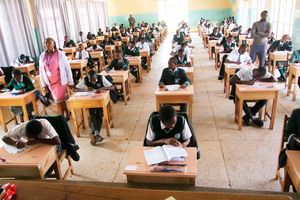
Candidates at Migosi Comprehensive School in Kisumu sit Kenya Junior School Education Assessment paper of the on October 27, 2025.
Photo credit: Alex Odhiambo | Nation Media Group
According to the Knec, a total of 3,424,836 candidates will sit for this year’s national examinations. Of these, 996,078 candidates are undertaking the Kenya Certificate of Secondary Education (KCSE), 1,130,669 learners the KJSEA, while KPSEA candidates are 1,298,089.
The Education CS explained that at the end of Grade 12, learners will be awarded the Kenya Certificate of Basic Education (KCBE), signifying mastery of competencies and readiness for further training.
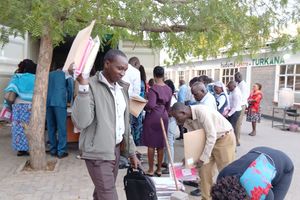
School heads pick up KPSEA and KJSEA exam papers for Grades 6 and 9 in Kisumu on October 27, 2025.
Photo credit: Alex Odhiambo | Nation Media Group
“Certificates after senior school will be issued based on the learner’s chosen specialisation pathway — whether in science, social sciences, or arts and sports. This approach provides a clearer transition to universities and tertiary institutions than the 8-4-4 model,” the CS said.
This shift ensures continuous feedback, supports mastery of competencies, and reduces examination malpractice.
The new structure is part of Kenya’s effort to align education with Vision 2030 and the Constitution, emphasising skills development, innovation, and social cohesion. According to the Ministry of Education, the CBE’s multiple pathways system mirrors international best practices, including those in Canada and the Cambridge International system.
To ensure continuity and reliability of assessment data, Knec has introduced a unique assessment number assigned to each learner from Grade 3. Learners use the number throughout their education journey, allowing for centralised tracking of performance.
“This number enables Knec to maintain a secure database of each learner’s formative and summative assessments. It also supports data-driven research and ensures that learners who transfer schools or systems can be properly evaluated,” Mr Ogamba said.
Kakamega County Deputy Commissioner Christine Chacha distributes KJSEA and KPSEA exam papers to centre managers of comprehensive primary schools for Kakamega Central at the container outside the Kakamega County Commissioner's office on October 27, 2025.
Photo credit: Isaac Wale | Nation Media Group
Officials believe the reform could reduce school dropouts and improve completion rates. Statistics show that while 82 percent of candidates under the KCPE system transitioned to secondary school, 88 percent of those who sat the KPSEA in 2022 have already registered for this year’s KJSEA — a sign of improved retention under CBC.
“The Kenya Certificate of Basic Education – KCBE will signify the completion of basic education and indicate the level of competencies that the learner has acquired while nurturing their potential in their chosen pathway. This is the internationally accepted best practice in countries like canada and in the cambridge international examinations. Further the use of transcripts to show the learners progress is an a globally accepted practice,” the CS said
“This is confirmed by the equation of transcripts that KNEC has done over the years from different education systems to join the Kenyan system. Transcripts are recognised and serve as an indicator of academic attainment before the learner gets to a level where certificates are awarded,” he added.