A High Court finding that the National Tallying Centre is necessary for the electoral commission to determine whether a presidential candidate has met the constitutional threshold has triggered a storm over the Presidential electoral process, with the petitioners planning to appeal the decision.
Justice Gregory Mutai ruled that national tallying does not reopen constituency results, which become final once declared and certified by constituency returning officers.
He explained that the Constitution’s 50 per cent-plus-one national threshold and 25 per cent requirement in at least 24 counties can only be assessed nationally.
“Kenya is not alone among African constitutional democracies in having to reconcile the transparency and finality of polling-station-level counting with the practical necessity of a national aggregation and confirmation exercise, and comparative practice from jurisdictions with cognate two-round or threshold-based presidential electoral architecture is instructive,” he said.
The Milimani Law Courts in Nairobi.
Photo credit: File | Nation Media Group
The judgment followed two petitions challenging Section 39 of the Elections Act and Regulation 83(2). Section 39 sets out electoral commission’s role in determining and declaring election results, including requiring it to tally and verify presidential results at both the constituency and national tallying centres, while Regulation 83(2) requires the commission’s chairperson to tally and verify the results received at the National Tallying Centre.
The legal dispute centres on what happens after votes are counted at polling stations and results are declared at constituency level.
Busia Senator Okiya Omtatah and opposition leaders argued that the constituency was the final point, leaving the national centre only to collate figures.
Both petitions argued that Articles 86(b) and (c) and 138(2) and (3)(c) of the Constitution vest finality in the results of a presidential election as declared by the Returning Officer. They argued that any process at the county or national level that purports to "confirm", "verify", "re-tally" or otherwise revisit those results, as opposed to merely aggregating them, is inconsistent with the Constitution.
But the court distinguished final constituency results from the constitutional test for a President. Under Article 138(4), a Presidential candidate must secure more than half of all votes cast nationally and at least 25 per cent of votes in more than half the counties.
That test cannot be established from one constituency or county, according to the court. Justice Mutai said national aggregation brings the 290 constituency results together and checks whether the constitutional threshold has been satisfied.
“The finality attaches to the returning officer’s arithmetic at the Constituency level, not to the Commission’s overall duty,” the judge said.
The judgment sets out a seven-stage process. Votes are counted at polling stations, then announced and certified by constituency returning officers.
The results are transmitted electronically and physically to tallying centres. At the national centre, the IEBC aggregates the final constituency figures into county and national totals.
Verification then checks whether national figures match results certified at constituency level and whether the presidential threshold has been met. It is not a fresh count, the judge explained.
The court said Section 39 of the Elections Act does not allow the Independent Electoral and Boundaries Commission (IEBC) officials to choose a different constituency figure at the national centre. If electronic and physical results differ, the accurate polling-station record must prevail.
“The polling-station record is thus the irreducible point of truth,” Justice Mutai said.
The court separated the IEBC’s collective tallying role from the chairperson’s declaration role. The Commission as a body must tally and verify, while the chairperson declares the presidential result after that exercise is complete.
The court decision imposes safeguards around the national process. Certified Forms 34A and 34B, filled at polling stations and constituency tallying centres, respectively, form the primary documentary records for verifying the presidential results.
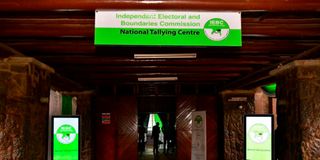
Observers and party agents at the Independent Electoral and Boundaries Commission’s desk at the Bomas of Kenya, the national tallying centre on august 10, 2022.
Photo credit: File | Nation Media Group
It said the certified Forms 34A and 34B, or their successors, must remain the reference documents. All commissioners must participate in verification, and any dissent must be recorded.
Candidates’ agents and accredited observers must have real-time access to the same data available to the Commission. Any discrepancy must be documented, including how it was resolved, with the record made public by the final declaration.
The court said a constituency result already included in the national tally cannot later be changed except through an election court. Even clerical corrections must be logged, explained and disclosed.
The petitions were filed in November 2025 and later consolidated. Mr Omtatah challenged the national centre and sought to invalidate Section 39 and Regulation 83(2). The second petition was filed by Kalonzo Musyoka, Rigathi Gachagua, Fred Matiang’i, Eugene Wamalwa, Mithika Linturi and Justin Muturi.
They also raised concerns over ballot reconciliation, publication of results, gazettement timelines and unequal treatment of presidential results. The court declined those additional claims, finding insufficient proof of the alleged constitutional violations.
The court relied on earlier decisions, including the Supreme Court’s 2022 presidential election judgment, which held that national tallying and verification are functions of the IEBC collectively.
While preserving national aggregation of the constituency results, the court said the National tallying Centre brings together final constituency figures, tests them against the presidential threshold and supports the chairperson’s final declaration.