From 'flight is coming' to never: Aviation workers strike hits local, international travellers hard

What you need to know:
- Flight disruption forces passengers to cancel plans or seek alternative means of transport.
- For some, the disruption stretched beyond 48 hours with airlines cancelling or rescheduling flights.
Local and domestic travellers in Kenya were hit by flight delays and cancellations for the second day running, even as striking airport workers and State officials remained deadlocked in negotiations to end the go-slow.
Aviation industry workers say the government has failed to honour the terms of a memorandum of understanding (MoU) signed with the union, prompting them to resume the strike.
"We did sign a back-to-work formula but, unfortunately, KAA and KCAA failed to meet our demands. They have never committed to the negotiations and have failed to cooperate and show effort in resolving our grievances. We therefore lifted the suspension on the strike," Kenya Aviation Workers Union (Kawu) secretary-general Moss Ndiema said.


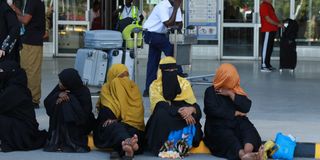
Passengers at the Moi International Airport on August 31, 2026.
At Mombasa International Airport on Monday, Italian tourists visiting Kenya were among passengers stranded after their flight was cancelled.
Alessia Bernardino and Raffaele Ceniccola, who travelled to Kenya on August 21 and had been staying in Watamu, said they were initially booked on a Jambojet flight from Malindi to Nairobi scheduled for 7:45am on Monday. Bernardino said the flight was delayed several times before passengers were eventually informed that it would not operate.
"From Malindi to Nairobi, we were supposed to connect through Jambojet today at 7:45am. It was delayed and later we were told it may be at 9am, or 11am. When 11am came, we were told it was never going to come," she said.
The tourists said they requested a refund but had yet to receive the money by press time, with the airline informing them that it would be processed through the payment method used to purchase the tickets.
After the cancellation, they hired a taxi from Malindi to Mombasa, arriving at Moi International Airport at about 3pm as they tried to find an alternative route back to Italy. However, they encountered the same issues there.
"We asked security if we could get a ticket to Dubai because the planes from Nairobi to Dubai had been cancelled," Ceniccola said.
However, they were advised that it was uncertain whether a flight from Mombasa to Dubai would operate, or whether there would be space on board.
They consequently opted for what they considered the most straightforward alternative: a flight from Mombasa to Frankfurt, Germany, before connecting to Rome.
"We decided to buy the easiest ticket from Mombasa to Frankfurt. They told us the company is German and has nothing to do with the strike," Bernardino said.
The new arrangement means the tourists will spend an extra night in Mombasa before travelling to Frankfurt and then connecting to Rome on Tuesday.
"We have been forced to travel tomorrow from Mombasa to Frankfurt and then connect to Rome. Maybe we will see another city," Ceniccola said.
Situation at JKIA
Meanwhile, passengers at Jomo Kenyatta International Airport (JKIA) could be seen returning to their hotels after airlines cancelled flights for the second day running.
A traveller, Audace James Ngendabanyika, said he arrived at JKIA on Saturday from Tanzania via Kenya Airways. However, his plans to catch a connecting flight to Australia have been cancelled twice, the latest on Monday morning at 8am.
He told the Nation that they had boarded a Turkish Airlines flight only to be informed six hours later that it had been cancelled.
"I've already spent more than $2,000. It's been a major inconvenience," he said.
Cecil Greene, who was travelling from Malawi to China through Kenya for a business meeting, was also caught up in the disruption.
Mr Greene said missing his connecting flight could cost him an important business deal.
“My business partner and I were supposed to connect to a flight from Kenya but apparently there are no flights coming in or going out. I just don't know what we are going to do. We are on a business trip and we have to be there on time. We are really affected by this,” he said.
The disruption also affected businesses that depend on airport traffic including hotels, taxis and other transport operators while tourism stakeholders warned that prolonged flight cancellations could damage Kenya's reputation as a tourist destination.
On its part, Kenya Airways cautioned its customers against coming to the airport until their flights are confirmed.
"We are experiencing delays of more than 6 hours, and due to the flight backlog, we have had to reschedule and cancel some flights...We advise our customers to only come to the airport once they have a confirmed flight," the carrier said.
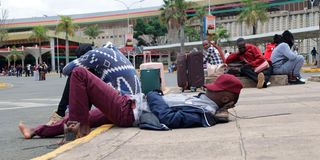
Stranded passengers at Jomo Kenyatta International Airport (JKIA) in Nairobi on August 31, 2026 after flights were disrupted by aviation workers' strike.
Tourism stakeholders have meanwhile urged the government to find a lasting solution to the aviation workers' grievances, warning that prolonged disruption could undermine efforts to attract more international visitors.
Hotelier Mohamed Hersi, in an open letter to President William Ruto, said reliable air connectivity was critical to Kenya's tourism ambitions.
“We are told we are chasing five million visitor arrivals. That target requires unbroken confidence in Kenya's air connectivity, because tourism is built entirely on the promise that a booking made today will still be honoured on the day of travel,” Mr Hersi said.
At Eldoret International Airport, a routine morning flight to Nairobi turned into an eight-hour ordeal for travellers on Monday.
Among those affected was Jacklyn Kurgat who had arrived at the airport before dawn with her 74-year-old mother Magrena Soti.
The two were travelling to Nairobi for Ms Soti's biometric processing, the final administrative requirement before she could travel to Australia to reunite with her children whom she had not seen for four years.
Instead, they spent more than eight hours at the terminal as departure boards remained unchanged and passengers struggled to obtain information about their flights.
“My mother cannot stand for long periods, and watching her sit in that cold hall for eight hours broke my heart. We missed our scheduled appointment at the biometric centre in Nairobi, which takes weeks to book. We were simply turned away at the gate without clear answers,” Ms Kurgat said.
Kisumu, Eldoret airports

Stranded passengers at the Kisumu International Airport on August 31, 2026.
At the Kisumu and Eldoret International Airports, the situation was the same. Travellers arrived for scheduled flights only to be told that they were either unavailable or had been cancelled due to the strike.
Several passengers similarly abandoned their flights and sought alternative means of transport.
By Monday afternoon, Kisumu International Airport management was holding a crisis meeting to assess the situation and determine the way forward.

Stranded passengers at Eldoret International Airport on August 31, 2026.
Meanwhile, Kenya Railways announced additional special train services to meet increased passenger demand on the Nairobi-Mombasa route on August 31 and September 1.
In a public notice, the railway operator said an additional train would depart from Mombasa Terminus at 8.40pm on Monday.
On Tuesday, September 1 another train will leave Nairobi Terminus at 9.40am while a second service will depart from Mombasa Terminus at 4.30pm.
Kenya Railways encouraged passengers intending to use the additional services to book early and warned the public to use only its official booking channels to avoid fraud.
The additional services come as hundreds of passengers seek alternative travel options following the aviation workers' strike which began on Sunday and has disrupted domestic and international flights.
At the same time, Kenya’s fresh produce exporters are losing up to $3 million (Sh387 million) every day as a go-slow by airport and air traffic control workers disrupts cargo operations at Kenyan airports, threatening shipments of flowers, fruits, vegetables, meat, herbs and spices to global markets.
The industry players are warning that prolonged delays could damage the country’s reputation as a reliable supplier to international markets.
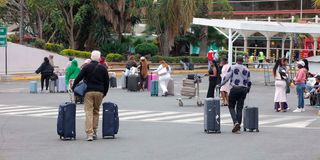
Stranded passengers at Jomo Kenyatta International Airport (JKIA) in Nairobi on August 31, 2026 after flights were disrupted by aviation workers' strike.
The Fresh Produce Consortium of Kenya (FPC) said the ongoing go-slow by airport and air traffic control workers is severely affecting the movement of perishable goods causing huge loss.
“Every aircraft departing JKIA carries substantial quantities of Kenya's fresh produce that include flowers, fruits, vegetables, meat, herbs and spices to markets across the world. This is cargo that cannot wait. When flights and cargo operations are disrupted, consignments miss connections, exporters lose money, orders are cancelled, produce risks deterioration and, ultimately, farmers, workers and the wider economy pay the price,” said FPC chief executive Okisegere Ojepat.
Shippers Council of Eastern Africa (SCEA) chief executive Ogayo Ogambi said the disruption had also affected exporters of perishable products, with shipments scheduled for dispatch facing delays beyond their control.
“Given the highly perishable nature of fresh produce, we are closely monitoring the situation and assessing the potential impact on individual consignments,” Mr Ogambi said.
According to the Kenya Association of Air Operators (KAAO) which represents more than 90 per cent of Kenya's air operators and aviation service providers, during the KAWU industrial action of February 16–17, 2026, preliminary assessment of sixteen (16) operators recorded 150 flight cancellations, 382 delays and approximately USD 5.1 million (Sh660,195,000) in direct losses.
The figure excluded aircraft diversions, crew disruption, network-recovery costs and the broader effects on tourism, trade and medical operations.
“A second major disruption within the same year shows that temporary settlements have not achieved the resilience the sector requires. As a regional hub, JKIA also connects onward traffic across the African network, so disruptions here carry knock-on effects for airlines and passengers well beyond Kenya,” the association said.
Reporting by Kevin Cheruiyot, Brian Ocharo, Domnic Ombok and Titus Ominde
Follow our WhatsApp channel for breaking news updates and more stories like this.