‘Every painting is a story’: How art is fuelling Kenya’s anti-femicide movement
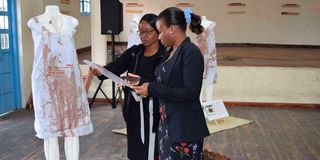
Jane Josiah (left) and Angelina Yohana at an exhibition stand in Nakuru Municipal Hall, Nakuru City on November 3, 2025.

What you need to know:
- The Maskani Exhibition is using art to expose the growing femicide crisis in Kenya through paintings, installations and poetry.
- The exhibition highlights where femicides occur, who perpetrates them and how justice systems often fail survivors. It has already reached thousands across major cities.
- Created by Usikimye and Creative Garage, and supported by the Heinrich Boell Foundation, Maskani combines art and activism to demand accountability from duty-bearers, including police, prosecutors and hospitals, thus presenting real cases and statistics in a raw, emotional format that resonates with visitors.
Jane Josiah and Angelina Yohana move slowly from one exhibition stand to the next, studying the artwork and photographs with quiet intensity. It is a bright afternoon at Nakuru Municipal Hall, where the Maskani Exhibition has set up camp in the heart of Nakuru City.
As the two women make their way through the displays, their faces reflect deep sadness and grief. The paintings, poetry and installations on show are designed to confront the reality of femicide—turning collective grief and outrage into a powerful call for justice.
Visitors to the exhibition are guided through different dimensions of femicide, including where these killings often take place and the times they commonly occur. The exhibition also highlights how duty-bearers such as the police, the Office of the Director of Public Prosecutions, and the Judiciary either facilitate or hinder access to justice for survivors.


After her visit, Jane praises the innovative use of art to raise awareness. “When you go through the exhibition, the message hits harder and you get a firsthand sense of what femicide really means. We appreciate Maskani for this initiative as it has opened our eyes,” she says.
Maskani is the brainchild of Usikimye, a women’s rights organisation combating GBV, and Creative Garage, an arts organisation that provides a platform for creatives. Supported by the Heinrich Boell Foundation, the initiative seeks to raise awareness, educate the public, and pursue justice for victims of femicide.
“Maskani” means dwelling or home in Swahili—a place meant for rest, laughter and safety. Yet for many women, the home has become a place of violence, even a crime scene. The exhibition aims to emphasise the severity of femicide using real stories, sounds and imagery. It also places responsibility firmly on duty-bearers.
Usikimye executive director Njeri Mwigi says the exhibition was conceived to display statistics and cases of femicide in a way that resonates deeply. She calls for accountability from essential institutions, including the police, Judiciary, and hospitals.
Citing research, Njeri notes that 72 per cent of murders occur in the home, with 60–70 per cent of the victims killed by intimate partners or family members. “What we see here reflects what we experience daily. These are real cases of women killed through femicide. Maskani is more than an exhibition; it is a movement where art meets activism. Every installation and painting tells a story that cannot be ignored.”
Maskani has already toured Nairobi, Nakuru, Kisumu and Mombasa, attracting more than 5,000 visitors and amplifying community voices in the fight against femicide. Njeri adds that the initiative was born from the pain of watching perpetrators walk free. “We wanted an artistic way to show the statistics and cases people truly understand. It is both a call for help and a call to action—something must be done to end this menace.”
Creative Garage’s Chris Wanyande says the exhibition confronts visitors with the raw reality of femicide. “This is an unfiltered space that forces us to see our reality—a reminder that our rights and freedoms can hinge on someone else’s whims. The writings and statistics make it easy to understand what is really happening in society.”
Akinyi Odera of the Heinrich Boell Foundation says the initiative serves both as commemoration and remembrance. “Maskani calls for accountability from duty-bearers—police, Judiciary, hospitals. It cannot be business as usual considering what is happening across the country.”
Kenya has witnessed a surge in GBV, particularly an alarming increase in femicide cases in the last two years. According to Femicide Count Kenya, the country recorded 160 femicide deaths in 2024—the highest in the region. Uganda reported 127 cases, while Tanzania recorded 102.
A UN Women–commissioned study, Social Analysis of Femicide in Kenya, indicates that 40 per cent of Kenyan women have experienced emotional, physical or psychological intimate partner violence. It also found that 30 per cent of women and 19 per cent of men believe a husband is justified in beating his wife under certain circumstances. Additionally, 34 per cent of women aged 15–49 have experienced physical violence.
While Nairobi remains the most affected county, Kisii, Kitui, Meru and Nyeri are also among the top 10. The Nairobi Women’s Hospital’s Gender Violence Recovery Centre reports an average of 4,000 cases each month, underscoring the crisis. “It is a crisis and something must be done,” says Dr Sam Thenya, CEO of Nairobi Women’s Hospital. “The economic burden of GBV is enormous. We must speak out against this vice inflicted on women and girls—they are our daughters, wives, sisters and mothers.”
Activists attribute the rise in GBV to systemic misogyny and weak legal protections. Responding to public pressure, President William Ruto early this year formed a 42-member taskforce to address GBV, including femicide, though concerns about its effectiveness still lingers. The President outlined the taskforce’s mandate in a Gazette Notice, appointing former Deputy Chief Justice Nancy Barasa as chair. The taskforce has presented its findings to the Interior ministry.
The President said the taskforce would examine and recommend measures to strengthen policies and structures for prevention, response, investigation, prosecution and survivor support. “There are existing gaps in prevention, response, investigations, prosecution, data management and survivor support systems. These egregious violations threaten national security and strain our social fabric.”
According to a joint report by the United Nations Office on Drugs and Crime and UN Women, current and former intimate partners are responsible for an average of 55 per cent of all intimate partner and family-related killings.


