FGM's bold return: A decade of silence, now proudly public, and why old messages aren't working
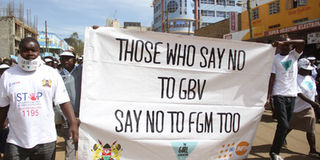
Anti-FGM campaign: Participants march in the streets of Eldoret during a campaign to end female genital mutilation.

What you need to know:
- A decade after FGM ceremonies disappeared from public view in Kuria community, they have shockingly returned, with educated women, including medical students, choosing to undergo the procedure.
- Despite falling national rates of FGM from 21 percent to 15 percent, anti-FGM campaigners face fierce resistance in 22 hotspot counties.
- Experts now call for a shift in messaging, as communities adapt their practices and move towards medicalised FGM.
Last December, Catherine Chacha Menganyi was moved to tears after witnessing something she believed had ended a decade ago: the public ceremonies for girls after female genital mutilation (FGM) in the Kuria community of Migori County.
“When I was growing up, I believed that none of the four Kuria clans would perform circumcision or FGM together during the holidays. But surprisingly, you’ll find three or even all of them doing it simultaneously,” says Catherine, county anti-gender-based violence (GBV) coordinator under the Health department.
She notes that public parading had disappeared for more than 10 years. However, this change raised concerns about a clandestine practice occurring in homes, with many cases remaining unreported. For her, the events in December marked an awakening moment.


What shocks her even more is the discovery that graduates, some of whom are medical trainees expected to understand the dangers of FGM, are returning home to undergo the procedure. Even worse, some women, who have been married for years, still choose to undergo the cut at an advanced age.
“It makes you wonder what trend is emerging, or what exactly is going wrong. A lot has been done in terms of advocacy and outreach, reaching different populations and listening to their concerns. But I always ask myself: 'What is the missing link that we need to address?’” she says.
She recalls an incident where a local Kuria man told her outright that arresting those who facilitate FGM would not stop them from cutting girls. Women, too, criticise her for advocating against the practice, despite her having undergone it herself.
“To them, it feels like an infringement of their rights, and nobody considers it a human rights issue,” Catherine notes.
Catherine was compelled to reveal that she is a survivor of FGM, which she underwent at her village home in Kuria, performed by a qualified healthcare worker. This revelation came after a social media user accused her of knowing nothing about FGM because 0f her online anti-FGM campaign.
“The ridicule and mockery that followed were overwhelming. It was tormenting; it drove me to tears,” she recalls.
According to the United Nations International Children's Emergency Fund (Unicef), 35 communities in Kenya practise FGM. Kenya has 45 ethnic groups and nine non-Kenyan groups listed in the 2019 Census.
These 35 communities are spread across 22 FGM hotspot counties, including Kajiado, Narok, Samburu, Laikipia, Migori, Kisii, Nyamira, Meru, Embu, Mandera, Wajir, Garissa, Tana River, and West Pokot. The others are Baringo, Elgeyo Marakwet, Isiolo, Marsabit, Bungoma, Bomet, Taita Taveta, and Tharaka Nithi.
Although the overall prevalence of FGM has dropped from 21 per cent in 2014 to 15 per cent in 2022, according to the Kenya Demographic and Health Survey, regional variations remain stark-from as high as 94 per cent among the Somali to as low as 0.2 per cent among the Luo, as noted in a 2020 Unicef analysis on the status of FGM in Kenya.
Messaging
With varying practices, traditions, and the risk of stigma and retraumatisation for survivors, stakeholders emphasise the need for a shift in anti-FGM messaging.
“It’s time we move to targeted messaging. You may be addressing an audience without realising you are retraumatising survivors or failing to resonate with the locals by using scientific information or discussing types of FGM they cannot relate to. You may leave a forum thinking you have made an impact, but in reality, you have done nothing,” she explains.
“I once attended a forum where a speaker claimed that women who have undergone FGM cannot deliver normally and must have caesarean section. Suddenly, a woman stood up and said, ‘I have had seven children through normal delivery.’ Who do you expect the people in the room to believe—the speaker or the woman?”
Furthermore, communities that previously practised severe forms of FGM have begun adopting less severe types. Jackson Onyando, a child protection specialist with Unicef Kenya, highlights that the Somali in Mandera, Garissa, Wajir, and Marsabit, which traditionally practised Type I FGM—partial or total removal of the clitoral glands—are now shifting to Type IV, which involves pricking, piercing, incising, or scraping the female genitalia.
He also notes that medicalised FGM, once mainly practised by the Kisii using healthcare providers, has now spread to all communities engaging in FGM, as they perceive it to be safer. “We’ve observed a shift in the types of FGM being practised. Parents are taking their children to clinics for Type IV FGM, and this change must inform our messaging.”
Jackson further explains that they are now encouraging partners to shift their messaging to FGM as a violation of human rights, rather than solely focusing on its medical and health consequences.
“When the conversation centres on the medical consequences, it often fails to resonate. Some health workers even share their own experiences, stating that they underwent the procedure and feel no regrets. They argue that someone who hasn't lived through it cannot truly understand or judge the experience,” he says.
This year, International Day of Zero Tolerance for Female Genital Mutilation will be observed today, February 6, under the theme: Stepping Up the Pace: Strengthening Alliances and Building Movements to End FGM.
One approach, according to Jackson, is to increase funding for women-led organisations that are taking a more proactive role in the fight against FGM, a shift from the previous reliance on international nongovernmental organisations to combat the practice.
Technology
In terms of prevention and response, Unicef has promoted the use of technology. In 2023, in collaboration with the Anti-FGM Board, they launched the Pasha mobile application, enabling users to report cases, with the information reaching relevant agencies for action. The application is currently under review to enhance its effectiveness.
“Initially, it was internet-based, allowing people to report anonymously. It was linked to a county steering committee for FGM, but we encountered challenges because internet access is a problem in some areas. We are now working with the board to develop an SMS platform that allows users to report via USSD,” he concludes.
The application, which was available for download on the Google Play Store, is currently unavailable because of ongoing upgrades aimed at improving its functionality.