‘Men suffer too’: Bomet police officer's scalding attack reveals years of hidden pain
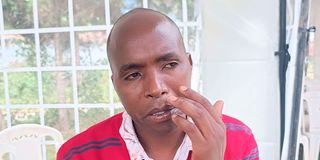
Hillary Kipkoech Chepkwony, a Bomet-based police officer who is a survivor of gender-based violence, reported at Sotik police station on November 27, 2025. He called on men in similar situations to come out and seek professional help and counselling, to heal and live meaningful lives.

What you need to know:
- Hillary Kipkoech Chepkwony, has spoken publicly about suffering domestic violence for years, including a recent scalding attack by his partner.
- The case has sparked conversations on the rising number of male GBV victims in the South Rift region. The story—culminating in a hot water attack—has encouraged men to seek psychosocial support and drawn attention from activists and county leaders.
- After years of silent suffering, the AP officer is breaking the stigma around male victims of domestic violence.
Police officers are often accused of assault, with some even turning their service firearms on family members, acquaintances or colleagues in moments of anger. But Hillary Kipkoech Chepkwony, an Administration Police officer based in Bomet, has found himself in an unexpected and unenviable position: that of a gender-based violence survivor.
For years, Mr Chepkwony projected the image of a calm and contented man. Yet beneath the surface lay a simmering pain—one he has recently chosen to confront publicly as part of his healing. The incident of October 16, 2025, remains vivid in his memory, marking a turning point that has drawn the attention of various stakeholders. On that day, his partner of nine years allegedly poured hot water on him following a domestic altercation at their residence in Sotik town, where he works and lives.
A misunderstanding between the couple had reportedly occurred earlier but was left unresolved, ultimately escalating into violence. The matter, recorded under Occurrence Book number 29/16/2025, states that the suspect (name withheld) poured hot water on the officer’s left hand.


“Police officers visited the scene and established that the suspect boiled water and burnt the complainant,” reads a police report. “He was treated at Kaplong Mission Hospital and discharged in fair condition. A P3 form was filled and the matter is under investigation by the Officer Commanding Sotik Police Station.”
Mr Chepkwony has since appeared at several public forums, openly speaking about his experiences and explaining that the attack was only the latest example of what had been happening behind closed doors. In an interview with the Nation, he said he had endured prolonged suffering in silence but chose to speak up to encourage other survivors, particularly men, to seek psychosocial support.
“The incident happened when I least expected it, as I was preparing for Mashujaa Day on October 20, 2025. I restrained myself, even though I had the opportunity to pick up a gun and commit a crime by harming my partner,” he said. “My left hand was injured after being scalded with boiling water while I was in the bathroom and later as I dressed for work.”
Neighbours responded to his distress after hearing an alarm, and the couple has since separated. “Men should restrain themselves in such situations, but they must also stand up, speak out and seek professional help so that they can heal and live normal, happy lives,” Mr Chepkwony said.
He noted that many domestic violence cases resulting in serious injury or death occur because victims, especially men, fear coming forward, worried they will be ridiculed. “In silence, we do not heal. When we come out and confront the challenges we face, we receive support and eventually emerge stronger,” he said.
“Victims should confide in those close to them—family, trusted friends or colleagues—so that they can begin the healing process. Those who have gone through this understand the pain, while those who have not may struggle to relate,” he added during an interview at Bomet Police Station.
Gertrude Chepkemoi, founder and chairperson of Beacons of Hope, a community-based organisation advocating women’s and children’s rights and addressing gender-based violence, said many men in the region are suffering silently.
“Unfortunately, men have increasingly been the victims in rising cases of gender-based violence in the South Rift region. The underlying issues must be addressed to curb murder cases,” Ms Chepkemoi said.
Bomet Governor Hillary Barchok echoed the concern. “The fact that a senior police officer has spoken openly about the challenges he has faced due to domestic violence should be an eye-opener for those suffering in silence. Men are known to keep quiet, but times have changed. We should all be treated equally even as we champion the rights of girls and women.
“Cases of men subjected to domestic violence are on the rise, and we must confront this monster before more lives are lost,” he added.