'My badge is a bandage': Why Policare's founder keeps winning international awards
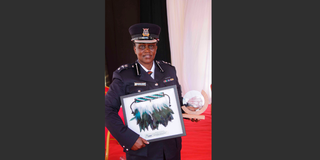
Policare founder Zipporah Nderitu holds her trailblazer award recognising her contribution to women's social justice during International Women's Day celebrations at Moi Stadium, Embu, March 8, 2024.

What you need to know:
- Zipporah Nderitu created Policare for sexual and gender-based violence victims under one roof.
- Her innovation has earned her multiple international awards including Queen Elizabeth II's Most Venerable Order of St John, US Senate commendations, and recognition as a 2024 World Humanitarian Hero.
In the sterile corridors of a police station, where empathy is often mistaken for weakness and protocol trumps compassion, Senior Superintendent Zipporah Nderitu dared to imagine something different. What if a survivor's journey through the justice system didn't have to be another form of trauma? What if dignity could coexist with due process?
When she conceived the Policare idea, she never imagined it would propel her into the international limelight. Hers was a simple vision: to ensure survivors of sexual and gender-based violence (SGBV) are treated with dignity and have access to justice.
Zipporah is the brains behind Policare, an integrated, survivor-focused, multi-agency response to SGBV. Her work in fighting GBV and pressing for justice has won her accolades both locally and internationally.


From constable to international recognition
Currently serving as a police adviser at the International Peace Support Training Centre, she has received numerous awards in recognition of her campaign. She is a recipient of the Most Venerable Order of St John by command of Her Majesty Queen Elizabeth II. She has also received commendations from the Franklin Police Department in the United States and the US Senate for her exemplary service in policing and training.
In 2023, she won the International Association of Women Police global award in New Zealand. On this year's World Humanitarian Day, she was named one of the World Humanitarian Heroes—a powerful recognition of her contributions to peacekeeping, humanitarian work, and security leadership. In 2014, she was nominated as Best Individual Police Officer at the Outstanding Police Service Awards by the Independent Policing Oversight Authority.
Today, Policare centres stand as a lasting symbol of her vision, offering medical, legal, psychosocial, and protective services to survivors under one roof. Currently, only one Policare centre is functional in Nanyuki, with studios for showcasing in Busia, Makueni, and Nairobi.
The seeds of change
In an interview with Nation.Africa, Zipporah recalls realising the need for survivor-centred reforms early in her career. She remembers almost losing her job during her first posting when she assisted a sick child who had been placed in custody with the mother.
She is elated by the recognition she has received but stresses that much of her work is carried out quietly, sealed by ethics and confidentiality.
"The awards I have received are not just recognition; they are a reflection of the journey and a reminder that empathy can live in uniform. My badge is a bandage. This honour stitches into a deep personal calling. That's the power of resilience that turns victims into survivors and quiet service into public recognition," she says.
Zipporah acknowledges that her work carries a humanitarian reflex with a competitive edge: the ability to choose how to respond to a crisis—whether in public or private, to act or to step back. Every spark of acknowledgement, she insists, belongs to a wider group of people who offer support. Policare shines because many well-wishers stand with it in the shadows.
Journey through heartbreak and reflection
The journey to founding Policare was a slow-burning realisation, stitched together through years of service, heartbreak, and reflection. As a young officer, she began to notice the stark contrast between victims of property crimes—who often had a chance at restitution—and victims of sexual violence, who were left with deep trauma and scars that rarely healed.
"I later, while serving as a court orderly, witnessed cases being compromised, exhibits mishandled, and perpetrators walking free. In the gender crimes office, I watched victims become ping-pong balls, passed from one investigator to another, one agency to the next," she recalls.
She adds that reporting sexual violence was humiliating, with statement recording, investigations, and courtroom cross-examinations often traumatising the very people they were meant to protect.
"Every time I voiced concern, I was reminded that policing is not for the faint-hearted; that empathy had no place in law enforcement. But I refused to accept that."
The constitutional shift
The turning point came when Supreme Court Judge Njoki Ndung'u sponsored the Sexual Offences Bill in 2003, which was passed and assented to in 2006.
"As a member of the Waki Commission, I saw first-hand the need for survivor-centred reform. The 2010 Constitution gave us a new beam of hope, transforming us from a police force to a police service. That shift made space for empathy, dignity, and people-centred policing."
By 2016, she began to formally review the concept, which was fully formed by 2018. In 2019, Policare was accepted by the National Police Service, launched by the state, and validated through a whole-of-government approach.
The driving force
Zipporah notes that dignity is priceless, and when it is taken through sexual violence, it cannot be reinstated.
"That truth is what drives Policare. This story is not without pain, shame, disgrace, oppression, and threats from naysayers. But what keeps me going is seeing victims turn into survivors. That transformation is the heartbeat of Policare."
To underscore her achievements, the National Police Service on Tuesday issued a statement recognising her exemplary work. It described Zipporah as a distinguished officer, scholar, innovator, and humanitarian whose career embodies excellence, resilience, and transformation.
"Zipporah Nderitu has grown into a respected leader and mentor, admired for her discipline, brilliance, and commitment to service. Her remarkable journey has seen her rise from Constable to Senior Superintendent of Police—a testament to her determination, integrity, and professionalism," the statement read.
Beyond the badge
Beyond her official duties, Zipporah passionately mentors young people and speaks in schools and churches on security matters. She currently serves as vice chairperson of the Professional Criminologists Association of Kenya. The police service regards her as a role model, not only to her colleagues in uniform but also to countless women and girls across Kenya.
"You are a shining beacon of excellence, a mentor to many, and proof that resilience and determination can create lasting change. The National Police Service is proud of your achievements and wishes you all the best as you rise to the highest echelons of the service."
She has previously worked at Kileleshwa Police Station, Buru buru, Thika East, and the Police Training College. She holds a Bachelor's degree in Criminology and will soon graduate with a Master's in Strategic Leadership and Security Studies. She also holds numerous international certifications from training institutions in Ghana, Uganda, and Italy.


