A Kenya modelled on Singapore could mean fewer women carrying the burden alone
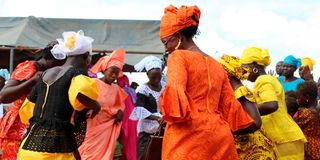
Women dance at a gathering.

What you need to know:
- As President William Ruto pushes to model Kenya’s economy on Singapore, stark gender gaps reveal why economic growth alone is not enough.
- Singapore’s stronger investment in care work, safety, and shared parenting has reduced the everyday cost of being a woman.
- Singapore’s state-backed childcare, paternity leave, and survivor-centred safety systems show what gender-responsive governance can achieve.
In the mind of Gladys Kerochi, Singapore, the country President William Ruto has repeatedly said he wants to turn Kenya into, is a place where women do not struggle alone with childcare when the men who sired the children disappear like a flash of thunderstorm lightning.
If Kenya does become a Singapore, will Gladys’ imagined country come to life? According to the World Economic Forum’s 2025 Global Gender Gap Index, Singapore scores 0.748, ranking 47th out of 148 countries, while Kenya scores 0.689, placing it at 98th. The 0.059 gap reflects differences across four key areas: economic participation and opportunity; educational attainment; health and survival; and political empowerment.
What sets Singapore apart is not the absence of inequality, but the deliberate way it has reduced the everyday costs of being a woman. Care work, the invisible labour that sustains families, offers a telling example. In Singapore, a 2022 Quality of Life survey found that 40 per cent of caregivers are men, while women make up 60 per cent. More strikingly, the survey found no significant difference in quality-of-life scores between male and female caregivers, suggesting that care work does not automatically impoverish women’s wellbeing.


In Kenya, comparable data does not exist. What does exist is the Kenya National Care Policy, which recognises unpaid care work as a public issue and sets out plans to develop national standards for childcare for children aged 0–3 years.
Singapore has backed the care policy with resources. Through its Caregiver Support Action Plan, the government provides respite care services, outreach teams focused on mental wellbeing, stress management and future planning, and access to counselling and peer support. Caregivers are not expected to cope in isolation.
The ripple effects extend into the workplace. Singapore has deliberately pushed fathers into the caregiving space, recognising that women’s economic participation is shaped as much at home as it is at work. Government-paid paternity leave was introduced in 2013, and by 2021, more than half of eligible fathers were taking it up.
In 2024, paternity leave was extended to four weeks, with the state reimbursing employers for the additional leave. Kenya’s laws acknowledge parental responsibility, but without strong incentives or widespread uptake. The outcome is predictable: women continue to shoulder most childcare and domestic work, limiting their ability to remain in or advance within the labour market.
Safety is another area where Singapore’s advantage is visible. In 2024, Singapore introduced a new sentencing option allowing serial sexual offenders to be detained until they no longer pose a significant threat to public safety.
Enforcement goes beyond the courtroom. A dedicated Sexual Crime and Family Violence Command within the police oversees investigations, while public awareness campaigns target nightclubs, public transport and entertainment spaces. Even trains carry warning messages aimed at deterring would-be perpetrators.
Kenya criminalises sexual and domestic violence and allows courts to issue protection orders and award compensation. Yet enforcement remains uneven, cases often drag on, and survivors face stigma, fatigue and institutional gaps. Specialised police units are limited, and prevention messaging is sporadic.
Singapore takes a firm approach to family violence. The 2023 amendments to the Women’s Charter expanded survivor protections, including Stay Away Orders, No Contact Orders, and Mandatory Treatment Orders, which can be issued if the perpetrator has a treatable psychiatric condition contributing to the violence. These interventions may continue even if the Personal Protection Order is later revoked.
Kenya’s Protection Against Domestic Violence Rules allow courts to issue protection orders and compensation but do not include Mandatory Treatment Orders. Protection orders may be granted if domestic violence has occurred or is likely, and victims can claim compensation for injury, financial loss, trauma, or property damage, either with the protection order application or separately within three years.
This is how Singapore has edged ahead, and for women like Gladys, their diverse aspirations could become reality if President Ruto prioritises not only Singapore’s economic model but also its social one.


