A safe haven at last: Vihiga launches centre for sexual violence survivors
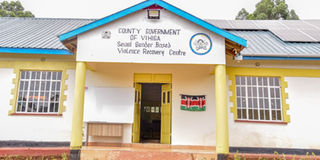
Sexual and Gender-Based Violence Recovery Centre at Wodanga in Sabatia, Vihiga County. The centre is the second in the Lake Region Economic Bloc counties, after Kisumu.


What you need to know:
- Vihiga County has opened its first 24-bed recovery centre for survivors of SGBV in Sabatia.
- The facility will provide comprehensive medical care, mental health support, legal aid, and safe shelter during court cases.
When Lucy* was defiled by a man courting her mother, her family chose silence over justice. Though she confided in her mother, Lucy was warned not to report the matter, as the perpetrator was their only source of financial support.
Today, the man remains free, visiting the family at will, while Lucy, like many other survivors in Vihiga County, has had no access to a functional rescue or recovery centre—until now.
While the latest statistics from the Kenya Demographic and Health Survey reveal that 13 per cent of women in Kenya have experienced sexual violence at least once, Vihiga County has reported 11.9 per cent of such cases.


Survivors in the county have now found relief with the launch of its first recovery centre, located at Wodanga in Sabatia. This is the second facility of its kind among the 14 Lake Region Economic Bloc counties, following Kisumu.

Vihiga Governor Wilber Ottichilo, accompanied by county and NGOs' officials, launches the Sexual and Gender-Based Violence Recovery Centre at Wodanga in Sabatia, Vihiga County, on October 1, 2025.
Presiding over the launch, Vihiga Governor Wilber Ottichilo described the centre as a vital intervention in light of rising cases of sexual and gender-based violence (SGBV). “As a county, we are not doing well; cases of violence remain rampant. That is why we saw the need to operationalise the centre, even as we continue to address root causes,” he said.
The 24-bed facility will act as a one-stop centre, offering comprehensive services for survivors. These include emergency clinical care, mental health support, paralegal services, crucial linkages to the police, and legal aid.
According to county health officer Abigael Osendo, the centre will also provide HIV prevention services, emergency contraception to prevent teenage pregnancies, and treatment for sexually transmitted infections. “We will also provide wound care, psychosocial support and mental health care. Our clinicians attached to the facility will serve as expert witnesses in court,” she explained.
The Office of the Director of Public Prosecutions emphasised the centre’s role in safeguarding survivors during litigation. Cosmas Okembo, a prosecutor, noted that many survivors face intimidation when perpetrators are family members.
“We always advocate that children in need of care and protection be removed from hostile environments. This centre offers a safe space where survivors can stay during court hearings. Early trial dates are critical because young survivors risk memory loss if cases drag on,” he said.
Enhanced efforts
The launch builds on Vihiga’s earlier efforts to tackle gender violence. Last year, the county unveiled the Vihiga County Sexual and Gender-Based Violence Policy 2024, which seeks to establish a comprehensive response to SGBV, reinforce survivor protection, improve service delivery, and promote gender equality.
Among the initiatives proposed are the creation of a dedicated Department of Gender with a director overseeing operations, the appointment of a county SGBV coordinator, and capacity-building programmes for clinicians and nurses to strengthen survivor care. Other measures include the establishment of court users’ forums at the sub-county level, gender desks in police stations, and operationalisation of recovery centres.
The new facility was constructed under the leadership of Vihiga Woman Representative Beatrice Adagala months ago, but remained dormant due to lack of funds. With support from Shining Hope for Communities, the Civil Society Organisation (CSO) Network, the UNDP, and the Embassy of the Kingdom of the Netherlands, it has now been equipped, staffed, and placed under a steering committee.
Betty Okero, Executive Director of the CSO Network, highlighted the facility’s significance: “Survivors from Vihiga previously had to travel to other counties, including Kisumu, Kwale and Murang’a, in search of a recovery centre.
"The absence of such a facility exposed them to threats and intimidation from family and community members, leaving many reluctant to report cases or testify in court. This centre will now host survivors for four to five months as their cases proceed in court.”
The operations of the centre will be guided by Vihiga’s GBV Policy. The county is also finalising a GBV Bill, which Governor Ottichilo said would provide a firm legal framework for enforcement and ensure coordinated response to cases. He further assured residents of the centre’s sustainability beyond donor support. “We have agreed as a government to create a budget for this centre. In the next supplementary budget, funds will be allocated to ensure it continues to run effectively,” he said.
The governor, however, stressed that prevention must take precedence over reaction. He identified illicit brews as one of the drivers of rising cases of GBV. “We must go down to the villages, talk to the people, and consistently educate them. Chiefs, ward administrators, religious leaders, and community groups all have a role to play if we are to prevent violence,” he said.
Dr Ottichilo concluded with a vision for the future: “My dream is that in the next five to 10 years, we should close this centre—not because it failed, but because cases of gender violence have drastically reduced. That will only be possible if government, partners, and the community work together.”
*Name changed to protect the minor’s identity and privacy.