Alice Wasike: The woman chief changing lives in Bungoma
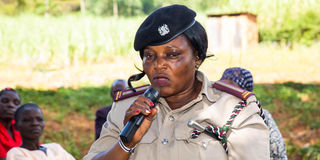
Alice Wasike, the chief of Musikome location in Kanduyi, Bungoma County, addresses residents in Tongaren. Alice has won accolades as a fierce fighter against gender-based violence and peace actor.

What you need to know:
- Bungoma’s “Super Chief” Alice Wasike leads grassroots fight against gender-based violence, land injustices and entrenched community conflicts tirelessly.
- From awareness barazas to peace building, Alice Wasike champions women’s rights, survivor support and local governance transformation in Bungoma.
Alice Wasike does not wait for trouble to come to her office. She goes looking for it, in villages, at barazas, in homes where widows are being pushed off their land and girls are disappearing from school before they have had a chance to grow up.
That is how she has come to be known, across Bungoma County, as the Super Chief.
Alice is the chief of Musikome Location in Kanduyi, Bungoma. On a clear morning, she is in Mahonge village, Tongaren, in full administrative attire, addressing a group of women who are listening closely. The agenda is familiar: gender-based violence (GBV) awareness, land rights, and peace building. These are the issues that have defined her work since she joined the public service as an assistant chief in 2014.

"Getting cases of gender-based violence is always very sad for me. I never hesitate to take the necessary action and make the referrals so that survivors can be taken care of," she says.
Her work involves identifying, referring and following up on GBV cases affecting women, girls and men in the community. She has held awareness barazas to educate locals on what the law says about gender-based violence, and has been at the forefront of defending widows facing disinheritance, a problem that remains widespread across western Kenya. "Getting cases of gender-based violence is always very sad for me. I never hesitate to take the necessary action and make the referrals so that survivors can be taken care of," she says.
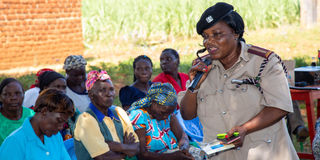
Alice Wasike, the chief of Musikome location in Kanduyi, Bungoma County, addresses residents in Tongaren. Alice has won accolades as a fierce fighter against gender-based violence and peace actor.
Her work involves identifying, referring and following up on GBV cases affecting women, girls and men in the community. She has held awareness barazas to educate locals on what the law says about gender-based violence. She has been at the forefront of defending widows facing disinheritance, a problem that remains widespread across Western Kenya.
She was promoted to chief in 2021 and has since expanded her work beyond GBV. She now serves as Coordinator of Bungoma Women Peace and Security, a role that has taken on added weight given the county's history of conflict.
The Mt Elgon region, in particular, has experienced recurring inter-ethnic and intraethnic clashes for decades, driven by land disputes, cattle rustling, political competition, and resource scarcity. Those conflicts have resulted in loss of lives, displacement, destruction of property and disruption of livelihoods.
"As peace builders, we engage the community on the importance of peaceful co-existence. Women have an integral role to play in ensuring peace prevails," she says.
Alice is a beneficiary of a project dubbed Advancing Women’s Leadership for Sustainable Peace and Inclusive Governance that is being implemented by the UN Women and funded through Irish Aid.
The project is being implemented in partnership with the Office of the United Nations High Commissioner for Human Rights and Echo Network Africa Foundation.
The project seeks to enhance women's leadership, participation, and equal benefits from governance systems, a life free from violence and influence in building peace and resilience.
Bungoma is one of the counties with many cases of sexual violence, which Alice has been at the forefront of fighting.
The numbers from the county make it clear why such interventions are necessary. From January 2016 to August 2023, a total of 106,982 girls aged between 10 and 19 became pregnant in Bungoma. The county's teenage pregnancy prevalence stood at 19 per cent against a national rate of 15 per cent, while its sexual and gender-based violence prevalence was 23 per cent, compared to the national figure of 13 per cent.
Between January 2016 and July 2023, the county recorded 9,089 cases of sexual and gender-based violence among girls aged 10 to 17, against 18,510 cases reported countrywide over the same period. In the first eight months of 2023 alone, 299 teenage pregnancies were recorded among girls aged 10 to 14, and 8,375 among those aged 15 to 19.
Tongaren Officer Commanding Station Leonard Mutai commends the work Alice and other women are doing, but he points to a recurring obstacle.
"After women are assaulted, they come to us asking to withdraw charges against the perpetrators. This affects the fight against GBV. My appeal to survivors is to always let the law take its course," he says.
Inspector of Police Bridget Baraza, echoes the call for women's involvement in peace processes. "Women and girls suffer most whenever there is conflict. As women, they must get involved in peace processes and know which peace processes can work for them," she says.
Beyond her official duties, Alice has used her position to push for better services at the grassroots level. She mobilised the community to construct an office for the assistant chief so that services could reach people closer to where they live.
She is a firm believer in affirmative action and women's economic empowerment as tools for community development.
"I have made sure I use my position to motivate and influence women to speak up on issues that affect them, including peace matters. Women's voice and unity is critical in peace building," she says.
"Women's leadership is the way to go. They should not fear to take up leadership positions because they have what it takes."


