Before the two-thirds rule, there was Phoebe Asiyo
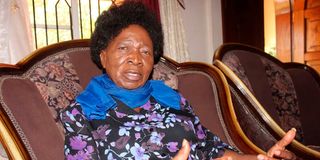
Former Karachuonyo MP Phoebe Asiyo on August 14, 2017. She died in the US on July 16, aged 93.

What you need to know:
- Phoebe Asiyo’s legacy stands tall; her alliance with Raila Odinga transformed the political landscape, bridging the struggles of Independence and modern democracy.
- Her fearless advocacy for women’s rights and political inclusion began long before Independence.
In 1952, the state of emergency declared by colonial Governor Evelyn Baring yielded the displacement of thousands of African children. Phoebe Asiyo, then an aspiring nurse, applied for a social work position advertised in the City Press by the municipal council. Her occupational mandate included improving the welfare of displaced children in Bahati, Baba Dogo, Ruaraka, Ololua, Kiserian, and Ngong, who had been ostracized by the conflict.
She used a bicycle to commute to all the areas and eventually bought a Vespa Scooter and helmet to speed her inspections. In December 1958, Phoebe's advocacy as a social worker compelled her meteoric ascension to becoming Kenya's greatest purveyor of gender parity.
She joined Maendeleo Ya Wanawake Organisation (Mywo) in 1953, one year after it had been created by wives of British settlers. She immediately noticed that the institution wasn't aligned to serve the needs of Black women. She, therefore, founded a parallel alliance in 1956 named Usalama Ya Wanawake na Watoto that directly targeted Black women and children.


Her determination led to Phoebe's election as the first Black president of Mywo. She subsequently assembled a historic contingent of female leaders in 1960 and led them to Lodwar. The purpose of the journey was to persuade the incarcerated Jomo Kenyatta to constitutionally allocate 50 per cent of parliamentary positions to women once he ascended to the presidency.
After Independence, Phoebe's term in Mywo ended in 1962, curtailing her aspirations of pressuring the new Kanu regime to grant women legislative representation in decision-making platforms. Her grievance was compounded by the Kenyatta regime's lack of goodwill, which resulted in the replacement of the regional constitution with a unitary one, making Kenya a de facto one-party state. Over the next 40 years, the Kenyan constitution was "eroded" through amendments by Kanu to legalise a litany of self-interested decisions while failing to implement vital domestic policies on gender integration.
In June 1966, Amendment Number Six to the Preservation of Public Security Act allowed for detention without trial. The most consequential victim of that act would be a young Magdeburg College of Advanced Technology graduate named Raila Odinga.
When he returned from his studies in Leipzig, Germany, in 1970, Raila was under constant surveillance by the Special Branch. He, therefore, strategically steered clear of politics while he lectured at the School of Mechanical Engineering at the University of Nairobi. His father Jaramogi was unjustly detained in Hola, while his brother Oburu was completing his doctorate in statistics in Moscow.
Raila's involvement in politics could have easily resulted in his detention and, as a consequence, crippled Jaramogi's numerous businesses, including Lolwe Bus Service and Ramogi Press, all of which Raila was administering.
He exerted his entrepreneurial skills by establishing Spectre and began manufacturing gas cylinders—a practical skill he had acquired from the Volkswagen factory in Wolfsburg, Germany, during his vacations from his studies. Upon realising that there wasn't a national standard against which his cylinders could be tested, Raila approached the then Kenyan Minister for Trade and Industry, James Osogo.
The interaction led to a Kenya Bureau of Standards Act being passed in Parliament in 1973, and Raila was appointed group standards manager. He travelled to the British Standards Institution in London and the US National Bureau of Standards in Gettysburg, Maryland, where he drafted the 'Standards for Standards'—a document that would guide the Bureau's work in the proceeding decades.
By the time Raila was detained in the atrociously gazetted camps of Kamiti, Naivasha, Shimo La Tewa, Manyani, and Hola, he was already a revered reformer with an impenetrable conviction for constitutional reform. Phoebe had been a confidant to Raila's mother, Mary Juma, and often assisted her in meal preparations for guests at Jaramogi's vice-presidential residence in 1964.
She had noticed Raila's elevation into a brash, compelling politician who could instantly read a room and intuitively work any crowd with formidable showmanship. He was passionate, whip-smart, brazenly articulate, self-assured, and never at a loss for words.
After Jaramogi's funeral in February 1994, Phoebe, who was by then the MP for Karachuonyo, chairperson of Uasu, and Dean of the Diplomatic Corps, convened a reconciliatory meeting of a delegation of prominent Luo politicians at her Wikondiek home. The meeting, which included Raila, reinforced the political relationship between the two reformers that would culminate in Kenya receiving a new constitution.
On April 23, 1997, Phoebe tabled the Affirmative Action Motion in Parliament, demanding a two-thirds gender rule and fair representation of women in the patriarchal August House. The motion was fiercely rejected in a Parliament that consisted of a paltry six female legislators. Raila subsequently ensured the removal of sedition legislation, paved the way for the granting of private broadcasting licenses, and solidified the freedom of speech.
He, thereafter, created a constitutional secretariat after a meeting at the Attorney General's chambers. Raila emphasises in his memoir Flame of Freedom that during the selection of the expert representatives who'd produce a discussion draft for the constitutional review process, he selected Phoebe. She became one of the 12 committee members formed to draft an amendment to the act of submission.
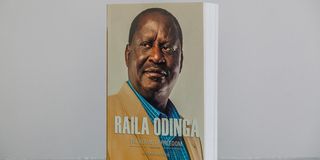
Former ODM leader Raila Odinga's memoir, The Flame of Freedom.
Raila subsequently campaigned for the appointment of Yash Pal Ghai, whom he had met in the 1970s while lecturing at the UoN, to chair the constitutional review process. Phoebe proceeded with her compassionate crusade against the subjugation of women and their relegation from key decision-making forums. Her 50-year persistence was eventually embedded in the 2010 Constitution through Article 27, which stipulated that 'every person is equal before the law and has the right to equal protection and equal benefit of the law.'
The author is a novelist, Big Brother Africa 2 Kenyan representative and founder of Jeff's Fitness Centre (@jeffbigbrother).