Behind the exports: Systematic abuse in tea estates as workers survive on one meal a day
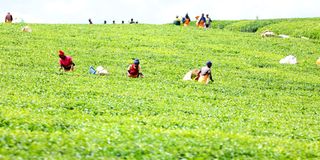
Women picking tea at a tea plantation in Limuru Kiambu County on June 5, 2023. A new study has exposed the hidden reality behind every kilogram of tea exported from Kenya with women enduring not only exhausting physical labour but systematic exploitation that robs them of their rights, safety, and dignity.

What you need to know:
- A study by the Wangu Kanja Foundation reveals that thousands of women in Kenya's tea plantations endure systematic exploitation.
- Despite working for decades, most remain on insecure short-term contracts without benefits, trapped by economic desperation and cultural norms that enforce silence about abuse.
Behind the rolling green hills and fragrant leaves that make Kenya one of the world's top tea exporters lies a hidden human crisis that demands urgent attention. Every day, thousands of Kenyan women face back-breaking labour, meagre pay, sexual exploitation, and the constant threat of abuse as they toil in the country's vast tea plantations.
From dawn until dusk, they pluck leaves under scorching sun or driving rain, carrying heavy loads across steep, slippery terrain—working beyond the legal limit of 45 hours a week, reaching 52 hours with barely a pause to eat.
Beyond the meagre pay lies a darker injustice hidden in corners of the tea estates: widespread sexual exploitation, abuse, and harassment.

Supervisors and managers, almost always men, hold enormous power over who gets hired or retained, who works which shifts, and who gets the lighter or more punishing tasks. The women are routinely coerced into unwanted sexual relationships to keep their jobs or secure favourable conditions. Those who resist often face intimidation, threats, or outright dismissal. For many, the fear of losing their only source of income leaves them feeling they have no choice but to comply.
These painful truths were laid bare in a study led by Emmanuel Siakilo, commissioned by the Wangu Kanja Foundation and the Coalition Against Sexual Violence with support from Oxfam.
Through countless interviews, focus groups, and first-hand testimonies, the study exposed the hidden reality behind every kilogram of tea exported from Kenya: women who endure not only exhausting physical labour but systematic exploitation that robs them of their rights, safety, and dignity.
Often, the women go hungry during workdays, pushing through exhaustion because missing their daily quota means earning even less. Despite their hard work, their pay is heartbreakingly low. Many earn just enough for a single daily meal for themselves and their children, yet still struggle to cover basic needs like rent, school fees, or medical bills.
"For the factory workers, the average income is around Ksh600 per day, approximately equivalent to $5. This level of income is below what is required to meet basic living standards, highlighting the economic struggles faced by women tea workers," the report states.
A huge chunk of their pay—which offers no medical cover or any sort of allowance for their extraneous work—is often spent on buying food for their families. With most of their income spent on food, their housing is substandard. In most cases, they make do with overcrowded houses rented in nearby villages that "lack basic amenities and adequate sanitation".
Short-term contracts
This daily hardship is made worse by the cruel insecurity of their employment. Most of these women are kept on short-term contracts that are renewed again and again to avoid providing the rights and benefits that come with permanent work: no sick leave, no maternity protection, no pension.
"When you look at the price of everything, it's rising every day, and the money is the same or even sometimes it decreases for us who pick tea," one respondent explained. "Now even a person fails to decide what to buy for the home and what to leave out. Sometimes you must choose between feeding the children or sending them to school."
The harsh reality is that in Kenya's multi-billion-shilling tea industry, the women who do the hardest work enjoy the fewest rights.
Many have worked for the same companies for decades and yet remain "casual" labourers, living in constant fear of dismissal.
One woman interviewed in the survey captured this cycle of insecurity, revealing that she has worked for tea companies for 20 years but has never been made permanent. Instead, she has always received three-month contracts, six months at most.
"Then I'm laid off for a few months before getting another one. That's how life goes on, and I have got used to it," she said.
Also read: Inside the fight to save tea sector
What makes this exploitation so enduring is a toxic mix of poverty, silence, and cultural norms. The economic desperation that pushes them into these fields in the first place makes it nearly impossible to walk away.
Many women have no other employment options—tea plucking is the only work available in remote highland communities. Traditional beliefs that women should be submissive and obedient reinforce the silence. Speaking out risks blame, shame, or being ostracised by neighbours and relatives. Even when women try to report abuse, they find no safe way to do so, as some companies lack clear sexual harassment policies altogether. Where such policies exist, they are rarely enforced.
"Reporting often leads to retaliation, whilst perpetrators, protected by complicity in management, go unpunished. The result is a climate of fear that traps women in repeated cycles of abuse and silence," the report states.
The health consequences are severe. Many women contract sexually transmitted infections, including HIV, from coerced encounters. They suffer injuries and exhaustion from physically demanding work done without proper protective gear. Psychological scars run deep—anxiety, depression, and a sense of powerlessness shadow them through every shift.
"Sexual exploitation and coercive sexual encounters lead to physical and mental health issues, including the transmission of diseases such as HIV," the report notes. "They also mentioned cases of physical assault, highlighting the extreme vulnerability and abuse faced by women in these environments."
Laws without teeth
On paper, Kenya's laws should protect these workers. The Constitution guarantees fair labour practices, reasonable working conditions, and freedom from discrimination. The Employment Act and Sexual Offences Act forbid harassment and exploitation, and require employers to protect workers' dignity.
But in practice, these protections often remain words without weight. Labour inspections are rare, enforcement weak, and penalties minimal. Many tea estates operate with few consequences, so long as the leaves keep flowing and the profits keep rising.
To rectify the situation, the report urges the Kenyan government to finally enforce its own laws, ensure labour inspectors show up and hold estates accountable, and that companies adopt and truly enforce zero-tolerance policies against sexual exploitation and harassment.
Safe, anonymous reporting channels must be established, with real protections for whistle-blowers and serious consequences for perpetrators, no matter their rank. Women must be given fair contracts, living wages, proper breaks, and equal chances to rise into management roles that remain stubbornly male-dominated.
Communities too must be part of the solution. Deeply held beliefs that trap women in silence must be challenged.
"Men must become allies, speaking out against abuse and standing up for women's rights. International buyers who profit from Kenyan tea must stop looking the other way. Ethical sourcing cannot be just a marketing slogan—it must mean real checks that the tea they buy is not tainted by exploitation," the report states.


