Beyond good intentions: Why Kenya trails its neighbours on women’s political representation
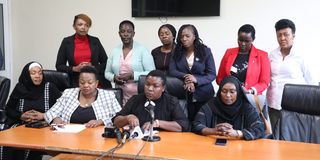
Women legislators address the media at Bunge Tower, Nairobi.

What you need to know:
A new regional assessment reveals why Kenya continues to lag, citing political-party gatekeeping, financial exclusion, online harassment and weak institutional responses to violence against women leaders.
- From digital violence to costly campaigns and party sabotage, the report exposes systemic barriers holding women back.
- Rwanda's parliament is 61 per cent female. Kenya's is just 23 per cent.
In Rwanda, six out of every 10 parliamentarians are women. In Kenya, barely two in 10 are. This stark contrast anchors a new report by the Association of Media Women in Kenya (Amwik), supported by the Friedrich Naumann Foundation for Freedom (FNF) Kenya, which finds the country trailing its neighbours 15 years after enshrining the two-thirds gender principle in its constitution.
The report, Fifteen Years On: An Evaluation of Kenya's Women Political Representation in Relation to the Two-Thirds Gender Rule, shows Rwanda leading the region with 61 per cent female parliamentary representation following its 2024 elections. Tanzania follows at 37.4 per cent, Uganda at 34.1 per cent. Kenya languishes at 23 per cent.
"Fifteen years later, the constitutional dream is still incomplete," said Amwik Executive Director Queenter Mbori at the report's launch in Nairobi on Tuesday. "The battles facing women in politics are now more intricate, rooted in digital violence, financial exclusion, and institutional sabotage."


The new-age barriers
The report identifies what it calls "new-age barriers" that have emerged alongside traditional obstacles. Weaponised online harassment now subjects women politicians to brutal social media attacks designed to silence them. Campaign costs remain exorbitant, disproportionately locking out women who lack access to male-dominated political financing networks. Political parties continue to steer women towards predetermined affirmative-action positions instead of backing them in competitive races.
"Increased access to digital spaces has amplified online harassment, with women facing trolling, defamation, and sexualised attacks at disproportionate levels," said Anne Nyokabi, former Kiambu woman representative.
The institutional response has been wanting. Survivors of political harassment rarely report cases due to fear of retaliation, lack of faith in investigative processes, and the likelihood that cases will drag past election periods. "Some women fear that reporting violence may be viewed as disloyal by their political parties, jeopardising their careers," Nyokabi added.
Inch by inch
Data from three general elections shows progress has been painfully slow. In 2013, Kenya elected no women governors or senators. By 2017, three women held each position. By 2022, the number of women governors had risen to seven, while women senators stagnated at three. The woman representative position provides an important platform, but the report cautions it was never designed to substitute for the constitutional two-thirds requirement.
At county level, the picture is equally mixed. Despite women constituting 49 per cent of registered voters in 2022, six counties—Garissa, Mandera, Marsabit, Samburu, Kajiado, and Nyamira—did not elect a single woman to key positions outside the Woman Representative seat. "Many of these counties also have strong patriarchal cultures, suggesting that socio-cultural norms remain an enduring barrier," Mbori noted.
Money and power
Economic constraints further marginalise women aspirants. Gubernatorial and presidential campaigns require billions of shillings; parliamentary and MCA races still demand tens of millions. Nomination fees imposed by parties serve as an additional deterrent. "This financial exclusion creates a vicious cycle: women remain economically disadvantaged due to socio-cultural factors, and their exclusion from political leadership limits opportunities to change those structures," the report states.
Political parties, largely controlled by male elites, exert disproportionate influence over nominations, often pressuring women to withdraw during primaries or steering them towards Woman Representative seats instead of more competitive positions.
Five failed attempts
Parliament has tried at least five times to pass legislation operationalising the two-thirds gender rule. All efforts have collapsed due to political self-interest, threats to existing power structures, and misconceptions about implementation costs.
Kenya's neighbours, meanwhile, have moved ahead. Rwanda and Uganda reserve at least 30 per cent of parliamentary seats for women. Tanzania employs proportional representation lists that mandate women candidates according to party seat share. Rwanda also requires gender equality in party leadership—a measure Kenya has yet to consider.
Calls to action
Ralf Erbel, Director of the FNF East Africa Office and Global Partnership, acknowledged persistent structural barriers while praising milestones such as the election of seven women governors in 2022. "A significant democracy requires full inclusion of women," he said, noting that their participation strengthens both the legitimacy and performance of political institutions.
Fahima Araphat Abdallah, vice chairperson of the Independent Electoral and Boundaries Commission, emphasised the critical role of responsible media coverage in shaping public perception. She reaffirmed the commission's commitment to Articles 27, 81, and 177 of the Constitution, which mandate gender balance, acknowledging that Kenya has yet to fully achieve this goal.
Hassan Omar, the secretary general of the United Democratic Alliance, was blunt: women's leadership is not a favour but a democratic obligation. Political institutions must move from good intentions to tangible implementation, including enforcing the two-thirds gender rule.
The road to 2027
The report calls for reforms ahead of the next general election: legislation establishing enforceable gender mechanisms combining direct elections with proportional representation; mandatory gender-balanced presidential and gubernatorial tickets; a stronger justice system capable of swiftly addressing political violence; stricter enforcement of gender-responsive party structures; and expanded civic education to challenge harmful socio-cultural norms.