Call for justice: 'Rider took a needle from his pocket and injected me'
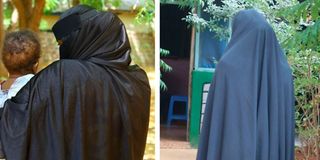
Defilement survivors during separate interviews in Garissa town and Wajir town on September 9, 2025 and September 28, 2025. They were defiled and impregnated, but their push for justice has been futile after elders used Maslaha to "settle" the cases by fining the perpetrators.

What you need to know:
- Instead of pursuing justice, elders pressured their families into Maslaha settlements, pocketing much of the money. Similar cases are widespread in northern Kenya, where stigma, cultural norms and fear keep survivors quiet while perpetrators walk free.
- Survivors in Garissa and Wajir rarely get justice because of the Maslaha system, which elders use to replace formal legal processes. Activists and judicial officers warn that Maslaha compromises witnesses and encourages perpetrators.
This story has been produced in partnership with the Pulitzer Centre.
It is mid-morning in Garissa and the unforgiving sun beats down relentlessly, forcing us to take shelter beneath a lone acacia tree. We are here to speak with Amina Hassan*, who was defiled by a tuk-tuk rider last year and left for dead. As she begins to narrate her ordeal, Amina’s voice carries the weight of trauma. She recalls being offered a lift by a man while on her way to school.
Innocent and unsuspecting, she accepted, grateful that she would arrive on time. She had no idea that the short ride would alter the course of her life forever. Amina, who hails from Garissa County, says she was shocked when the man suddenly pulled the tuk-tuk over on the roadside just minutes into the ride.


“The man then pulled me aside and ordered me to follow him into the thicket. I refused, but he covered my mouth with his hand to stop me from shouting for help. He then took a needle from his pocket and injected me. I lost consciousness shortly afterwards.”
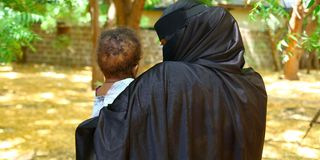
A survivor of sexual abuse with her child during the interview in Garissa town on October 28, 2025. She was defiled and impregnated by a tuk-tuk driver last year. Her push for justice has been futile as elders used Maslaha to "settle" the case by fining the perpetrator.
When she regained consciousness, Amina realised she had been defiled and the man had fled. “I had no underwear on, and I was bleeding from my private parts. I stood up and screamed for help. Well-wishers rushed to my aid and took me home, where I received first aid.”
Later, she reported the matter at a police station and the perpetrator was arrested after being positively identified. However, elders soon scuttled her quest for justice, prevailing upon her and her mother to drop the case even before it reached court. Elders in the region often use the Maslaha system, an alternative dispute resolution mechanism.
Under this system, elders, perpetrators and their families negotiate with the survivor's family to reach an out-of-court settlement. Money, cattle, goats or camels commonly change hands as supposed compensation. In Amina’s case, Sh60,000 was raised—half of which was pocketed by the elders. Her family received Sh30,000, barely enough to cover clinic visits after she became pregnant following the defilement.
Amina was in Form Three at the time. She dropped out of school because of her pregnancy and eventual childbirth. She says life has never been the same; she has become the subject of ridicule in her village and faces severe stigma and discrimination daily.
“My education was cut short and my life completely ruined. I wanted to finish my secondary education, go to university and have a bright future. My best friends have shunned me and do not want anything to do with me. I just leave everything to God,” the mother of one says.
The situation is no different for Zainab Ibrahim* from Wajir, around 300 kilometres away. When we meet her in Wajir town, 15-year-old Zainab is eight months pregnant. She says she was defiled early this year by her cousin, who lived in their home. She says he entered the room she was sleeping in and abused her.
“He forced himself on me. I pleaded with him to stop, but that fell on deaf ears. After he was done, he warned me never to tell anyone about what had happened. He said if I dared mention him anywhere in relation to what had happened, I would be dead meat,” she says.
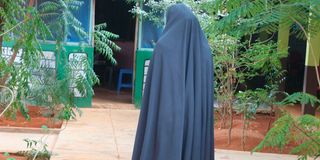
A defilement survivor during the interview in Wajir town on September 9, 2025. The girl was defiled and impregnated by her cousin early this year. Her push for justice has been futile after elders used Maslaha to "settle" the case by fining the perpetrator.
Fearing further harm, Zainab fled and found refuge in a shelter far from home. What angers her most is that she has never received justice. Through Maslaha, Sh60,000 was raised to “settle” her case before it reached authorities. Elders took Sh40,000, her uncle pocketed Sh3,000, and her mother was handed Sh17,000. The settlement barred any party from reporting the incident thereafter.
The suffering of the two girls mirrors the ordeal of countless survivors of sexual and gender-based violence (SGBV) in northern Kenya. Maslaha is widely blamed for denying survivors access to justice.
Reported cases
In Wajir, county data shows 44 defilement cases reported between January and September this year, alongside 40 rape cases. Fourteen sodomy cases were reported in the same period, and 13 incidents of intimate partner violence. The Wajir Gender Recovery Centre provides survivors with a safe space where they access psychosocial support and counselling.
The centre offers testing, counselling, medical assessment, injury management, crisis and trauma counselling, as well as HIV prevention through PEP, STI treatment and forensic evidence collection. Survivors also receive legal aid and links to police to support justice processes. Senior nursing officer Hanidiah Ahmed says they store forensic evidence securely and provide emergency contraceptives to prevent pregnancy, alongside PrEP and PEP to prevent HIV infection. The centre handles at least five cases every month, though stigma likely keeps the true number much higher.
At Garissa Police Station, 19 defilement cases involving minors aged 15 were reported between January and October. Police also recorded one gang-rape case, one attempted rape, and three cases of sodomy. In 2024, 37 sexual violence cases were reported, including 20 defilement cases, three rapes, seven gang-rapes, and one incest case.
Garissa Law Courts currently has 40 active SGBV cases. So far this year, 28 cases have been filed—25 active and three withdrawn. In 2024, 32 cases were filed, with 15 active and 13 withdrawn, and four convictions. In 2023, a total of SGBV cases were filed, with three still active and 14 withdrawn. The year saw eight convictions and one acquittal.
Gender activist Halima Bochola has long fought for justice for survivors in Wajir. She describes the situation as nothing short of a disaster.
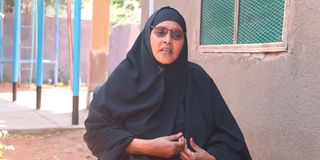
Halima Bachola, a human rights and gender activist, during the interview in Wajir town on September 12, 2025. She fights sexual and gender-based violence.
“There is a lot of defilement, rape, sodomy and domestic violence against women and girls. The sexual violence prevalence in Wajir County is high. Many such cases are not reported as the community is discreet,” Halima says. She blames elders for the rising cases, noting they often question activists’ motives: “usually ask us what we gain when we report”.
“Elders are the ones perpetuating the vices to continue by shielding perpetrators. Nothing will prevent a sex pest from violating more girls and women in the future. By contributing money for Maslaha, the clan or community is, in a way, celebrating what the perpetrator did.”
Halima adds that survivors rarely receive counselling or psychosocial support. She notes that, under Muslim teachings, pregnancy before marriage is treated as shameful, leading to girls and women who conceive after rape being labelled “prostitutes” or “loose women”.
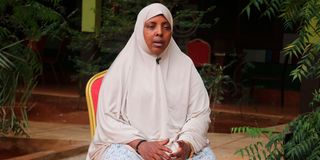
Fatuma Abdi, a human rights and gender activist, during the interview in Wajir town on September 9, 2025.
Human rights and gender activist Fatuma Abdi faults the Maslaha system for promoting mediation in sexual violence cases, terming it a grave mistake. “Maslaha is a nightmare for survivors. It is the biggest barrier to justice for women and girls. Maslaha favours masculinity and is mainly a men’s gathering,” she says.
She accuses elders of abetting crime by insisting that defilement, incest and sodomy should not be discussed openly. “Elders are making a killing from sexual violence. They are making huge sums of money from cases brought before them. Defilement and rape should not be handled by elders through Maslaha. These are criminal acts and perpetrators must be taken to court to face the law.”
She says the system tampers with key witnesses, leading to case collapse.
Mohamed Gedi, programmes and governance officer at the Arid Land Development Focus, says Maslaha is the biggest impediment to justice. “As a father of five girls and one boy, I fully support the campaign to fight gender-based violence and harmful cultural practices. As Muslims, we do not support SGBV of any form. It is against our religion,” he says.
He calls for robust community-level campaigns targeting men to promote respect for women and male involvement in ending SGBV.
Human rights activists say most defilement and rape cases go unreported because of shame, trauma, fear of losing one's virginity before marriage, and self-denial.
Wajir resident magistrate Xavier Baraka acknowledges a surge in sexual violence cases and says the Judiciary faces challenges such as witnesses being compromised through Maslaha. “We always expedite sexual violence cases by making sure the victims and all key witnesses testify and the accused is released on bond. This makes sure they are not intimidated or compromised to collapse cases,” Xavier says.
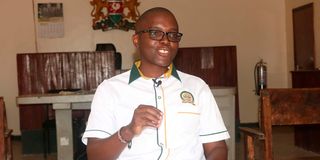
Wajir resident magistrate Xavier Baraka on September 12, 2025.
“As a result of using this method, we have witnessed reduced withdrawals touching on cases of sexual violence. In the past two years, we have had 10 convictions, two acquittals and one withdrawal, which I must say is good progress.”
Court data shows that in 2023, six cases were withdrawn because of missing witnesses—three defilement cases, one rape and two attempted rape. In 2024, 10 cases were withdrawn. Between January and September this year, five cases were withdrawn. In 2022, the court convicted seven perpetrators; in 2023, five; and in 2024, nine perpetrators were jailed.
Lawyer Stephen Wanyoike, who offers pro bono services in Wajir, says cases involving minors aged 12–18 are particularly high. “The court is serious when dealing with matters of sexual violence and most of the cases we handle lead to conviction, which has helped many survivors to get justice,” he says.
He adds that survivors and witnesses are often intimidated and compromised by family members. In the past two years, he has handled more than 10 cases; this year he has five ongoing. Over 15 years, he has handled more than 50 cases, with 80 per cent leading to convictions. One such case involved a chief sentenced to 40 years in prison for repeatedly defiling an 18-year-old girl and sharing her nude images online. The chief was also fined Sh500,000. Before the activists intervened and had him arrested, he had forced an out-of-court settlement.
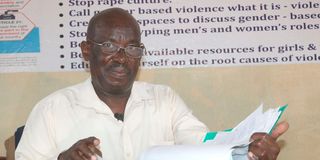
Lawyer Stephen Wanyoike in his office, Wajir town, on September 9, 2025. He offers pro-bono services to survivors of sexual and gender-based violence in Wajir.
Stephen also offers counselling to survivors to manage trauma. He points to deep-rooted cultural beliefs as a major barrier: many locals believe all issues should be resolved culturally, including SGBV cases. Cases of sexual violence have been rising in northern Kenya counties. Alongside entrenched cultural practices, rising alcohol and drug abuse are also blamed.
In Wajir East, Sub-County Police Commander Aliyow Buri says 27 SGBV cases have been reported this year—16 defilements, eight rapes and three attempted rapes. “Once we receive cases of sexual violence, we ensure the files are processed and forwarded to the DPP for approval and prosecution. The work of the police is to protect and ensure justice prevails and that the survivors fully get justice,” Aliyow says.
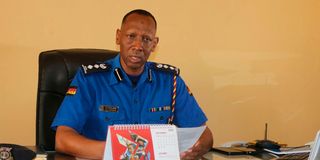
Aliyow Buri, the Wajir East Sub-County Police Commander, during the interview in his office on September 12, 2025.
Tradition and entrenched cultural norms are also blamed. Elder Mohammed Abdillahi supports activists’ efforts and stresses the need for justice. “If a girl or woman is violated, then such cases need to go to court and perpetrators face the law.”
He admits that money changing hands—often between Sh300,000 and Sh400,000—through Maslaha is common and should be stopped. “As a community, we do not support sexual violence of any form against women and girls. It goes against our religion. As an elder, I believe Maslaha should not be used to solve any sexual violence cases,” Mohammed says.
Human rights activist Muktar Dahir says Garissa has seen a spike in cases over the last six years. As chairperson of the Garissa Human Rights Defenders Network, he says about 10 cases are reported daily at the Gender Recovery Centre. He blames Maslaha. “The community is condoning the vice by protecting and shielding perpetrators of sexual violence through Maslaha. We have a clique of elders who sit under a tree and purport to settle cases. They do not care about the welfare of survivors,” he says.
He urges political, religious and community leaders to speak out firmly against SGBV. “Maslaha is the worst form of dispute resolution as it works against women and girls. The worst part is that they do not even invite the survivors to appear in those meetings to at least get to understand their pain.”
He advocates a robust awareness plan, amendments to the Sexual Offences Act to outlaw Maslaha in SGBV cases, and mandatory compensation for survivors in addition to jail time for perpetrators.
As our tour of northern Kenya ends, many survivors remain hopeful that a day will come when Maslaha will no longer be used to derail justice for crimes committed against them.
*Names of sexual violence survivors changed to protect their identities.


