Children aged 10–14 hardest hit as teen pregnancies rise in Kenya

Pregnant teenagers. The Kenya Economic Survey 2026 reveals a worrying rise in teenage pregnancies across the country. It shows a sharp increase among adolescents aged 10–14.

What you need to know:
- Kenya Economic Survey data reveals rising teenage pregnancies among girls aged 10–14 across several counties nationwide.
- Poverty, sexual violence and inadequate reproductive health education blamed for Kenya’s growing teenage pregnancy crisis.
Grace Nyanjago* was 14 when a domestic worker at Nairobi’s Kawangware home she shared with relatives forced his way into her bedroom one morning, armed with a knife, as she dressed for church.
"I was dressing up when he came to my bedroom, armed with a knife, as I prepared to go to church. He warned that if I screamed, he would end my life. Out of fear and to save my life, I remained silent as he defiled me," she said.
A month later, Grace noticed she had missed her period. A hospital test confirmed she was pregnant.


Her story is far from isolated. New government data shows that teenage pregnancies in Kenya are rising sharply, and the youngest girls are bearing the heaviest burden.
The Kenya Economic Survey 2026 reports that teenage pregnancies increased from 224,333 in 2024 to 235,938 in 2025. Among girls aged 10 to 14, the rise was even steeper, up 14.6 per cent, with 11,605 cases recorded in 2025 compared to 11,126 the previous year. In 2023, the figure stood at 10,670, itself a drop from 13,034 in 2022.
Nairobi leads all counties in reported cases. The counties with the highest numbers are Nairobi (14,291), Kakamega (11,835), Narok (10,934), Bungoma (10,443), and Migori (8,663). Those with the fewest are Elgeyo Marakwet (2,111), Samburu (2,172), Laikipia (2,892), and Nyamira (2,982).
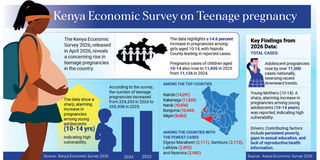
The survey points to poverty, gaps in sexual education, and limited access to reproductive health services as key drivers of the crisis, with many cases surfacing only at first antenatal visits.
Kenya ranks third globally in teenage pregnancy rates. About one in five girls aged 15 to 19, roughly 18 per cent, are either pregnant or already mothers. Each year, more than 13,000 girls drop out of school due to pregnancy. Cultural practices, sexual abuse, and inadequate sex education all contribute to the problem.
Ivy Muriithi, founder of True Care Newday Centre, a community-based organisation in Dagoretti, Nairobi, says the situation has reached crisis level. Established in 2023, the centre has supported 98 girls who have experienced sexual violence and become pregnant as teenagers.
"It is a crisis that needs to move to action because a lot has been said about it, but little seems to be done," she said.
Evelyne Bowa, a teenage counsellor and girls' mentor, attributes the rise to a lack of reproductive health information and inadequate access to family planning products.
Globally, Unicef estimates that about 21 million girls aged 15 to 19 become pregnant in developing countries each year, with nearly 12 million giving birth.
Kenya has made some progress. The Kenya Demographic and Health Survey 2022 showed a decline in teenage pregnancy rates from 18 per cent in 2014 to 15 per cent in 2022, though significant disparities persist across counties. Access to family planning has also improved, with modern contraceptive prevalence rising from 39 per cent in 2014 to 58 per cent in 2021, but advocates say this is not enough.
*Name changed to protect privacy.


