Christmas without celebration: The widows of Kapedo and their daily battle against hunger
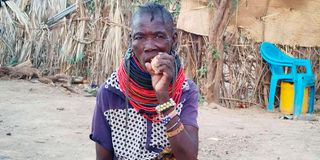
Limangole Ekiru, 65, crashes a wild fruit she harvested for supper at a river in Kapedo, Suguta Valley, on December 16, 2025. Her husband was shot dead by armed criminals in 2009 while grazing livestock, forcing to her take care of their eight children. Three of the children later died of hunger-related diseases.

What you need to know:
- In Kapedo village on the Turkana–Baringo border, Christmas has arrived without celebration as widows of banditry victims struggle daily to find food, years after violence destroyed their families and livelihoods.
- Although relative peace has returned to the Suguta Valley following government intervention and support from Interpeace, hunger remains the dominant reality for families who abandoned livestock farming following repeated attacks.
Christmas has come to Kapedo, but there is nothing to celebrate. No feasts are being prepared. No new clothes have been bought. In this dusty border village straddling Turkana and Baringo counties, the festive season has arrived quietly, almost unnoticed, for the widows still living with the scars of decades of banditry.
At around 5pm on Tuesday, as families elsewhere in the country prepared for the holidays, Limangole Ekiru finally reached home after a punishing day's work. On her back hung a three-litre container of water. In her hands, she carried a bundle of wild fruits wrapped in nylon paper—the only meal her family would eat that evening.

Limangole Ekiru, 65, crashes wild fruits for supper in Kapedo, Suguta Valley on December 16, 2025. Her husband was killed in 2009, and three of her eight children later died from hunger-related illnesses.

The 65-year-old had been walking since dawn, covering more than 10km to collect palm fronds from a river in the neighbouring Adoket Adome village. She would later craft them into brooms for sale. It is gruelling work, often under a scorching sun, but it is all she has.
For the mother of eight, this has been her routine ever since relative calm returned to the bandit-prone Suguta Valley a year ago. Life in Kapedo may now be less deadly. But for widows like Ekiru, whose families were shattered by violence, survival remains a daily struggle. The hardest battle, they say, is no longer gunfire. It is hunger.
While the rest of Kenya prepares to mark the birth of Christ, these women will spend the season as they spend every other day—searching for food, crafting brooms, and praying for buyers.
Ekiru's ordeal began in 2009 when her husband, Francis Ekiru, was ambushed and shot dead by armed criminals while tending to their goats. The raiders stole more than 30 animals, wiping out the family's primary source of livelihood. In the years that followed, tragedy compounded. Her husband's three brothers were killed in separate attacks.
Left without a husband or livestock, she turned to selling firewood at Kapedo shopping centre. But renewed bandit attacks soon made even this dangerous. The community could no longer venture into the bush, forcing families to rely on scarce government food rations that were rarely enough to survive.
"My husband was brutally killed by armed criminals 16 years ago while grazing livestock. They took everything we had. I was left a widow and my children orphaned," Ekiru recalls when we meet her.
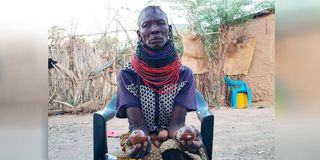
Limangole Ekiru, 65, displays wild fruits she harvested for supper at Kapedo, Suguta Valley, on December 16,2025.
Three of her children later died from hunger-related illness. Three others dropped out of school because she could not afford fees. The rest married young. "Most nights, we went to bed on empty stomachs," she tells Nation. "I feel abandoned. My husband, his brothers, and my children were all taken from me. I live one day at a time because farming is impossible here due to erratic rains."
Her survival strategy offers no respite. She collects palm fronds each morning and hopes she can sell enough brooms to feed her family.
"We rely on food aid from the government and well-wishers, which does not come regularly. When it gets depleted, we sleep hungry. During dry spells, it gets worse," she says, her voice breaking.
This Christmas will be no different.
A chief's widow
Next door, Lilian Ejore, 38, faces a similar struggle. Her husband, Henry Ejore, was a local chief. He was killed in January 2017 while defending villagers from a bandit attack in neighbouring Lomelo. Tens of bandits had raided the village that day, stealing livestock. Ejore, alongside security officers, tried to repel them. He was shot dead along with two other villagers.
Following the attack, Lilian fled to Kapedo with her four children. Life has been extremely difficult ever since. Her husband had been their sole provider. "I have been forced to make brooms to feed my children, but we can only venture out when there is calm," she says.
Despite repeated trips to Lodwar and Nairobi seeking compensation for her husband's death, she has received nothing. She relies on bursaries to send her children to school and a Sh2,000 monthly widow's stipend, but it is never enough. She sells each broom for Sh15, with no guarantee of finding a buyer on any given day. "We have been scarred by banditry for years. Peace has returned for now, thanks to government and Interpeace efforts, but we need help to rebuild our lives," she says.
For Lilian and her children, the festive season will pass like any other week—marked not by celebration, but by the search for the next meal.
Denied even a stipend
Epuyi Long'or, another widow in the village, lost her husband when bandits ambushed a lorry carrying livestock from Nakuru to Kapedo. At the time of his death, she had a one-month-old baby and six other children. "He was our only provider. I had to find work washing clothes, but it is never enough," she tells Nation.
Long'or has been denied the monthly widow's stipend because local records had reached capacity, she claims.
A valley of graves
For decades, Kapedo and the surrounding areas have borne the brunt of banditry, resulting in deaths, displacement, and destroyed livelihoods. Graves line the outskirts of the village, many belonging to residents killed in raids by gunmen often suspected to come from neighbouring communities.
Boundary disputes between the Pokot and Turkana communities over an 18-acre piece of resource-rich land have fuelled repeated conflicts. Hundreds of residents, including security officers, have been killed over the years. Almost every family in Kapedo has lost a relative to the violence. Like many families in Kapedo, locals have largely abandoned livestock farming due to repeated thefts and killings of herders. Families are left facing chronic hunger, school dropouts, and early marriages for their children.
Suguta Sub-County Deputy County Commissioner Njuki Nazario Kithii confirmed that local residents have largely stopped keeping livestock and now rely on government food aid, which is insufficient. "Normalcy has returned, and we are making strides in peace-building. But people cannot farm in this arid area. The county government must ensure sustainable food and water supplies," he tells Nation.
Peace efforts by the government and organisations like Interpeace have reduced violence over the past year. But for these widows, everyday life remains a struggle—the battle against hunger.


