Clean cooking mirage: Why women are taking matters into their own hands
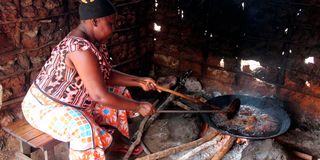
Tabu Taura (Mama Sadiki) fries fish at her business in Mavueni, Kilifi County, on August 27, 2025. She has relied on firewood for over two decades as the most affordable way to sustain her business. Two years after climate summit pledges, rural women like Tabu create own solutions as affordability barriers persist.

What you need to know:
- Kenya pledged universal access to clean cooking by 2028 at the Africa Climate Summit, but two years later she has heard of no government campaigns on this commitment.
- However, women in low-income settlements continue finding their own energy solutions without government support.
Until 2022, Jane Muthoni relied on charcoal as her only affordable cooking fuel. Living in Nairobi's low-income settlement of Kawangware, the church volunteer's weekly stipend was too small to buy Liquefied Petroleum Gas (LPG) or pay for refills.
That changed in March 2022 when she met a non-governmental organisation that taught her and other women how to make briquettes from organic waste such as sawdust and charcoal dust.
"I'd use Sh200 a day on charcoal, but since I learnt how to make the briquettes, I have cut that cost," she says.


"I use Jikokoa and with five briquettes I can prepare supper, lunch and breakfast. With ordinary charcoal, you have to add more just to fry vegetables after cooking ugali. A two-kilogramme tin of briquettes costs Sh100 and contains more than 10 pieces. That's a huge saving."
While scientists do not classify briquettes as clean cooking fuel, for Jane they were a lifeline. Her discovery came a year before Kenya joined other African nations in making a related commitment during the inaugural Africa Climate Summit, held in Nairobi from 4 to 6 September 2023.
Two years later, with a second Africa Climate Summit just concluded in Addis Ababa, she has not heard of any government campaign on the commitment.
Also read: Billions for climate resilience, but women, youth and persons with disabilities left behind
In Nairobi, African leaders pledged to "promote clean cooking technologies and initiatives for just energy transition and gender equality for African rural women, youth, and children."
Long before that declaration, the Ministry of Energy and Petroleum had commissioned the development of the Kenya National Cooking Transition Strategy in September 2022. Unveiled in 2024, a year after the summit, the 2024–2028 strategy set out the government's aim to achieve universal access to clean cooking by 2028.
The strategy seeks to bridge the supply gap for clean cooking solutions by leveraging the proximity of public institutions to households. It aims to develop a clean fuels supply chain, mainly bioethanol, biogas, pellets, electric cooking and LPG.
Of particular relevance to women is the government's plan to estimate total energy demand across public institutions, then group them into demand clusters to create economies of scale that will attract private sector interest. It would then competitively tender to identify the least-cost option per cluster, while ensuring that a third of the slots are allocated to women- and youth-led enterprises.
Progress unclear
The extent of the government's follow-through on this commitment remains unclear, owing to the absence of a publicly available progress report on the gender and climate-related pledge.
President William Ruto's report, *From Nairobi to Addis Ababa: Africa's Journey of Climate Action and Partnership*, which offered reflections on progress since the inaugural summit in 2023, made no reference to Kenya's progress on this particular commitment.
However, in a detailed response to queries, the Ministry of Gender said Kenya had moved from "pledge to policy." It cited the finalisation and launch of the Kenya National Cooking Transition Strategy, the drafting of the National Energy Compact (2025–2030), and growing public–private partnerships to scale up clean-cooking distribution and awareness campaigns, especially in rural areas.
The ministry pointed to progress in embedding gender-responsive programming in multilateral and donor-supported projects, which now prioritise women's and youth entrepreneurship in the clean-cooking value chain. It also highlighted training programmes for women sellers and technicians.
The ministry noted that Kenya's efforts are linked to continental initiatives under the Nairobi Declaration and African Union briefs, with lessons from pilots being shared regionally.
Also read: The deadly cost of traditional cooking
Still, the ministry admitted to persistent gaps: financing bottlenecks, weak last-mile markets, affordability barriers for poor households, and limited gender-disaggregated monitoring of progress.
"Achieving transformational, gender-equitable impact for rural women, youth and children requires faster finance disbursement, stronger last-mile markets, targeted affordability measures, and rigorous gender-disaggregated monitoring," the response stated.
Some progress may be happening on the ground. Gachambi Njuki from Lari in Kiambu said she was recently engaged by the Kenya Industrial Research and Development Institute (KIRDI) in a study involving Gastov Cookstove.
Although the commercial farmer's primary source of cooking fuel is LPG, her secondary fuel remains firewood.
On December 20, 2024, Kirdi posted on Facebook that it had "proudly handed over Gastov Cookstoves to Lowaki, an incredible organisation dedicated to empowering women and promoting sustainable living."
The public research institution described the stove as one designed to utilise multiple fuel sources such as briquettes and pellets, reduce fuel costs, promote cleaner and healthier cooking, and contribute to environmental conservation.
Climate justice actors dismiss the Nairobi Declaration on Climate Change and Call to Action as little more than rhetoric with no firm ground for implementation.
"When you make a declaration, and it has no timeframe, no means of verification, no deliverables, it becomes just a statement," said Jonathan Kapanga, Country Chair of the Africa Faith Actors Network on Climate Justice.
"We want to see clear targets within a set period and ways to measure them. Are we targeting rural folks, who face the daily effects of climate change, or just holding forums in the city? What is the real impact on those most affected?"
Pan African Climate Justice Alliance Executive Director Dr Mithika Mwenda added that the failure to anchor gendered realities in climate action is part of a bigger problem of addressing issues in isolation.
"When we are talking about adaptation, and addressing climate action in its real sense, in delivering our commitment to national economic contributions, and particularly in countries' national adaptation plans… we address these things in isolation," he noted.
"We are promoting decentralised, people-owned, community-controlled, affordable energy systems, where, for instance, you can mount a solar-powered borehole in a village. That way, women can extract that water, irrigate their crops cheaply, and then they can grow food and achieve nutrition without necessarily worrying about external disruptions. These are issues of systems change."
In the draft declaration from September 8 to 10 Addis Ababa Climate Summit, African leaders commit to promoting gender equity in the mining sector.


