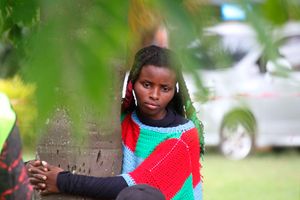
Cry for help, then death: How system failure resulted in girl’s suspected murder by boyfriend
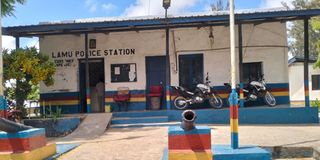
The Lamu Police Station where the boyfriend, Bwanaidi Ramadhan,19, suspected to have murdered Khadija ALI Jiba is being held.

What you need to know:
- Sixteen-year-old Khadija Ali Jiba repeatedly warned her family and teachers about violence from an older boy. Reports were filed. Threats were documented. Authorities failed to act. Three weeks after completing her national exams, she was found murdered.
- This investigation exposes the layers of negligence that enabled her death. Khadija’s killing in Lamu was not a sudden tragedy—it was the culmination of ignored police reports, unaddressed school warnings, and a community accustomed to informal justice. Death reveals the deep cracks in Kenya’s child protection system and the gender norms that silence girls long before harm occurs.
- None of the institutions meant to protect her intervened, hence her death highlights systemic failure and the urgent need for stronger, coordinated responses to violence against girls.
The headscarf was still tied around her neck when they found her. Blood seeped from Khadija Ali Jiba’s mouth and ears. She was lying face-down in a thicket, just 200 metres from home—close enough that her mother could have called out her name.
Three weeks earlier, the 16-year-old had sat her Kenya Primary School Education Assessment alongside 3,497 other candidates in Lamu County. She should have been celebrating, preparing for secondary school, dreaming about her future. Instead, her family was preparing for her burial.
The preliminary report suggested suicide. The postmortem revealed a different truth: defilement, strangulation, signs of a violent struggle, and a broken hand. At the centre of the investigation stood 19-year-old Bwanaidi Ramadhan—the boy Khadija’s family had been warning authorities about for months. Everyone knew. No one stopped it.

The pattern
Khadija and Bwanaidi met in mid-2024 in the Jamhuri-Mkunguni area of Mokowe in Lamu West. She was in Grade Five at Mkunguni Comprehensive School. He was in Grade Eight at Mokowe Comprehensive School. Their homes were separated by a 20-minute walk.
Early this year, as both prepared for critical examinations—Khadija for the KPSEA and Bwanaidi for the Kenya Junior School Education Assessment (KJSEA)—parents, elders, and school administrators intervened to separate them. The intervention backfired.
According to Khadija’s family, he began forcibly taking the girl from her parents’ home and keeping her for days before returning her at will. He would waylay her at the water pond, grab her at the trading centre, and wait for her father to leave for night shifts at the Kenya Wildlife Service office where he worked.
“I wanted my daughter to pursue education to the highest level,” says Ali Jiba, Khadija’s father. “Once I got wind of her relationship with the boy, I went to his parents and asked them to tell him to leave my daughter alone. That fell on deaf ears.”
The boy continued visiting at night, taking Khadija away and returning her early in the morning before her father got home. Khadija’s elder sister, Fatuma Ali Jiba, received numerous complaints about beatings. In September, when Khadija refused to spend the night at Bwanaidi’s homestead, he snatched her mobile phone. When Fatuma intervened, he assaulted her.
“Bwanaidi slapped me. He tore my dera and headscarf and left me with bruises on my face,” Fatuma recalls. “He then took a panga and sliced my sister’s phone into two pieces as we watched helplessly.”
Fatuma reported the incident at Mokowe Police Station. No arrests were made.
School raises the alarm
At Mkunguni Comprehensive, head teacher Athman Twalib watched Khadija’s grades plummet. Once among the school’s top candidates, she withdrew into silence. Guidance and counselling failed. Her absenteeism worsened.
In early October, Khadija missed school for four days. Her parents said they did not know where she was. Twalib reported the matter to police. She resurfaced. “That’s when I realised she had again eloped with the boy,” he says. “When the boyfriend realised I was pursuing the matter, he visited my school twice and threatened me. I informed the area chief and the parents before reporting to Mokowe Police Station under OB NO 14/16/10/2025.”
Still, no arrests were made. On October 29, Khadija completed her KPSEA examination. Five days later, Bwanaidi completed his KJSEA. Three weeks after that, she was dead.
Five days before her body was found, he had taken her to his rented residence in Mokowe town. Their last known sighting was on Wednesday, November 19, at Mokowe Jetty. They were heading to Lamu Island for the 23rd Lamu Cultural Festival, which took place from November 20–22. On Monday—two days after the festival ended—he told Khadija’s family she was missing.
Fatuma and their mother, Hashora Msuo, grew suspicious. They visited his home, and together with his mother, Zena Omar, searched the area before notifying police. This time, officers acted. They arrested him. After interrogation, he led them to Khadija’s body, deep inside the bush. The postmortem conducted on November 26 ruled out suicide.
“As per the postmortem report, Khadija was defiled and strangled to death. There are indications of struggle, with part of her hand broken,” says County Police Commander Shadrack Ruto.
Bwanaidi remains in custody as the prime suspect. “We shall move to court next week to ask for more days to conclude investigations, including DNA testing. If the boyfriend is found culpable, we shall present him in court to face murder charges.”
The failures
Mohamed Abdalla, an elder at Jamhuri, is blunt: police negligence enabled this tragedy. “The school administration and the family filed numerous complaints at the police station, but not a single day was the perpetrator arrested,” he says.
Sammy Karisa, the assistant chief in Mokowe, admits he had handled more than three theft-related and indiscipline cases involving the suspect. “Twice or thrice, I’ve summoned the boy and his parents to my office,” he says.
Lilian Malika Kofa, chair of Lamu’s Hindi Division Kenya Primary Schools Head Teachers Association, holds the entire system accountable—parents, local administration, human rights groups, and police.
“Red flags were all over, reports were filed, but no arrest was made until death happened,” she says. “All the failed systems need to be held accountable. Let tangible action be taken to prevent future tragedies.”
Juma Boga, County Children Services Coordinator, says Khadija’s parents had not exhausted all available options. The children’s department only learnt of the case days after her death.
After engaging the local administration and police, the family could have escalated the matter to the children’s office and the county commissioner, Boga notes. “Notifying the children’s department early enough would have helped fast-track processes to have the girl protected and the perpetrator apprehended.”
He emphasises that at 16, Khadija was a minor, and the alleged boyfriend was committing defilement—a serious criminal offence. Boga says the family also failed to pursue relocation. “Had the girl been rescued and relocated to a safer environment far from the troubling partner, that would have prevented her death.”
A safe house for survivors of sexual and gender-based violence was established in July 2022 at Mokowe Health Centre, funded by Kenya Ports Authority at Sh6 million. Khadija’s village falls within Mokowe, meaning access would have been straightforward.
The wider crisis
Ramadhan Babo, the suspect’s father, describes his son as a “cool guy,” the second-born in a family of four. He insists on his innocence. “The two were in love. Every time we advised them to part ways and focus on education, they didn’t listen,” he says.
He claims the girl sometimes sneaked out to stay with his son and even threatened to harm herself if forced to return home. He prays for fair investigations.
Women’s rights groups in Lamu have, for the past five years, recorded five to 10 cases of violence against women each week. Most victims refuse to report. Raya Famau, Executive Director of Lamu Women Alliance, cites harmful gender stereotypes, patriarchal attitudes, and stigma that silence survivors. “Many women and girls prefer silence due to fear of social stigma, outdated norms, economic instability, and societal repercussions,” she says.
Without strong support systems, survivors may feel compelled to return to their abusers “for economic stability”.
Haji Shee Mbwana, Lamu Field Coordinator for Muslim Women Advancement of Rights and Protection, condemns informal justice systems that shield perpetrators. His organisation provides psychological support, legal advice, and documentation to survivors seeking justice.
Andrew Masama, chair of the Kenya Counselling and Psychological Association in Lamu, says Khadija’s case illustrates the dangers of early dating. A World Health Organisation study published last year in The Lancet Child & Adolescent Health shows that 29 per cent of girls aged 15–19 in Kenya have experienced physical and/or sexual violence, with 23 per cent having experienced it in the previous year.
Toxic, controlling relationships in adolescence, Masama notes, lay the groundwork for dangerous patterns in adulthood. He urges parents to be open, genuine, and approachable when discussing romantic relationships with teenagers, stressing that Khadija’s case required expert psychological intervention.
“Teenagers are at a crisis age that needs utmost care. Teens view parents as protectors and disciplinarians. Direct confrontation makes them feel unwanted. It’s an age that feels it knows everything, hence the rebellious attitude.”
Child and adolescent psychiatrist Annette Obiero stresses the importance of close parental monitoring. Adolescence shapes adult trajectories. Early exposure to dating violence brings harmful consequences — low self-esteem, depressive symptoms, psychiatric disorders, drug abuse, risky sexual behaviour, and low academic performance.
Parents, she says, must talk early about healthy relationships, consent, respect, and boundaries. According to the 2022 Kenya Demographic and Health Survey, more than 40 per cent of women experience intimate partner violence.
On Monday, November 24, at around 6pm, Khadija Ali Jiba’s body was found. She had complained to her sister and mother many times. Her sister had filed a police report in September. Her school had raised concerns repeatedly. Her teachers had reported threats. The assistant chief knew the boy was troublesome. The reports were filed. The warnings were given. The red flags were everywhere. No one stopped it.