Devolution’s broken promise: Minimal support for women and girls across counties
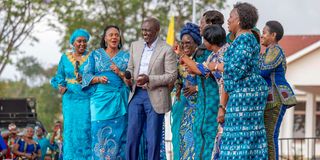
President William Ruto joins women leaders from Nyanza in a dance ahead of the the Devolution Conference, at Homa Bay State Lodge on August 12, 2025.

What you need to know:
- Despite managing billions, counties allocate negligible funds to gender programmes, undermining women’s empowerment and inclusion efforts.
- Women’s programmes suffer chronic underfunding as counties neglect gender-responsive budgeting despite constitutional equality obligations.
Counties have managed billions of shillings since devolution began, yet many allocate little— and in some cases nothing—to programmes targeting women and girls.
A recent analysis of the impact of devolution on women and girls, prepared by the Council of Governors’ (CoG’s) Gender Committee with support from UN Women and the UN Capital Development Fund, shows that gender departments often receive minimal funding, making it difficult to implement planned interventions.
Previous interviews with gender executives in Kiambu, Turkana, Kajiado, and Bungoma reveal similar concerns: gender is not prioritised in budgeting. In one county, an official said she worked for a year without a budget to attend to women’s empowerment events. She relied on donor support, occasionally using her own funds without reimbursement, before eventually requesting a transfer to a better-resourced communications department.

In 2020/21, Busia received Sh6.11 billion as its equitable share of the national revenue, Sh761.84 million in conditional grants, and Sh322.56 million in own-source revenue, totalling Sh7.19 billion. Despite this, there was no direct allocation to women- or girl-specific interventions, even though the county identified challenges such as vulnerability to HIV/Aids, early marriage, rape and defilement. The gender department received just 1.77 per cent of the budget.
Between 2013 and 2017, Garissa received Sh31.38 billion but allocated only 1.51 per cent to gender, social services, and children—the lowest among all departments.
In Kajiado, the 2013/14 approved budget was Sh3.76 billion, yet there was no documented allocation to gender mainstreaming. In 2020/21, with Sh8.86 billion available, gender, social services, culture, tourism and wildlife received Sh147.86 million, of which only Sh4.09 million was for gender mainstreaming.
Mandera’s 2020/21 budget was Sh12.72 billion, but the department responsible for gender received Sh188.14 million, just 1.42 per cent of the total.
The CoG committee notes that the absence of dedicated budgets undermines efforts to address women’s and girls’ needs. “Inclusion programming requires availability of budgets for effective implementation,” the report states.
It attributes the funding gaps to limited political goodwill and a lack of understanding of gender-responsive budgeting (GRB) techniques. The National Gender and Equality Commission developed GRB guidelines in 2013 and reviewed them in 2018 to include county governments, but these have not been fully adopted by counties.
As a result, many gender departments depend heavily on development partners, leaving interventions vulnerable to external funding priorities. The committee recommends that “every county establish a well-resourced gender department in terms of human and financial resources. This will enable county governments to comply with the gender equality, diversity and inclusivity principles provided by the Constitution and the County Government Act.”