From child marriage to the classroom: Samburu elders back girls’ education, declare war on harmful practices
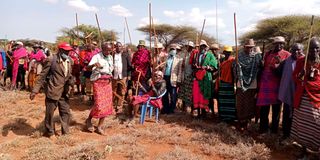
Elders perform a special ritual in the Ngilai area, Samburu County.

What you need to know:
- Samburu elders have vowed to end child marriage and FGM and ensure every child remains in school.
- Elders across Kenya are turning against harmful cultural practices and championing education for girls.
Charity Nasieku* was the youngest in a family of nine children. Born in Suguta Murmur, about 45 kilometres from Maralal town, she loved going to school and playing with her friends at weekends as they looked after livestock.
However, her life suddenly changed in 2022, when she was about to turn eight. Charity remembers that one evening after school, her father took her aside for an “important conversation”. She recalls her father telling her that she was growing into a woman and would soon start a family of her own. He added that, from the next day, she would no longer go to school but remain at home to take care of household duties.
Heartbroken, she remembers pleading with her father to let her go back to school, but he refused, citing cultural expectations. “I spent months out of school, looking after cattle and helping my mother around the house,” she recalls.

During this period, older men came to the family home each day, bringing gifts and asking to meet her. Charity did not know that the men were frequenting her home as suitors seeking her hand in marriage. Of the five who showed interest, a 72-year-old man emerged as the successful suitor, making her his fourth wife.
As the culture stipulated, Charity first underwent female genital mutilation (FGM) before she was married off. With that, Charity’s thirst and quest for education came to an abrupt end.
Rescued and sheltered
She was, however, lucky to be rescued a few weeks later and taken to a safe house, where she was enrolled in a nearby school. Her experience mirrors that of many girls in Samburu who have to grapple with child marriage and FGM at the expense of their education.
However, the plight of these girls could soon end, following a declaration by elders. The Samburu Council of Elders Association (SCEA) earlier this week vowed to end child marriage and directed that every child be enrolled and retained in school. The elders regretted that many girls in Samburu remain out of school, a situation they noted fuels child marriage and perpetuates the cycle of poverty.
The elders said those marrying off underage girls will no longer be allowed to hide behind culture. Speaking at Kisima Springs in Samburu Central, SCEA patron Richard Leiyagi said Samburu children have been left behind in education, with many of them, especially girls, out of school because of child marriage, FGM and poverty.
“This is a warning to all men, women and elders who hide under culture to marry off girls as young as 10 years that SCEA has declared an end to this harmful practice. All our girls must be taken to school to pursue education just like other girls from other parts of the country,” Mr Leiyagu said.
Kisima Springs is a deeply revered, sacred community site where traditional elders gather for major cultural oaths, prayers and historic social declarations affecting the community. Samuel Lolkitekui, an elder championing girls’ education, has built a name for himself by fighting harmful cultural practices and promoting girls’ education.
He says he decided to champion girls’ education by leading efforts to rescue those trapped in harmful cultural practices such as child marriage and FGM after seeing the suffering they were undergoing. “I journeyed widely as a civil servant across the nation and gained a wealth of knowledge and experience. I observed how our community was lagging behind because of outdated cultural traditions that were affecting our girls and depriving them of education.”
The retired police officer says he vowed that none of his daughters would be subjected to the cut or child marriage, or fail to go to school. “I stood firmly against the culture of FGM and chose education for my daughters instead. They have all completed university and are now working. I also encouraged my brother to do the same, which he did. All his daughters have also gone to school and are working in various fields.”
Since then, he has also been educating other men about the dangers of FGM, child marriage and denying girls an education. Together with other elders and male champions, they visit schools, churches and public gatherings across the county to raise awareness of these harmful practices and the law.
“Our efforts have helped hundreds of girls, including those from Suguta Marmur, avoid FGM and child marriage and pursue their education. We now have a high number of girls in our schools.”
In Samburu, girls’ education remains low. Recent statistics from the Kenya Demographic and Health Survey show that the proportion of girls in primary school has persistently stagnated at around 40 per cent of total enrolment. The data further shows that only 18.4 per cent of women in the county have attained secondary-level education or higher.
The completion rate for young women aged 20–24 stands at 26.7 per cent, compared with 54.2 per cent for young men. Samburu is among the few counties that failed to reach the national benchmark. Eighty per cent of counties achieved a primary completion rate of 70 per cent or higher for girls.
Education retention is heavily affected by the county’s 50 per cent teenage pregnancy rate among girls aged 15–19, one of the highest in Kenya; the FGM rate affecting 75 per cent of girls over the age of 15; and a high rate of early childhood marriage at 35 per cent.
In recent years, elders from different communities have denounced decades-long retrogressive traditions that disempower girls. The Supreme Council of Sabaot elders last year denounced FGM and child marriage and committed to supporting government efforts to end the practices and promote girls’ education.
The elders further committed to protecting their daughters from physical, emotional and psychological pain. Sosi Ndiwa, chairman of the Sabaot Supreme Council of Elders, said they would support efforts aimed at enhancing girls’ education. “We are committed to supporting girl-child education by making sure girls go to school and acquire education to make them equal to their male counterparts,” Mr Ndiwa said.
Last November, Maasai councils of elders from Narok and Kajiado also denounced FGM and child marriage and committed to supporting girls’ education. They linked these harmful practices to school dropouts and early child marriages, committing instead to keeping girls in school and supporting equal educational opportunities.
Musa Sayo, an elder, says they are at the forefront of championing girls’ education to improve enrolment. “We must encourage girls’ education if we want them to develop like the others. Girls’ education is changing the community. Our girls and women are now engaging in business and farming, which was unheard of before. As men, we are now involving women in decision-making at home.”
According to a study by the Maasai Girls Education Fund, an organisation working to increase literacy, health and the economic well-being of Maasai women, about 48 per cent of school-age Maasai girls enrol in primary classes, an increase from under 20 per cent in past generations. Only five to 10 per cent of those enrolled advance to secondary education, while only one per cent proceed to college or university.
Josephine Naramat, a gender activist in Samburu who escaped child marriage after refusing to undergo FGM, has welcomed the move by the elders to ban the outlawed practice and instead support girls’ education. “At least we can now see some positive change from the elders, something we have been hoping for a long time. As custodians of culture, their word is final and we expect it to have a lot of impact on the ground.”
Josephine says the move will help many girls gain access to education. “Child marriage has been the biggest impediment to girls’ education. The move by the elders to ban it is good news and a step in the right direction.”
*Name changed to protect the identity of the survivor of harmful practices.