From 'mjengo' woman to top contractor: How Rebecca Cherop is defying stereotypes
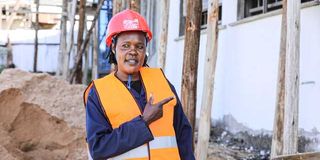
Rebecca Cherop at an upcoming women’s hospital in Kapenguria town, West Pokot, on April 9, 2026. Rebecca is one of the few women contractors in the county.

What you need to know:
- Rebecca Cherop’s journey highlights resilience, breaking barriers in construction and empowering more women to enter the sector.
- Women in construction are rising, driven by opportunity, training, and government procurement support programmes.
When Rebecca Cherop completed her Kenya Certificate of Secondary Education in 2000, she had hoped to join college. Her parents, however, could not afford the fees. Left with few options, she took up casual labour on construction sites to raise the money herself.
"I worked as a casual labourer on several school construction sites. I actually loved the job. I was able to get money for my college fees," she says in an interview in Kapenguria town.
The work did more than put her through school; it sparked a passion for building and construction. Rebecca went on to pursue a diploma at Kitelakapel Technical Training Institute and has since built a career that cuts through gender and cultural stereotypes to make her one of the leading contractors in West Pokot, in a sector that remains male-dominated across Kenya.


After working for several years as a mason and foreman, she registered her own construction company in 2009.
"Since 2009, I have been in the construction industry. It's a good industry to be in, but not easy for a woman, more so because of gender stereotyping by people who don't think women should be in construction," she says.
Today, through one of the companies in which she is a director, Rebecca is undertaking a Sh100 million, 40-bed capacity women's hospital in Kapenguria for West Pokot County. She has also handled schools, ablution blocks, dispensaries, and roads. On her sites, she prioritises hiring qualified women plumbers, masons, electricians, and carpenters, aiming to encourage more women into the industry.
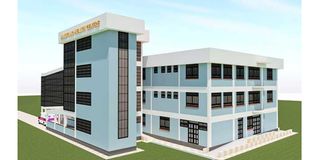
Artistic impression of the upcoming West Pokot’s Women’s Hospital in Kapenguria town. The hospital has facilities like ICU, maternity wards, delivery room, and delivery theatres, among others.
She notes, however, that a skills gap remains, with women lagging in technical and vocational training in areas such as plumbing, masonry, painting, carpentry, and electrical installation.
"I ensure 50 per cent of casual labourers who do not require specialised training on my construction sites are women. We also have many women making food for the workers and others fetching water," she says.
The path has not always been smooth. In Pokot culture, she says, gender stereotyping remains deeply entrenched, and women in the industry often face open hostility.
"In some of the forums, men verbally attack us, saying they do not know what women are doing in the construction industry instead of being in the kitchen," she says.
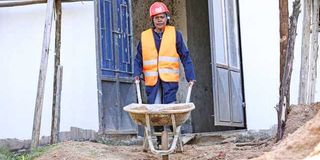
Rebecca Cherop, a contractor in West Pokot, pushes a wheelbarrow with sand on construction site in Kapenguria town on April 9, 2026. Rebecca is one of the few women contractors in West Pokot.
Competition for government and private sector contracts adds another layer of difficulty. Construction is capital-intensive, and women are often at a financial disadvantage. Rebecca says financial stability is critical to winning and executing projects.
Despite the 30 per cent rule requiring public contracts to be awarded to women, youth, and persons with disabilities, women still struggle to access these opportunities. She is calling on both the national and county governments to adhere to the rule and to support women contractors through Access to Government Procurement Opportunities (AGPO).
Rebecca is a beneficiary of the United Arab Emirates Strategic Partnership Framework (UAE-SPF) programme run by UN Women in Kenya, which supports women entrepreneurs through capacity-building on gender-responsive procurement, women's empowerment principles, and access to finance and trade. She says the training was an eye-opener, particularly around e-procurement.
UN Women commitment
"Before the training, I did not know anything about e-procurement. Now I can register for AGPO, where another woman contractor and I have been able to get two contracts," she says.
Antonia N'Gabala Sodonon, the UN Women Representative in Kenya, says the organisation is committed to advancing women's economic empowerment as a pathway to gender equality.
"Gender-responsive procurement creates enabling ecosystems for women entrepreneurs and women-owned businesses to thrive, compete, and drive economic development. The UAE-SPF programme provides much-needed momentum by expanding economic opportunities for women entrepreneurs in Kenya, including through making procurement policies and practices more gender-responsive," she says.
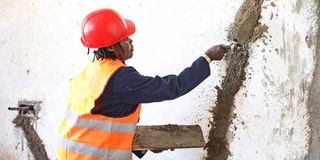
Rebecca Cherop plasters a wall at an upcoming women’s hospital in Kapenguria town on April 9, 2026. Rebecca is one of the few women contractors in West Pokot.
Stephen Kapel, head of procurement in West Pokot, says the county has met the AGPO threshold, with at least 14 per cent of contracts awarded to women. He notes that women make up the majority of suppliers in county hospitals, with some undertaking road and hospital projects. He does, however, point to the decline of LPO financing by banks as a challenge that has locked many women out.
He stresses the need for greater awareness around AGPO and gender-responsive procurement so that more women understand their rights and opportunities.
"As a county, we are not doing badly, though more needs to be done. We have, however, been having challenges with e-procurement, which is web-based, locking out women with no access to the internet," he says. He encourages women not to shy away from government opportunities, describing gender-responsive procurement as a vital tool for achieving equality.
Read: Beyond concrete walls: Meet the women turning timber into Africa's next construction revolution
The Kapenguria women's hospital, which broke ground in 2023, is now 80 per cent complete. It includes laboratories, consultation rooms, four delivery rooms, two theatre rooms, newborn units, maternity wards, X-ray rooms, a gynaecology ward, a four-bed intensive care unit, and offices.
Collins Okaro, the site foreman, describes Rebecca as a knowledgeable and supportive leader. "Women should come up and take up the opportunities available in the construction sector. I have personally worked under many women, and I can say they are good bosses," he says.
He also points to the skills gap as a challenge that needs addressing. "I would say the number of women who are skilled as plumbers, electricians, and painters, among others, is still low and perhaps stands at about 30 per cent. I encourage women to embrace these courses as they are marketable and well-paying," he says.
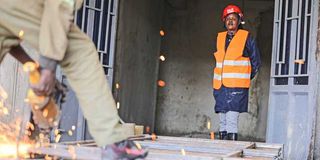
Rebecca Cherop looks on as a welder works at an upcoming women’s hospital in Kapenguria town on April 9, 2026.
As the interview wraps up, Rebecca has a direct message for other women.
"I am calling on women to venture into the construction industry. They need to come up and register companies. There are so many opportunities here waiting for them," she says, adding that she is grateful for the support of her husband throughout her career.