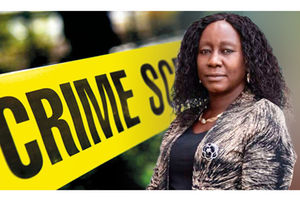
From tithe to power: How Joyce Kamene turned faith, job and charity into political influence
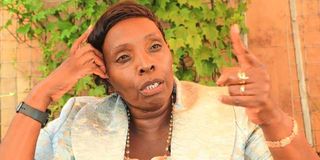
Machakos Woman Representative Joyce Kamene Kasimbi during the interview on Syokimau Estate in Machakos County on November 20, 2025.

What you need to know:
- Joyce Kamene Kasimbi’s political journey began not in Parliament but in prayer, charity and the grit of small business.
- After leaving a stable accounting job, she ventured into 'hustling', endured failure, and eventually found success supplying building materials.
- Her unusual decision to divert part of her tithe to the needy inspired her path into public service. Today, Machakos Woman Rep champions empowerment, education, water security and integrity.
Joyce Kamene Kasimbi wears her rosary like a fashion accessory—a visible symbol of faith that makes her next confession all the more surprising. Twenty years ago, the devout Catholic made a decision that would scandalise many believers: she diverted her tithe away from the church.
"When the business of supplying building materials started flourishing, I asked myself tough questions," says the second-term Machakos woman representative. “For someone who was used to tithing around Sh3,000 per month whilst in the civil service, what will the church say upon discovering that I was tithing 100 times my usual amount? Will the church think I am into some illegitimate business? I decided to divert a portion of the tithe to helping the needy in society.”
That controversial choice illuminated a path from building materials supplier to politician, and ultimately shaped how she would wield power once she reached the National Assembly. The decision to divert tithe came after Joyce had already taken the biggest leap of her life—resigning from the Kenya Broadcasting Corporation, where she had worked as an accountant for years, to venture into business.


She was not prepared for the tough world of 'hustling'. A cereals business burned her fingers badly—she bought tonnes of maize and beans in Busia County for sale in Nairobi, only to watch the venture collapse. She prayed hard for another opportunity.
When that opportunity came, she vowed to tithe religiously. A friend introduced her to the business of supplying building materials, and a Catholic priest offered her a lucrative contract at a church project in Syokimau Estate on the fringes of Nairobi.
A truckload of sand yielded a Sh2,500 profit margin. Joyce also supplied building stones, gravel, and murram, which was in high demand. They equally had impressive profit margins. Besides diverting a portion of the tithe, she stopped banking the money she collected regularly from contractors "to avoid raising eyebrows. Instead, I used to keep it under a mattress.”
With spare cash at her disposal, Joyce spent most of her free time helping the needy in and around Mlolongo Township. As the leader of a wing of Mlolongo Catholic church dedicated to evangelism through helping the needy, she discovered that children and women were badly hit by poverty and disease.
Nothing was more unsettling to the staunch Catholic who had grown up admiring Mother Teresa for her charity work targeted at the poorest in society. It did not take long before Joyce realised the need for affirmative action by the government to pull the communities living in informal settlements in and around Mlolongo Township out of poverty. She wondered why local leaders were not pushing the government hard enough to address the problem. This is how she started entertaining the thought of becoming a politician.
The road towards becoming the Machakos woman representative was anything but smooth. Joyce battled with scepticism from friends and relatives who believed she was not cut for politics. Her first attempt at the position in 2013 was unsuccessful. However, the setback did not dim her dream. When she finally made it to the National Assembly in 2017, President Uhuru Kenyatta had placed the National Government Affirmative Action Fund (Ngaaf) under woman representatives.
In Machakos County, Joyce prioritised promoting economic empowerment, rainwater harvesting, and fighting sexual and gender-based violence after extensive consultation. She has brought women together in self-help groups of different dimensions, which she empowers regularly through grants, business tools such as tents, cutlery and cooking ware, and training on entrepreneurship and governance.
“We started with nothing. Today, through the support of Ngaaf, we are worth more than Sh700,000,” says Josephine Ndunge Kithembwa, chairperson of Kyuka Community-Based Organisation, a group of 2,030 women located in Katangi ward.
"Our main business is table banking. We advance emergency and development loans to our members at friendly rates. This has enabled us to kick out predatory micro-finance firms from this region. To cut dependency, we champion entrepreneurship. We raise indigenous chickens and have acquired a prime plot near Katangi township where we intend to set up our offices and a poultry farm."
Joyce has also taken it upon herself to give teenage mothers a second chance in life through education. The programme entails identifying teenage mothers interested in resuming their studies and sponsoring them through school, college, and university. The beneficiaries have assumed frontline roles in the campaign against gender-based violence in the county.
In Machakos County, Ngaaf has also partnered with Computers for Schools Kenya to offer elementary computer training to secondary school leavers in the countryside.
"We did public participation and discovered that most teenagers in the countryside are computer illiterate. This locks them out of many economic opportunities, which require elementary computer literacy,” Joyce says of the training programme, which has empowered more than 200,000 youth.
Water harvesting
Water harvesting has remained a signature Ngaaf programme in the semi-arid county. Joyce has designed an innovative programme in which individuals and groups acquire water tanks at subsidised rates. The beneficiaries are allowed to pay in small instalments.
The water harvesting programme is meant to relieve women of the burden of drawing water from dams and rivers—a key campaign agenda. It also guarantees communities clean water free from germs. "So far we have distributed water tanks to more than 7,000 households," she says.
The water harvesting programme has exposed Joyce to criticism, with a majority of residents advocating more transparency. "We do not understand the criteria she uses to distribute water tanks across the county," says Clement Kyalo, a hawker at Machakos Town.
Joyce has dismissed the criticism as an outcome of ignorance about the work of a woman representative. Joyce believes that the woman representative position has significantly boosted the quality of leadership in the country. "A woman brings compassion to leadership. This enhances service delivery," she says.
When she was re-elected in 2022, she joined Machakos Governor Wavinya Ndeti and Machakos Senator Agnes Kavindu, who earned the moniker “Machakos Girls”. Although the term is used to convey contempt by their critics, Joyce has embraced it. “It shows that Machakos County, just like the rest of the country, is warming up to women's leadership.”
Official records at the National Assembly show Joyce among the most vocal MPs. The member of the Trade Committee at the National Assembly has made a big name advocating integrity in leadership.
Advocating integrity and taking a clear stand against corruption has earned her the sarcastic nickname "Mother Superior" from colleagues who believe she was not supposed to be in politics. The term refers to a pious woman who heads Catholic nuns.
Joyce identifies the late Raila Odinga among the politicians she admires for playing a key role in expanding the country's democratic space. She admires the bravery of former Kitui Governor Charity Ngilu, who once did the unthinkable—challenging President Daniel arap Moi in a State House race. She has also singled out Namibian President Netumbo Nandi-Ndaitwah, whom she commends "for etching the place of women in the African leadership table in the proper way."
“In terms of expanding the place of women in leadership, Africa has come a long way. The 1995 Beijing Conference provided a platform for men to understand that women can work and still be housewives and mothers,” she says. “We laud pioneer women leaders for paving the way for the current generation of women leaders. It is our turn to pass the women leadership mantle by working hard and amplifying our voices. The future of women in leadership is very bright. A time is coming when we shall have a female president in Kenya. That future lies in the Gen Z generation, who displayed a lot of bravery during the recent anti-government protests.”
Joyce has her eyes trained on defending her seat. Curiously, she has expressed readiness to support someone else—but there is a condition. "I am ready to support someone else seeking the woman representative position in the 2027 General Election. However, that person must be of unquestionable integrity. I have offered myself because getting such a leader is proving difficult. I cannot afford to have a leader who does not have the people of Machakos County at heart," she says.
Meanwhile, she has embarked on mentoring the next generation of women leaders.