Game changer: Why women are eyeing Fifa's highest office
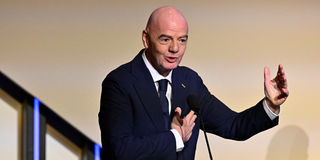
Fifa president Gianni Infantino gives a speech during the 36th AFC Annual Congress at Vancouver Convention Centre, Canada. He has been fighting for survival following the collapse of a controversial proposal that would have allowed private investment into major Fifa tournaments, including the World Cup.

What you need to know:
- Women leaders are pushing for greater female representation in Fifa as pressure mounts on Gianni Infantino to leave office.
- Fifa’s gender imbalance remains despite reforms, raising questions about women’s influence in football governance and decision-making at global level.
As Fifa President Gianni Infantino fights for survival following a botched attempt to privatise the association, the pressure to take a bow has taken a gender angle, with two powerful women in the leadership calling for his exit to pave the way for their kind to take over. According to an August 5 Reuters article by Lori Ewing, this onslaught is led by Laura McAllister of Wales and Lise Klaveness of Norway.
McAllister, one of Union of European Football Association’s vice-presidents, is reported to have intimated that “it would be wonderful to see a woman elected as president of Fifa”, adding that the global body has “to do some catching up with the rest of society” but acknowledging that it is more complex than “simply bringing forward a woman” however qualified she is.
The call was supported by Fifa former president Sepp Blatter. While decrying commercialisation and politicisation of Fifa, McAllister declared that “women are less bogged down with the business of football and more focused on what the game really is”.


This blunt call puts the spotlight on the gender breakdown in Fifa’s governance. To start with, there are only 10 Fifa member associations led by female presidents out of 211. And of the 37 members of the Fifa Council, the top executive organ, there are only eight women, constituting 26.6 per cent of the total, having risen from 13 per cent in 2024.
Progress to this level is traced to a crisis detailed by Moya Dodd and Catherine Ordway in a 2020 article in which they note the historical exclusion of women from the sport and “implicit and/or conscious biases”. Specifically, the accountability traumas of 2015 led to amendments in Fifa’s governance instruments in February 2016, providing that members’ legislative bodies “must be constituted in accordance with the principles of representative democracy and taking into account the importance of gender equality in football”.
Dodd, then a member of the Fifa executive, had led the campaign and chaired its Women’s Football Taskforce, which drafted the Women’s Football: 10 Key Development Principles. In these reforms, “six positions were reserved for women on the 37-person Fifa Council” as affirmative action.
To its credit, Fifa has in place a number of gender equality initiatives. One is the requirement that all teams in women’s Fifa competitions must have a female head or assistant coach, at least one female medical staff member and minimum two female officials on the bench. Two is the Female Health and Performance Project linked to needs specific to women’s physiology and related dynamics, such as “nutrition, strength training, menstrual health, pregnancy, postpartum return and menopause”.
In 2021, Fifa introduced a policy allowing professional women footballers at least 14 weeks of paid maternity leave.Three is the Women’s Football Development Programme aiming to stimulate and expand women’s football at grassroots and national levels to reach 60 million female players worldwide by 2027.
In an article on August 24, 2025, the Fifa Ethics and Regulations Watch noted that Fifa’s own 2025 diversity audit reported that women constitute “just 22 per cent of head coaches in women’s professional leagues and less than 15 per cent of executives within national federations”. This denies them the platform to shape policy and reform. An article by the same team in April 2026 decries the mismatch between Fifa’s rhetoric on gender equality and actual practice.
It notes that while “reserved seats for women on the Fifa Council and expanded investment in women’s tournaments are frequently presented as evidence of structural change … beneath these visible gains lies a more complex reality in which gender disparities persist across financial, institutional and cultural dimensions” as evident in decision-making authority that is “concentrated in established networks, often dominated by long-standing regional alliances and leadership blocs” headed by men and in which there is systematic resistance to gender reforms. In summary, the optics and fundamentals are discordant.
The report further notes that this skew also exists within key committees responsible for financial and strategic decisions. The result is that “gender considerations are often addressed within specific committees rather than integrated across all areas of governance”, making them “lack the institutional backing required for comprehensive implementation”.
The situation is worsened by the dense institutional bureaucracy where committee recommendations must “pass through broader governance channels where competing priorities dominate”. Gender parity is then sacrificed since it is “treated as a specialised issue rather than a core governance principle”. This is what is referred to as gender fade away or evaporation.
Addition of the gender angle to the current debate demands not only Infantino but also any future Fifa leadership to match theory with practice, specifically by creating more room for women in policy and decision-making.
The writer is a lecturer in Gender and Development Studies at South Eastern Kenya University ([email protected]).