How Africa's hidden billionaires are building empires without loans
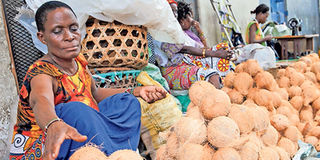
A woman sells coconuts at the Mwembe Tayari Market in Mombasa in this file photo. Despite their contributions, female entrepreneurs still struggle more, relative to men. They face cultural, financial, and institutional barriers that hinder their economic participation and are often mischaracterised as high risk or liabilities.


What you need to know:
- Despite contributing 58 percent of Africa's self-employed workforce and reinvesting up to 90 percent of African women's income back into communities, they face a crushing $42 billion funding gap. I
- 'Extensive research shows that women-led businesses consistently outperform their male counterparts, yet they receive less than half the investment compared to men.
- Successful cases like Angella Nabweteme's million-dollar porridge business, shows firsthand how African women entrepreneurs are Africa's greatest hidden assets.
The African investment climate is optimistic. The African Development Bank’s 2024 outlook was explicit. Africa’s economic performance was strong and shows resilience, but that performance has been slower than expected and uneven.
With challenges and global shocks, Africa’s 2022 GDP growth slipped from 4.1 to 3.1 percent in 2023, yet forecasters predict with smart policy and stable global conditions, it could climb to 3.7 percent in 2024, and 4.3 percent in 2025, making it the second-fastest growing region in the world.
To achieve this, African economies must diversify beyond resources and low-skill services, to education, energy, productivity-enhancing tech and innovation, and productive transport infrastructure. This includes innovating areas such as agri-food and high-skilled services while developing market systems. The vast financing gap in these areas is about $402 billion annually. To close it, Africa needs to mobilise and scale, foster private investment, and support entrepreneurs, especially by empowering women through innovative finance.

Women are Africa’s economic backbone. They comprise 58 percent of the self-employed population and contribute 13 percent to the continent's GDP. Sub-Saharan women have amongst the highest rates of entrepreneurship at 26 percent. Globally, one in six women intend to start a business; in Africa, it’s one in three.
Fifty-eight percent of Africa’s self-employed are women and contribute between $250-300 billion to the continent’s GDP. Women reinvest up to 90 percent of their incomes in education, health, and nutrition, in comparison to 40 percent by their male counterparts, transforming societies in the process. The female economy is the world’s largest emerging market, with the potential to add $12 trillion to the global GDP. Yet, women are overlooked or perceived as risky.
Africa needs all entrepreneurs to reach its economic potential. Gender parity in financing and private equity will accelerate and sustain economic growth, creating meaningful employment. Currently, there is a $42 billion funding gap for women entrepreneurs. The World Economic Forum projects that bridging this gap could boost Africa’s growth by $316 billion.
Economic participation
Despite their contributions, female entrepreneurs still struggle more relative to men. They face cultural, financial, and institutional barriers that hinder their economic participation and are often mischaracterised as high risk or liabilities. According to Global Entrepreneurship Monitor’s 2022/23 Women’s Entrepreneur Report: Challenging Bias and Stereotypes, women are overrepresented among the smallest businesses in highly competitive, low-margin markets and industries.
They also face inequality in the home, carrying a heavier burden of domestic responsibilities, which contribute to increased economic dependence and decreased interpersonal power and influence. In Africa, these factors perpetuate harmful stereotypes that hold back women entrepreneurs in terms of legitimacy, limit access to financial capital and other critical resources necessary for business growth and success. We need to change this.
In 2018, the Boston Consulting Group (BCG) conducted a novel study at MassChallenge, a US-based network of business accelerators, where companies were supposed to be evaluated on merits and not gender. They found that women-owned startups were better bets. BCG reviewed five years of data and found a higher percentage of women outperformed male-dominated companies. Yet, women-owned companies, on average, received $1 million less in financing than their male counterparts.
Men-founded firms' average investment was $2.1 million, versus a women-founded average of $935,000. Yet, women-founded and co-founded firms made 10 percent more cumulative revenue ($730,000) than men ($662,000). BCG expanded this research, conducting similar studies in France, then the UK, Germany, Sweden, and Spain. It concluded that the gender gap and bias are persistent everywhere, and the opportunity cost of not investing in women is too great to ignore.
Female-dominated sectors
Similarly, in 2023, Camille Hebert from the University of Toronto reviewed French startups over 20 years. She found that female entrepreneurs were 22 percent less likely to obtain financing with external equity and venture capital. She discovered that highly skilled and motivated female entrepreneurs who operate in male-dominated sectors are particularly hampered, but the gender gap closes in female-dominated sectors.
Moreover, female-founded startups outperform their male counterparts when offered venture capital. Gender stereotypes were the driver again. This meant females would substitute debt for equity and this limits scaling and faster growth. Hebert calls for policy to address the imbalance, offer balanced representation, and attenuate gender stereotyping.
Some of the origins and effects of the gender gap may hinge on male investor socialisation during a leader’s formative years.
A 2021 study published in the Review of Financial Studies found that a gender gap in investment in US conglomerates was evident in a business leader’s exposure to gender imbalance during his formative years. If he grew up in a traditional household with a male breadwinner, went to an all-boys school, and didn’t see female business role models, he was less likely to invest in women.
Research at the Wharton School of Finance at the University of Pennsylvania found homophily (tendency to bond with similar others) by male investors for male founders over females could be overcome. Women-led companies make up around 35 percent of new ventures but only account for two per cent of venture-backed US companies.
The study attributed the gap to bias and homophily preferences held by male venture capitalists. It surmised that boosting women’s representation in leadership and resource-controlling roles would remediate the issue if a critical mass of female talent was present. The team found that this was true as representation rose above 30 percent, but going over 54 percent began to see a gender bias reversal.
I’ve seen these financing challenges affect female African entrepreneurs. In fact, Alicia Plemmons studied gender-related bias in equity, debt, and philanthropic contribution financing decisions for early-stage African entrepreneurial ventures in 2,812 firms in Ghana, Kenya, Nigeria, Tanzania, Uganda, and South Africa in 2020.
She found substantial evidence of a negative effect of having a female primary founder on the probability of getting selected for equity funding, but not in the amount the startup attracts. She also learned that with debt, female entrepreneurs are subject to a lower probability of being selected for funding and smaller total amounts of debt financing. However, philanthropic contributions don’t show significant gender bias in either selection or size.
Plemmons recommends gender-lens policies for equality in both selection and investment decisions using incentive programmes, networking and promotional support for female-led startups, and government programmes that base funding on project performance projections. She also calls for debt lending with decisions based on project quality, instead of gender (i.e. property ownership or other assets for collateral for loans, non-predatory lending based on gender). And development financial institutions should spur more philanthropic investment tuned to community impact.
Women are the greatest hidden assets in African investment. Overcoming these financing stereotypes and challenges is paramount for closing the gaps and promoting robust African economies. We must change the narrative to confirm that women entrepreneurs and investors are assets, not high-risk and liabilities.
Meda is a global economic development organisation creating business solutions to poverty. For 70 years, we’ve worked with partners to support market-driven development and deploy impact investing. Meda joins with entrepreneurs to create value in agriculture businesses through access to finance, market linkages, and innovation.
African-owned and domiciled funds are perceived as risky, limiting both their ability to secure financing to scale their potential to drive growth and employment and change perceptions. African IVs can be catalytic to address economic challenges, promote entrepreneurship, and leverage sustainable growth.
As a pioneer Fund of Funds, the Mastercard Foundation Africa Growth Fund’s investments in IVs lower the risk and serve as a pivotal player in driving continental economic transformation. We joined with the Mastercard Foundation and a consortium of partners to create the Mastercard Foundation Africa Growth Fund.
A Fund-of-funds working through African Investment Vehicles (including venture capital funds, SME debt funds, permanent capital vehicles, etc.) to support growth-oriented African SMEs with the goal of enabling dignified and fulfilling work for young people, particularly young women. It is catalytic in helping to crowd in more capital for entrepreneurs focusing on young women, by strengthening IVs that are committed to advancing gender equity in entrepreneurship.
Homemade porridge
Ugandan-based Inua Capital, led by Kim Kamarebe, is one of the Fund’s IVs. They have invested in Forna Health Foods, founded by African single mother Angella Nabweteme, who built her business out of necessity, when she was unemployed and raising an infant. Healthcare providers marvelled at how healthy her child was because of her homemade porridge. Word of mouth spread and soon she had a business.
When the Covid pandemic hit, Nabweteme doubled down, digitised and took online nutrition classes to improve her product. Nabweteme's homemade porridge, Aunt Porridge and Instapo!, has become a sensation. Nutritious, fortified porridge is targeted at helping weaning infants, children, breastfeeding mothers, and immune-compromised patients get essential nutrition to thrive when they need it the most, with sales exceeding $1 million in 2018. The Mastercard Foundation Africa Growth Fund partnered with Inua Capital and Kamarebe to invest in these companies, recognising them as Africa's hidden entrepreneurial assets and helping them scale.
Dr Dorothy Nyambi is the president & CEO Mennonite Economic Development Associates (Meda), and group CEO and co-founder: Africa Communications Media Group Mimi Kalinda, while Joy Anderson, is the founder and president of Criterion Institute.