Jaboya goes digital as women still struggle for fish
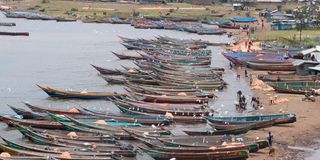
Fishing boats docked along Lake Victoria in Homa Bay County. Boat ownership is helping Homa Bay women escape sex-for-fish exploitation.

What you need to know:
- Declining fish catches and lack of capital are leaving women traders vulnerable to exploitation on Lake Victoria beaches.
- Women fish traders are, however, gaining control of boats and income as communities seek to end the Jaboya practice.
It is afternoon on Angalo Beach in Homa Bay town. Siprina Oyier, 70, waits for boats to dock. She has been in the fish business for more than 30 years.
“When I started selling fish, we would wait patiently on the beach as fishermen hauled fish in their canoes. They would then bring the catch on land before we bought it in a controlled system,” she recalls.
That is no longer the case, and the story mirrors what traders on other beaches face. Reduced catches are forcing traders to fight for the limited supply. “I have to be with the other women or else I will miss out. What is supplied is not enough and everyone struggles to get a share so that she can take it to the market,” Siprina says.

Wading in the water is her only chance of getting fish hauled from the lake. But she is slow. At 70, she cannot move fast. Other women run past her. They all carry basins in their hands to hold fish when they are transferred from the canoes.
Soon, they get into a frenzy, trying to catch the attention of a group of fishermen whose boats are almost docking. “Dock here. We will help you offload the fish,” one woman shouts.
When some of the fishermen reach the shore, they go straight to particular groups of women standing ashore. The women get all the catch. For an outsider, this looks like a fair trade. But for people who know how activities are conducted at the lake, there is a reason why the fishermen choose to give their fish to particular women. They have a bond, and it goes beyond the fish business. They have a special relationship. Some women offer sex in exchange for fish.
This practice is called Jaboya. It is a decades-old informal economy rooted in deep poverty, a lack of capital for women traders and traditional power imbalances. The practice started in the late 1990s and spread from Siaya to Homa Bay and finally to Migori.
It became widely documented because of its devastating role in fuelling high HIV/Aids infection rates across lakeside communities. Although it has reduced, there are reports that it is still practised on some beaches, largely because of the difficulty of getting fish.
Ibrahim Kasera, the Kendu Bay Beach Management Unit chairperson, says fishermen have been enlightened about the dangers of the practice and are taking precautions. He says multiple non-governmental organisations camped on beaches for several years to educate the fishing community about the effects of Jaboya. “So many people decided to change. They were told about its dangers and many fishermen opted out of the practice,” he says.
But this does not mean it no longer exists. Ibrahim says that, with greater knowledge about HIV, fishermen tend to practise safer sex. He says many know that it is important to use condoms. The practice has not disappeared but has changed its form, he says, adding that it was openly discussed whenever women bought fish.
But stigma and other factors have muted the conversation, and it is now practised silently. “Arrangements once made in plain sight are now brokered quietly by phone. You will notice this relationship when fishermen favour certain women over others when they haul fish from the lake,” Ibrahim says.
Fishermen say the introduction of county governments in 2013 made it easier for people to access medical services and receive health education. Most of them learnt about the risks of unprotected sex and decided to change. A different approach was used in Homa Bay town.
Homa Bay sub-county Beach Management Unit chairperson Alfred Anyango says the people who lead were sensitised to programmes aimed at eradicating the practice. He says a number of fishermen were told to involve their wives in the fish business. So instead of fishermen leaving their wives at home, they bring them along to take their catches to the market.
“When the fishermen get back to land after spending time in the lake, they go straight to their wives who wait for them by the beach. This ensures their wives are the first to be given fish before others are considered,” Alfred says.
But not every beach has undergone such reforms. About 30 kilometres away, at Achuodho Beach in Rachuonyo North, dozens of boats line up before their operators venture into the lake to catch fish. When they return to land after hours, they are greeted by women whose role in the fish trade starts when the day’s catch is hauled from the boats.
Often, just like at Angalo Beach, it is a struggle of the fittest on a “first come, first served” basis. Fishermen only supply women who are aggressive and ready to pay cash. But not all women are ready to play by this rule. Sharon Akumu, a trader at Achuodho, says women are vulnerable and have no control over what they sell.
She is the chairperson of a women’s group called Team Anjeyo, mostly made up of widows. Within her village, women venture into the fish trade to put food on the table. After being supplied with fish by men, some fry it before reselling it on the beach. “Some women target people travelling on the Kendu Bay-Katito road. They hold the fish in their hands, hoping that motorists will stop and buy,” Sharon says.
She explains that Jaboya is still practised on different beaches, albeit in a different form. With the advent of technology, it is possible for fishermen to communicate with women without other people knowing, she says. “They will have their own arrangements then meet. You can only sense there is something going on when some women are favoured when they are supplied with fish.”
Her group is made up of 50 women. She says it is always a concern when widows and unmarried women become pregnant. She notes that this causes a lot of stigma for those involved, who sometimes end up withdrawing from the business. “Often, a lot of risks are involved. Those who get into Jaboya relationships never find time to know their health status, leading to reinfections of sexually transmitted diseases.”
Breakups and teenage pregnancies
Besides disease infections, Sharon says the practice leads to family break-ups and a spike in teenage pregnancies. Achuodho Beach Management Unit chairperson Silvance Oriko confirms this, saying some fishermen have specific women with whom they engage in sex.
He notes that some men have multiple partners, with up to 10 women. “Some women are known to venture into fish trade without any capital and use Jaboya as an avenue to trade. It puts fishermen in a trap as they struggle to escape,” Silvance says.
The official expresses concern that this practice will make it difficult for the government to reduce HIV transmission, adding that some fishermen do not use condoms. Beach Management Units have in recent years started awareness campaigns, urging women to be included in boat ownership and in the fisheries value chain to break the cycle of dependency.
On August 18, members of Team Anjeyo received a fishing boat from Geno Community Development Initiative Trust in a bid to fight Jaboya practice. Sharon says her group expects to grow from the vessel they received and stop depending on men. She hopes to have multiple boats purchased using proceeds from the first vessel.
Sunira Achieng', a fish trader and chairperson of Kendu Bay Women’s Group, had her team benefit from the programme. The wooden boats the two groups received are fitted with nets and sails that propel them.
Sunira admits that fish supplies have reduced, with traders facing a bleak future. She accuses men of taking advantage of the situation to exploit women. Her team has already identified a boat operator who helps members of her group obtain fish to sell.
“The operator will get some men who will help him catch fish. They will then bring it ashore and supply us with the delicacy. We plan to keep records of sales and use the profits we collect to expand the business,” she says.
Rambira location chief Octaf Aluoch says the Jaboya practice is not as widespread as it was in the past. He attributes this to women’s empowerment and wants more women to be supported, calling for assistance with advanced fishing gear. He says traditional systems are a challenge as people resort to technology. “Embracing technology will enable the women to get more fish. We expect fishermen to consider using machines,” Octaf says.
Team Anjeyo secretary Maurine Awuor says her team has drawn up plans for diversification. The group practises table banking, but most members complain of low incomes because of the prevailing challenges. “We intend to venture into other projects as a means of expanding our source of income. We intend to be job creators. We don’t want to depend on men to earn a living,” Maurine says.
Geno Community Development Initiative portfolio manager Hannington Nyamori says his organisation recently gave out more boats in Sango Rota and Kusa in Kisumu County to enable women to have control over their income.
“Beneficiaries make their own decisions. They no longer have to wait for anyone to supply them with fish. What they do is give instructions to the people they have assigned to go to the lake before they take the catch to the market,” he says.
He notes that cases of gender-based violence against women are still widespread in some parts of the county. “We conducted a needs assessment and established that there is a lot of abuse where male owners of boats still demand sexual favours before supplying fish to women. Giving women the power to control the catch saves them from submitting to men,” Hannington says.
He says the pilot project aims to promote women’s dignity. Women are only respected when their names appear on boats, but their voices are unheard on land. There is an unwritten rule that every boat must have a woman’s name for good luck.
Fishermen name their boats after their wives, mothers, daughters or respected women in the community but fail to show respect to the women who sell the fish they catch, violating their rights when they show vulnerability.
The tradition is rooted in superstition and personal attachment to the trade. Local maritime folklore treats women as symbols of industriousness and good fortune. Naming a boat after a beloved female is believed to “charm Lady Luck”, leading to an abundant catch.
Fishermen say women are caregivers and that those who name their boats after their wives, mothers, aunts and grandmothers find the lake kind to them. Conversely, boats named after men are often said to have no luck. Their operators are believed to struggle to get fish or sometimes face accidents.
The respect ends with the paint on wood. While women’s names grace most boats, the women themselves rarely own the vessels. So, while the painted names celebrate women as “lucky charms”, the economic reality leaves them with little ownership, little protection and high vulnerability. The boats remain registered and controlled by men.
Declining supply
Geno chief executive officer Enosh Odera says many women in the fish business are exploited. He notes that Jaboya is promoted by poverty and is exacerbated by a declining fish population. Women who depend on the fish trade should be empowered to make their own decisions, he says.
“If the women depend on the fish business for their livelihood, it would not be right to have men control them. We are empowering them to enable the women to make decisions on the catch that they bring from the lake.”
Geno board chairperson Lawrine Odera says women should no longer be exploited through Jaboya. “This is a fight we will not let go. We are fighting for women’s rights and it will not stop in Karachuonyo,” she says.
Besides boat donations, women are being introduced to cage fish farming, run by groups that want to eliminate their dependency on men.


