Jennifer Maingi defied harsh climatic condition, tapped Athi River water, to smile all the way to the bank
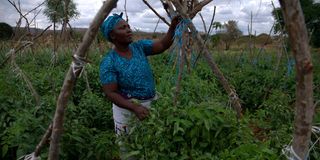
Jennifer Maingi, a farmer from Athi village, Kitui South checks on her pawpaw fruits in her farm in this picture taken on July 3, 2025. She uses water from the nearby Athi-River to irrigate her farm.

What you need to know:
- Jennifer Maingi started with a Sh10,000 loan from her Chama in 2021 to begin farming near Athi River in drought-stricken Kitui South.
- She uses river water irrigation to grow tomatoes, mangoes, and vegetables, earning Sh250,000 per season while neighbouring farms fail due to drought.
The scorching afternoon sun beats down mercilessly on the arid landscape of Ukambani, where most farms lie barren under the unforgiving dry spell. But step into Jennifer Maingi's farm, and you're transported into a different world—one painted in vibrant greens and bursting with life. Here, amidst the harsh climatic conditions of Athi village in Kitui South, a remarkable transformation is taking place, one tomato plant at a time.
As the Covid-19 pandemic ravaged the country and the world in 2020, while many were grappling with uncertainty, Jennifer was nurturing a different kind of hope—a dream that would change her family's destiny forever.
A dream takes root


The mother of three, had long harboured ambitions of venturing into agriculture. The challenge seemed insurmountable: the harsh climatic conditions in the Ukambani region are largely not conducive to farming. But rather than let this dampen her spirit, she looked beyond the obvious obstacles and found opportunity where others saw impossibility.
Her solution lay in the imposing Athi River that flows near her village. With readily available water from the river banks, Jennifer knew she had found her pathway to agricultural success.
In 2021, armed with just a Sh10,000 loan from her chama (investment group), she embarked on her farming journey—a decision that would prove to be life-changing.
When we visit Jennifer, she is in her element, tending to her tomatoes with unwavering dedication. Not even the scorching sun can derail her from ensuring every plant is properly trimmed and well-irrigated.
"Welcome to my farm. This has been my office for the last four years. This is where I get my daily bread," Jennifer says with pride.
The contrast is striking. While neighbouring farms are characterised by dry thickets—victims of the ongoing dry spell in the region—Jennifer's farm glistens with healthy crops. Tomatoes, mangoes, pawpaws, and vegetables including kale, spinach, and traditional vegetables create a tapestry of agricultural abundance.
Her tomatoes alone occupy three-quarters of an acre, and the numbers tell a compelling story of success.
"On average, I harvest about 10 crates of tomatoes a month, which I sell at Sh5,000. In a season which takes about six months, I am able to make about Sh200,000," she explains.
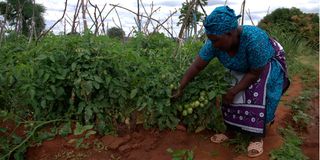
Jennifer tends to her tomatoes in her farm in this picture taken on July 3, 2025. She is one of the known farmers in Kitui-South which is predominantly a dry area.
Jennifer's agricultural prowess extends well beyond tomatoes. She has emerged as a budding mango farmer with more than 20 mango trees dotting her farm. Every season, she makes about Sh100,000 from mango sales alone.
She attributes her farming success to the irrigation system she has put in place, which shields her crops from the harsh dry spells that regularly affect the area. This strategic approach has made her one of the most sought-after farmers for tomatoes, vegetables, maize, and fruits in Kitui South.
Her success is measurable: every season, she makes Sh150,000 from tomatoes and an additional Sh100,000 from mango sales, excluding revenue from vegetables like kales, spinach, and other traditional produce.
Success has bred ambition. Jennifer is now venturing into watermelon farming and has prepared five acres for planting. She has also prepared an additional three acres for this new venture.
The fruits of her labour extend beyond the farm. Jennifer recently bought a parcel of land from her farming proceeds. Looking ahead, she hopes to put up rental houses on her newly acquired land to diversify her income streams.
"Farming has been very good to me. I have been able to pay school fees for my children," she says.
Her produce has found a ready market extending far beyond her village. She regularly sells to buyers who travel from as far as Kitui and Mutomo towns. When buyers don't come to her, she takes her produce to markets in Mutomo and Athi towns, where her fresh produce is always in high demand.
"Here, her produce is a hot cake, and buyers scramble to get the fresh produce from her farm," locals attest.
Behind every successful venture is often a supportive partnership. Sammy Maingi, Jennifer's husband, is working alongside her when we visit. His daily routine involves helping pump water from the river to the farm, cultivation, weeding, and transporting produce to market when buyers haven't come directly to the farm.
"I also help her do cultivation and weeding and also take the farm produce to the market when buyers have not come to buy," Sammy observes.
He notes that farming has improved the family's financial standing and enhanced their food security significantly.
However, Jennifer's journey hasn't been without obstacles. The high cost of farm inputs, particularly fertiliser and seeds, remains a significant challenge for her and fellow farmers.
"Controlling the diseases affecting tomatoes and mangoes normally requires a lot of pesticides, which is expensive. My appeal to the government is to lower the cost of these farm inputs so as to lighten the burden of farmers," she explains.
The high cost of diesel presents another major hurdle. She uses a generator to pump water from the Athi River, consuming diesel that costs her at least Sh3,000 weekly—an expense that significantly eats into her profits.
"I need a solar-powered water pump to help me cut fuel costs, which are really taking a toll on me," she adds.
As our visit concludes, it's impossible not to marvel at Jennifer's well-maintained piece of land, which is about to welcome a bumper harvest of tomatoes, mangoes, and pawpaws.
Her message to fellow women is clear and inspiring: "Embrace farming and consider using irrigation in areas where the weather is not conducive."


