Justice against all odds: Meet Ganze’s lone warrior for abused children
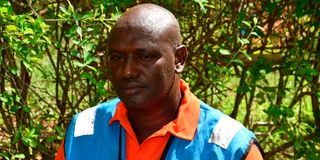
Ganze Sub-County Children’s Officer Omar Mohamed during an interview with the Nation in Kiilifi town on December 4, 2024.

What you need to know:
- Driven by compassion, Omar Mohamed risks everything to rescue and protect Ganze’s abused and neglected children.
- With perpetrators ranging from sorcerers to teachers, Ganze’s child abuse crisis demands urgent action beyond Omar Mohamed.
The sun beats down mercilessly on the parched earth of Ganze sub-county, where the rains have long forgotten to fall and hope seems as scarce as water. Here, in one of Kilifi's most remote corners, children's dreams are crushed under the weight of poverty, cultural traditions, and unspeakable violence. But walking these dusty paths, navigating impassable roads during the rare downpours, is a man who refuses to let darkness win.
Omar Mohamed has spent 13 years as Ganze Sub-County Children's Officer, and every day feels like a battle. In this forgotten land spread across three divisions and 13 locations, he stands between vulnerable children and a world that has failed them. His weapon? An unwavering belief that every child deserves justice, no matter who stands in the way.


Mohamed's journey began far from these drought-stricken plains. In 2005, in the bustling streets of Dagoretti North where he was born, he watched children his age abandon hope for the uncertain promise of street life.
"In 2005, most children were joining the street, and I decided to volunteer at this centre to assist the children," he recalls, speaking of his time at the Light and Power Centre in Gatina, Dagoretti North. "Fortunately, I assisted a lot of children who are now good citizens—some are senior government officers."
That volunteer work planted a seed that would grow into a lifelong mission. For eight years, he honed his skills at the Malindi Children's Remand Home before finding his true calling with the Directorate of Children's Services.
"When I joined the Directorate of Children's Services, I saw it as a calling," Mohamed reflects. "I was fulfilling the work I started a long time ago."
But nothing could have prepared him for Ganze. Here, crushing poverty intertwines with deep-rooted cultural beliefs to create a perfect storm of vulnerability for children. Sexual and gender-based violence lurks in the shadows of tradition, while prolonged drought pushes families to the breaking point.
"I am working in a community that is poor and rooted in cultural beliefs," Mohamed explains. "We always conduct public sensitisation to safeguard children."
Yet sensitisation is just the beginning of his challenges. The geography itself seems to conspire against justice. When the rains do come, they transform roads into impassable rivers of mud, cutting off the most vulnerable children from help.
"Sometimes it is hard to go and rescue a child in the furthest area, especially during the rains because of poor, impassable roads," he says. "It is hard for a child to reach the nearest trading centre."
When witnesses disappear
The courtroom should be where justice prevails, but in Ganze, Mohamed has learned that the law means little when witnesses vanish like morning mist. Families who bravely fill out P3 forms suddenly develop cold feet when it's time to testify. The reason? Often, it comes down to money.
"Sometimes police officers cannot get the family of the child, and it is because they went and talked about the matter at home to have the case settled out of court for them to get bride price," Mohamed reveals, his frustration evident.
The problem runs deeper than greed. In a community where witchcraft suspicions run high, pointing fingers can feel like signing a death warrant.
"If the perpetrator is a sorcerer, no one is willing to point a finger at him," Mohamed explains. "You find they continue to abuse children without them reporting."
When witnesses cannot or will not come forward, the legal system collapses. "When a witness cannot come to testify in court, the court will withdraw the case for lack of evidence, and the child will not get justice."
What sets Mohamed apart is his unwavering principle: justice is blind to status. Whether the perpetrator is a teacher, a chief, or a government officer, he pursues each case with equal vigour.
"Mine is to ensure a child gets justice as long as the case has been reported," he states firmly. "I don't need to know the status of the perpetrator or what happened behind the curtains by the parties."
This principle was put to the test on July 26, when Mohamed opened a care and protection file for two minors aged seven and nine. Their alleged abuser? A teacher at Fudumulo Primary School. The children's mother had discovered the defilement in October 2023 and reported it to Bamba Police Station under OB/621/3/2024.
Behind the statistics
In Mohamed's office, statistics transform into human stories. There's the 16-year-old girl he rescued from marriage, now thriving academically. Her success story burns bright in his memory.
"The girl is doing well in her education and going to Form Three next year," he says, and for a moment, his weathered face lights up with pride.
But for every success, there are countless untold stories. Parents who migrate to cities like Mombasa in search of work often leave children behind, creating a generation of abandoned minors.
"When a mother gets the job, they forget the children in the village, and if it is a father and starts working, he finds another woman, so both abandon the child," Mohamed observes.
Networks of hope
Recognising that he cannot fight this battle alone, Mohamed has built a network of allies. Each of Ganze's 13 locations now has two child protection volunteers, creating eyes and ears in every corner of the sub-county. When families try to silence cases, these volunteers help trace them down.
The Ganze Sub-County Children Advisory Committee brings together stakeholders in the child protection sector, creating a united front against abuse. Through dialogue meetings with chiefs, they've identified hotspots for kangaroo courts and made resolutions to arrest all those involved.
"We have dialogue meetings with chiefs and made a resolution that we identify hotspots for kangaroo cases and arrest all those involved to end the habit," Mohamed explains.
Early marriages plague Ganze, though Mohamed knows the reported cases represent just the tip of the iceberg. "The unreported cases are the ones with the issue, but we have rescued girls who are now in secondary school."
Adding to the challenge is disco matanga—a cultural celebration that has become a breeding ground for defilement and educational dropout among girls.
"We need to address GBV issues because many children in Ganze have dropped out of school, and we do not want it to be like that," Mohamed emphasises.
Part of Mohamed's mission involves educating the community about his role under the Children Act, 2022. Many residents don't realise that children's officers can take cases directly to court, bypassing police when confidentiality is crucial.
"Cases of a child in need of care and protection, neglect, or any other case that they are afraid of reporting to the police because of confidentiality are handled by the children's officer," he explains.
When families are compromised and refuse to release children for court testimony, Mohamed takes drastic action—rescuing children and securing them at rescue centres until they can testify safely.
Armed with a Bachelor's Degree in Security Studies and Criminology and a Diploma in Community Development and Social Work, Mohamed continues to expand his knowledge, currently pursuing a master's programme in the same field. But his greatest qualification remains the passion that has driven him since those early days in Dagoretti North.
"If you love and have passion for your work, you will fight to protect a child from anywhere," he declares.


