Kenya’s bold step: National strategy puts men at the centre of gender equality campaigns
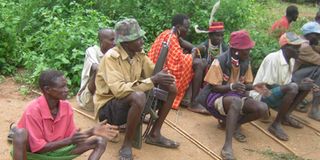
A group of men from West Pokot County attends a public forum on female genital mutilation (FGM). The county is now engaging men to boost the fight against FGM; and it is bearing fruit.

What you need to know:
- As HeForShe marks 11 years, Kenyan men and elders are stepping up to fight FGM, support girls’ education, and champion gender equality.
- From Samburu to Mt Elgon, communities are making historic declarations against child marriage and harmful traditions, proving men’s role is vital.
Eleven years ago, UN Women launched HeForShe, a global solidarity movement that invites men to stand alongside women in the fight for gender equality. Since then, the initiative has become a bold platform for collective action, mobilising millions worldwide to challenge harmful practices, promote positive masculinities, and expand opportunities for women and girls.
As the movement marks over a decade of impact, we look at how it has reshaped conversations and driven change in Kenya. Key areas of impact include preventing gender-based violence (GBV), expanding digital access to support services, promoting science, technology, engineering and mathematics education, and advancing economic empowerment, positive masculinities, and safe digital spaces.
Kenya has witnessed an increase in the number of men joining the fight against GBV. More men now campaign against female genital mutilation (FGM) across 22 hotspot counties. One of them is Tony Mweiba, who has been at the forefront for the past decade and is the founder of Men End FGM, a foundation that rallies men and boys to unite against harmful cultural practices.


“Including men in eradicating harmful cultural practices and in the whole gender equality discourse is important. We cannot ignore them as they are part and parcel of cultures that largely entrenched patriarchy,” he tells the Nation.
Tony has been one of the notable and vibrant HeForShe champions. The movement has also brought elders from different communities into the fight against harmful cultural practices.
Last December, Sabaot elders made a declaration to unite against FGM. In Mt Elgon, the Supreme Council of Sabaot Elders denounced FGM and child marriages and committed to supporting government efforts against the practice. The elders vowed to promote alternative rites of passage that emphasise dignity, respect, and honour for women and girls, while eliminating cultural biases that cause stigma and discrimination.
The elders further committed to protecting their daughters from child marriage, noting that FGM, besides causing physical, emotional and psychological pain to victims, is a precursor to early marriage, teenage pregnancies, and school dropouts. They pledged to support girls’ education to ensure equality with boys.
Other pronouncements include the Alale Declaration by Pokot elders, the Loita Declaration by Maasai elders, and the Kisima Declarations by Samburu elders. The historic Kisima Declaration was witnessed by then President Uhuru Kenyatta. Samburu, one of the communities where FGM is rampant, drew elders from its six sacred mountains to demonstrate commitment. They lifted the cultural curse against girls who had not undergone the cut.
Cultural curse
The cultural curse had been one of the drivers of FGM among the Samburu. Girls often opted to undergo the cut for social acceptance. Its lifting meant that uncircumcised girls could now be accepted and participate in all cultural activities and ceremonies.
Samuel Lolkitekui, a Samburu elder and HeForShe champion, rejected the tradition that demanded his daughters be circumcised and married off. Instead, he sent them to school, a decision he never regretted. “I stood firm against the retrogressive culture that required my daughters to be cut. I said a big no. They have now completed university and are working. I also influenced my brothers to follow in my footsteps,” he says.
The retired police officer did not stop with his daughters and nieces but went further to engage other men, enlightening them on the importance of educating girls. Musa Sayo, an elder from Narok, has also been championing girls’ education.
He tells the Nation that his community must encourage girls to study if it wants to progress. “Girls’ education has transformed our community. Women are now engaging in business and farming, which was unheard of before. As men, we are involving women in decision-making at home.”
He wants girls from his community to be competitive in the job market. Musa has been rallying fellow elders against subjecting their daughters to FGM, urging them instead to take them to school.
During the recently concluded United Nations General Assembly in New York, it was revealed that the HeForShe movement has attracted nearly 40 million supporters, including 1.24 million direct beneficiaries – primarily women and girls. At the event, UN Women Executive Director Sima Bahous emphasised the urgency of renewed leadership and collective action to advance the Sustainable Development Goals. “HeForShe reflects the growing recognition that gender equality is both a shared responsibility and a shared reward,” she said.
Last week, the HeForShe initiative received a boost after the government adopted the National Strategy on Male Engagement & Inclusion. This landmark framework, signed by the Gender Cabinet Secretary and Principal Secretary, marks a pivotal shift towards inclusive national development. The policy commits to actively engaging men and boys as allies of gender equality. It promotes positive masculinity and mental well-being while fostering inclusive partnerships for a stronger, more equitable country.
When it comes to women’s economic empowerment, men are also playing a supportive role. Under male leadership, Standard Chartered Bank has been empowering women entrepreneurs. Every year, more than 10 small and medium-sized businesses receive mentorship and networking opportunities. The top five firms from its Women in Tech incubator programme receive Sh1 million each as seed capital, alongside access to investor forums to help them meet international standards.
Faith Nashipae, a leading champion for men and boys in Kenya, says the HeForShe movement is vital because the involvement of men and boys in promoting positive masculinity and ending violence against women and girls is critical. “Male engagement and inclusion is paramount if we want to achieve gender equality as a country. It presents an opportunity to address social issues that disadvantage men, women, boys and girls in our society.”
Faith, who also chairs the National Committee on Male Engagement and Inclusion, adds that engaging men and boys is a transformational approach to changing social norms and ending violence against women and girls. She notes that for social norms to shift across Kenya, men must be fully involved as they are the gatekeepers of culture.


