Kenyan politicians and the politics of personal attacks, misogyny and gendered insults
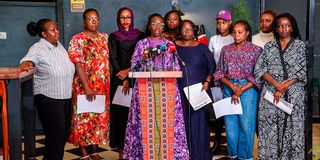
Pan-African Progressive Leaders Solidarity Network members, led by People's Liberation Party leader Martha Karua (centre), demand an end to political weaponisation of sexual violence in Uganda, at Mageuzi hub, Nairobi, on February 8, 2026.

What you need to know:
- Personalised political attacks in Kenya increasingly weaponise misogyny, humiliation and emotional violence against women in leadership.
- Gendered insults and sexualised rhetoric continue shaping Kenya’s political culture while undermining respectful democratic public engagement.
Good morning class. We will begin with a multiple choice question. Which of the following best defines a Kenyan politician? A person who: a) engages the mouth before the brain; b) treats the brain as a decoration inside the skull; c) leaves the brain behind when going to places where it is required; d) has vocabulary that does not include the word ‘principle’; e) has a mind that is in autopilot; f) thinks the word ‘honourable’ is a synonym for ‘horrible’; g) says the truth by accident; h) represents self instead of the electorate; i) has an insatiable appetite for stolen wealth; j) is permanently on sale; k) does not see a microphone s/he does not want to speak into; l) the parents sold a cow to take another cow to school (with all due respect to cows); m) fulfils all the above.
In recent times, a septuagenarian Kenyan politician, who is also a senior counsel (irreproachable legal personality), insulted a female politician by insinuating that she has a moral deficit. Without providing any evidence (he would call it ‘hearsay’ in court), he declared that he did not provide the kind of services he accused her of. The attack suggested that her political fortunes were a function of a transactional sexual relationship. How that advanced his political campaigns is debatable. But its nuisance value is palpable. While the damage intended was for the target, the attacker himself has erased his reputation to abysmal levels.
Class. Note that this politician is using personalised attacks because of political differences instead of saying why his choices are right and hers are wrong. He has also sexualised the attack. He is passing a moral judgement, and suggesting that sexual intercourse is a form of conquest over women. What he has not said is whether male politicians are immune from sexual shenanigans.


You remember the article titled ‘Sexualising politics in Kenya: An evolving strategy to acquire power?’ by Thomas Otieno Juma and Alfred Kipyegon Bett of Kabianga University. Referring to a study by Jessica Valenti (2015), it says that “there seems to be no end to the number of insults that are tailor-made for women… For as long as women have wanted to have a voice in our political process, there have been men looking to shut them up with slurs and condescension”. It categorises this treatment under objectification, four of whose features are relevant to our case.
They are “fungibility (treatment as interchangeable with other objects); violability (treatment as lacking in boundary-integrity); ownership (treatment as something that is possessed by another - can be bought or sold); and denial of subjectivity (treatment as something whose experiences and feelings, if any, need not be taken into account”.
But it notes that women in politics also legitimise their objectification by sexualising themselves. For instance, in a past presidential contest, women branded themselves as queens and bevies of certain candidates, using sexually suggestive dance moves “to endear the masses to their political narratives using their beauty”. What do you think of women politicians recently twerking in public and defending it?
In a previous lesson, I told you about double standards – condemning a person or group for precisely the mistake that another is not vilified for. We characterised this as “a pot calling the kettle black”. The male politician forgot that he also has a lot of skeletons in his cabinet, which determined sleuths are able to unearth. One of these is that his performance as the chief executive of his county is underwhelming, a track record from his days as a single constituency legislator. Keen observers may thus see the crass remarks as desperation for political relevance.
Let us sample reactions from defenders of the female politician. One shook her bosom and threatened to breastfeed the attacker, probably to inject enough colostrum for his intellectual development. Another doubted the delicacy of his nether quarters. The female politician herself was conciliatory. But she is also on record asking a crowd whether not to kick the scrotum of a politician she accused of belittling her ethnic group.
Logical fallacy
In essence, both camps have capacity to personalise and sexualise political matters. In critical thinking, this is a logical fallacy referred to in Latin as “ad hominem”. It is a disease that afflicts people suffering from cognitive evaporation.
I hope you remember the types of gender-based violence I mentioned before. Gendered verbal attacks of the nature described fall under emotional violence – harm targeting the feelings. Such violence can result in suicidal ideation, self-hate, stigma, withdrawal, breakdown in relationships and depression. We will end with homework. Find out what grounds can be used to withdraw the ‘senior counsel’ title.
The writer is a lecturer in Gender and Development Studies at South Eastern Kenya University ([email protected]).


