Make society safe: Why rights groups want GBV campaign integrated in CBC
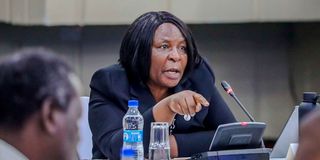
Technical Working Group on Gender-Based Violence, Including Femicide Chair Nancy Baraza during a stakeholder engagement at KICC, Nairobi, on April 9, 2025.

What you need to know:
- Integrating GBV and FGM awareness into the competency-based curriculum from primary through secondary school levels would foster early understanding and prevention.
Sexual Offences Amendment Bill seeks to prevent employment of individuals with a history of sexual offences.
A revolution against gender-based violence (GBV) might soon take root in the quiet corridors of Kenya's schools. As the nation grapples with alarming rates of violence against women and girls, experts are now turning to education as a powerful weapon in this persistent battle.
"The classroom is where values are shaped. It's where the next generation learns what is acceptable and what isn't," says Bernadette Loloju, CEO of the Anti-FGM Board, whose organisation is among those championing bold new approaches to combat GBV.
Among the most significant proposals presented to a government taskforce is the integration of GBV awareness into the competency-based curriculum (CBC) from primary through secondary schools—a move aimed at fostering early understanding and prevention strategies among Kenya's youth.


The proposal comes at a critical juncture. In January, responding to rising concerns, President William Ruto established a technical working group on GBV, including femicide, under the leadership of former Deputy Chief Justice Nancy Baraza. The taskforce's mandate includes assessing, reviewing, and recommending measures to strengthen policies and structures to eliminate these forms of violence.
The memorandum, jointly developed by the Anti-FGM Board and a civil society organisation, goes beyond classroom education. It advocates for strengthening and enforcing laws on GBV, female genital mutilation (FGM), and femicide, with particular emphasis on accountability and survivor protection.
Another key recommendation is the institutionalization of gender desks at police stations, staffed with officers specifically trained to handle FGM and GBV cases with sensitivity and urgency—addressing a long-standing concern about how these cases are processed within the justice system.
Loloju emphasised the interconnected nature of these violent practices. "The Anti-FGM Board remains committed to working with the taskforce and all stakeholders to eliminate FGM, prevent GBV, and ensure justice, dignity, and protection for all survivors," she said, noting that FGM is not only a form of GBV but also often precedes other forms of violence against women and girls.
Parallel efforts to strengthen legal frameworks are already underway. The Anti-FGM Board, in partnership with Unicef, is revising the Anti-FGM Act to address emerging challenges that weren't contemplated when the original legislation was passed in 2011. These include medicalised FGM (performed by healthcare professionals), cross-border practices, and inter-county FGM—all of which have emerged as perpetrators adapt to evade prosecution.
On a related front, the proposed Sexual Offences Amendment Bill, spearheaded by Cradle, a child rights organization, seeks to introduce stringent measures against sexual offenders. If passed, the bill would compel employers to ensure their employees have no history of involvement in sexual offenses—effectively barring convicted offenders from employment.
The bill also proposes making the sexual offenders’ registry public and preventing foreign sexual offenders from entering the country, addressing growing concerns about cases involving foreigners accused of molestation and defilement.
Perhaps most significantly for communities in northern Kenya, the amendments would ban traditional dispute resolution mechanisms, commonly known as "kangaroo courts" or locally as "Maslaha." These informal systems have been criticized for denying survivors of sexual and gender-based violence access to formal justice through negotiated settlements between families and perpetrators.