Male champions challenge tradition: Inside the Maasai fight against FGM
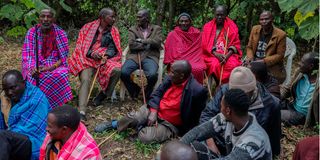
Maasai elders and young Morans participate in discussions about ending FGM and gender-based violence at the sacred Olpul meeting ground in Narok County on September 25, 2024.

What you need to know:
- Maasai elders and Morans are meeting at their sacred Olpul gathering place to fight FGM and child marriage.
- These traditional leaders are abandoning centuries-old practices to protect girls and promote education instead.
The aroma of roasting goat meat drifts through the morning air as men gather beneath an ancient tree, but this is no ordinary feast. Here, in a sacred space where tradition once silenced the voices of girls and women, a quiet revolution is taking root.
A sacred space transformed
The chilly morning leads us deep into the heart of Ntulele in Narok North, tens of kilometres from the busy Narok-Mai Mahiu highway. We arrive at a heavily forested compound where indigenous trees form a natural canopy overhead, their branches alive with birds singing melodious songs that fill the crisp air.

At the far left stands a modest stone house belonging to one of the village elders. But our destination lies 100 metres from the entrance, toward the right, where a group of men—both grey-haired elders and young Morans—sit beneath a massive tree. This place is called Olpul, a sacred meeting ground in Maasai culture where women have traditionally been forbidden to enter.
As the goat meat develops its irresistible golden crust over the fire, the significance of today's gathering becomes clear. While Olpul meetings have historically focused on pastures, trade, and community cohesion, today's agenda represents a dramatic shift—one that could change the lives of countless Maasai girls and women.
Standing before the assembled men, Lemasi Menja commands attention. This young Moran has positioned himself at the forefront of an unlikely battle—fighting against female genital mutilation (FGM) and child marriage within his own community.
"We need to let go of some of these retrogressive cultural beliefs like cutting of girls and child marriage," Lemasi tells the elders, his voice carrying both respect and conviction. "Other communities are not doing it and are instead prioritising girl education, which we also need to do. The law of the land also outlaws FGM and child marriage, and engaging in them could lead to a jail term."
But Lemasi's journey as a male champion hasn't been without consequences. He recalls a particularly challenging rescue mission involving a young Class Six girl who had been subjected to FGM and was about to be married off.
"After we conducted the rescue, the girl's family went to my home and carried my wife away as revenge," he recounts. "We, however, eventually emerged victorious, and the girl went to school."
Beside him, Frank Parkipale shares similar convictions. This fellow Moran decided to join the campaign after witnessing first-hand the suffering of girls in his community.
"As Morans in this community, we have decided to stand against the cutting of girls and child marriage," Frank explains. "Our daughters and sisters need to be safe and complete."
The two young champions have developed a strategic approach, acting as community watchdogs who report harmful practices to local administration officials. These authorities then intervene to apprehend perpetrators and rescue girls at risk.
"We have a lot of work to do to ensure that we completely root out FGM in this county," Frank acknowledges. "We need your support as elders to ensure we safeguard our girls from the cut."
Wisdom evolving
The transformation isn't limited to young warriors. Elder Musa Ole Punyua, a polygamous man with two wives, represents the changing mindset among community leaders.
"As a community, FGM has not assisted us in any way," Ole Punyua admits. "We are now telling our young men why it is not wrong to marry a girl who has not been cut. We want our girls to be educated so that they can become competitive in the job market, just like other girls from other communities."
He credits the Prohibition of Female Genital Mutilation Act of 2011 with playing a leading role in encouraging elders to abandon the practice.
Another elder, Joseph Ole Memuruti, echoes these sentiments while sharing his personal transformation.
"FGM has no benefit, and child marriage only comes to rob innocent girls of their future," Ole Memuruti states firmly. "We have now decided to fight against these vices and instead support girl education and embrace development. My daughters are now in university pursuing their education."
The grassroots movement has gained significant institutional support. William Mbanyamlenge, a Project Officer at the Centre for Rights, Education, and Empowerment (Creaw), recognises the crucial role these male champions play.
"Elders are the custodians of culture; they hold a lot of influence," Mbanyamlenge observes. "Their move through Olpul to support the fight against FGM and child marriage is commendable, as it can only mean that girls and women in the community will be safe."
The initiative has achieved remarkable results, with beneficiaries gaining access to essential services including healthcare, legal aid, and psychosocial support to address issues related to gender-based violence and FGM.
UNFPA Country Director Dr Anders Thomsen acknowledges both the progress and challenges ahead.
"The deeply rooted social-cultural norms require sustained engagement with communities in order to realize transformation," Dr Thomsen explains.
"This is why we support local and grassroots organisations implementing long-term community-led interventions to eliminate the vice."
He notes that effective law enforcement through collaboration with the Kenya police, judiciary, and directorate of public prosecution has enhanced both prevention and response to FGM.
The UNFPA initiative extends beyond Narok to seven other counties: Baringo, Garissa, West Pokot, Samburu, Bungoma, Isiolo, and Elgeyo-Marakwet—representing one of Kenya's 22 counties grappling with these practices.
"Women engaged in these programs develop a new sense of confidence and are now acting as agents of change to ensure most of the girls at risk are protected from FGM," Dr Thomsen tells Nation.Africa. "They work closely with the local administration and rescue centers on FGM prevention and response."
Legal momentum
The 2011 legislation appears to be yielding results in the fight against these outlawed cultural practices. Violations carry a minimum punishment of three years imprisonment and a Sh200,000 fine—consequences that are increasingly becoming reality for perpetrators.
As our extraordinary gathering concludes, we join the men in sharing the roasted meat, prepared according to strict Maasai cultural traditions. The meat is tender and flavourful, followed by traditional soup mixed with herbs. The ritual remains unchanged, but the conversations happening around it represent a profound shift.
The young Morans and respected elders who once might have gathered here to discuss bride prices and circumcision ceremonies now strategise about school fees and scholarship opportunities. In this sacred space where women were once forbidden, men are fighting for women's rights.
As evening approaches and we return to Narok town, the significance of what we've witnessed lingers. In a community where tradition runs as deep as the roots of the ancient trees surrounding Olpul, change is happening one conversation, one rescue, and one educated girl at a time.
The warriors have not abandoned their role as protectors—they've simply redefined what it means to protect their daughters, sisters, and community's future.


