More women to be nominated for 20 years in new gender top-up plan

National Assembly building in Nairobi.

More women will be nominated to Parliament for the next 20 years under a plan to bridge the persistent imbalance in the election of women to the two Houses.
The measure, designed to ensure that neither gender accounts for more than two‑thirds of representation, is contained in the Constitution of Kenya (Amendment) Bill No. 29 of 2025, now before the National Assembly.
The Bill is co‑sponsored by Deputy Speaker Gladys Boss Shollei, Dagoretti North Member of Parliament (MP) Beatrice Elachi and Laikipia Woman Representative Jane Kagiri. It allows for one extension of the top‑ups, capped at 10 years, but only if supported by two‑thirds of MPs and two‑thirds of county delegations in the Senate.



National Assembly Deputy Speaker Gladys Boss Shollei during an interview at her home in Kitusuru, Nairobi on July 2, 2025.
Articles 97 and 98 on the membership of the National Assembly and Senate would be amended to introduce special seats, allocated after each General Election to close the gender gap, a model already in use in county assemblies.
This marks a departure from the current fixed quotas of 12 nominated MPs and 16 nominated women senators, together with youth and disability representatives.
If, for example, Kenyans elected almost all men to the 290 constituencies, enough women would be nominated to meet the two‑thirds threshold.
The same formula would apply to the 47 elected senators. In 2022, only 29 women won National Assembly seats, later reduced to 28 when Alice Wahome, who won the Kandara parliamentary seat joined the Cabinet. Just three of the 47 elected senators are women.
The sunset clause would lapse 20 years after the first General Election following the Act’s commencement.

Senate Majority Leader Aaron Cheruiyot.
In the Senate, Majority Leader Aaron Cheruiyot has tabled a parallel Bill, Constitution of Kenya (Amendment) No. 16 of 2025, which also provides for gender top‑ups. His version introduces that five per cent of special seats must go to persons with disabilities. It has no sunset clause but limits holders of special seats to two terms.
Resolving the gender impasse, now 16 years after the new Constitution came into force, was a central issue for the National Dialogue Committee (NADCO) in 2023.
The committee referred the matter to the taskforce on the realisation of the two‑thirds gender principle, which had already been established by former Gender Cabinet Secretary Aisha Jumwa. NADCO recommended that the framework developed by the team be adopted once complete.
If applied today, 53 women would need to be nominated to the National Assembly and two to the Senate.
On cost, Daisy Amdany, who co‑chaired the gender taskforce, said earlier while popularising their recommendations that each Kenyan would pay Sh74 annually to cover salaries and support staff for the 55 additional legislators, a total of Sh3.8 billion.
“In the 2023/2024 financial year, the government collected Sh5.19 billion per day. So the annual amount for the added members is less than a day’s revenue,” she said.
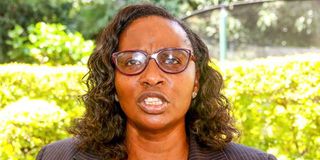
Dagoretti North MP Beatrice Elachi. Ms Elachi calling for more substantive learner populations in slum areas.
But Elachi insists women and political parties themselves hold the key. More women must contest seats, she argued. But without the backing of dominant parties in their regions, success will remain elusive, she said.
“Any woman in this room going to vote, don’t tell us you are going to a party that is not strong in your region,” she said during a National Gender and Equality Commission (NGEC) meeting in Nairobi on 2 October 2026.
“You will fail. If you are from Central, fight in DCP. In Nairobi, fight in DCP or ODM. In Ukambani, fight in Wiper. Don’t go to a party you know very well cannot deliver.”
NGEC and the Registrar of Political Parties have already begun a joint audit of all 98 parties ahead of primaries.
NGEC chair Rehema Jaldesa said accountability must start early.
“Elections are a process, not just a day. If we are serious about increasing women’s numbers, we must nominate them from their strongholds or make it possible for them to compete fairly.”
Follow our WhatsApp channel for breaking news updates and more stories like this.