New face of FGM: ‘Married women disappear for a month and return as if they’d gone for further studies!’

Nyerere Kutwa, director of programmes at the Anti-FGM Board, engages women during a sensitisation forum at the Kibingor Full Gospel Churches of Kenya in Baringo South. Concerns have emerged about married women in Baringo South and Mogotio going for genital mutilation.

What you need to know:
- Married women in Baringo who had escaped FGM in childhood are mocked and called ‘children’ by peers, hence prompted to undergo the practice to avoid ridicule, exclusion and pressure.
- Activists warn that cultural expectations and marital coercion are fuelling a disturbing resurgence of FGM among adult women.
Residents only hear whispers that so-and-so had undergone the cut while away.
A troubling new twist is emerging in Baringo County, where the decades-long fight against female genital mutilation (FGM) is reportedly taking an unexpected turn. Married women are voluntarily undergoing the cut under intense cultural and social pressure.
In remote villages across Mogotio and Baringo South, women who escaped circumcision in childhood are increasingly being pushed—and in some cases choosing—to undergo the outlawed harmful practice after marriage in a bid to secure social acceptance and avoid persistent ridicule, stigma and exclusion.

Nyerere Kutwa, director of programmes at the Anti-FGM Board, engages women during a sensitisation forum at the Kibingor Full Gospel Churches of Kenya in Baringo South. Concerns have emerged about married women in Baringo South and Mogotio going for genital mutilation.


Hotspot areas cited include Maji Moto, Kipteweret, Radad, Kamar, Molo Sirwe, Emsos, Kapyemit, Emining, Mugurin, Kipkitur, Kisanana, Olkokwe and Waseges in Mogotio, as well as Mochongoi in Baringo South.
Despite the legal ban on female circumcision in Kenya, enforcement remains inconsistent, with local administrators citing secrecy, fear and alleged complicity among some community members and enforcement actors as major challenges.
In Baringo, cattle symbolise wealth and social status. Activists say this continues to reinforce the practice despite the law. Elders and traditional leaders also associate circumcision with discipline, maturity and readiness for marriage, further entrenching its social acceptance.
The development marks a disturbing shift in a practice that has long been targeted through legislation, awareness campaigns and community interventions under the Prohibition of Female Genital Mutilation Act, 2011.
Despite the ban, the practice remains entrenched among sections of the Pokot, Ilchamus and Endorois communities, with cultural perceptions of womanhood, marriageability and social respect sustaining it.
Activists say the pressure is no longer confined to girls of school-going age. Instead, it is extending into adulthood, with married women increasingly caught at the centre of social expectations that equate circumcision with dignity and belonging.
Women who remain uncircumcised are reportedly mocked, infantilised and excluded from community spaces, including women’s gatherings and cultural forums, where they are sometimes labelled “children” or “incomplete”.
Esther Keitany, a resident of Kibingor in Baringo South, says the pressure is both psychological and social, making resistance increasingly difficult. “It is heartbreaking because women who escaped the cut while growing up are mocked and treated like children. They are told they are not real women and are excluded from women’s meetings and community forums,” she said.

Esther Keitany, a resident of Kibingor village, during an interview after attending an anti-FGM sensitisation forum at the Kibingor Full Gospel Churches of Kenya in Baringo South, on May 27, 2026.
According to her, uncircumcised women are often barred from speaking at public meetings and excluded from cultural ceremonies, reinforcing their isolation within their own communities.
“Some are even chased away from women’s gatherings until they agree to undergo the rite. Eventually, many surrender because they can no longer endure the humiliation,” she added.
Privately carried out
Anti-FGM campaigners say the practice has been widely resurfacing in response to enforcement pressure, becoming more secretive and shifting from public ceremonies to discreet, hidden arrangements. Procedures are reportedly carried out at night and during school holidays, with women transported to remote areas within Baringo and neighbouring Nakuru County, including Chemarmar, Banita, Kapkilinga and Solai, away from public scrutiny.
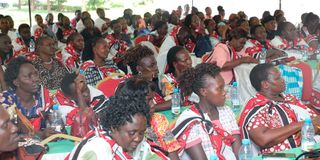
Women from Baringo North and Baringo South during an anti-FGM sensitisation forum at a Marigat Hotel in Baringo South on May 26, 2026.
Majimoto assistant chief Kibet Kobetbet says the secrecy has made detection and enforcement increasingly difficult. “They disappear for almost a month and return as if they had gone for ‘further studies’! You only hear whispers later that so-and-so underwent the cut while away.”
The local administrator noted that, unlike in the past when initiates would return amid public celebrations, the practice is now concealed to avoid arrest.
Activists warn that pressure from husbands is becoming a significant driver of the trend, with some men insisting their wives undergo FGM to be accepted as “proper wives”.
Selly Rotich, an official with African Girl Generation, says coercion within marriage is a growing concern.
“Some husbands refuse to eat food cooked by uncircumcised women. Others threaten to marry second wives if their wives do not comply. This has prompted many women to eventually give in because they fear rejection, ridicule and isolation.”

Selly Rotich, an official of the African Girl Generation, during the interview after attending an anti-FGM sensitisation forum at the Kibingor Full Gospel Churches of Kenya in Baringo South.
She estimates that women aged between 20 and 50 are now among those undergoing the procedure, marking a stark departure from the traditional focus on adolescent girls.
She said that at one point, about 30 women were found gathered in Kiplombe, Eldama Ravine, waiting to undergo FGM while insisting they were tired of community mockery.
Activists say many of these women had previously escaped FGM through education, religion or anti-FGM interventions, only to face renewed pressure after marriage.
Health experts warn that the practice carries severe risks, including excessive bleeding, infections, childbirth complications, trauma and long-term reproductive health problems.
Selly has also raised concerns over allegations that some women may be cut in collusion with rogue health workers during childbirth, sometimes without their knowledge.
In many of the worst-hit areas, the practice remains closely tied to economic and social expectations, particularly bride price, where circumcised girls are reportedly considered more valuable in livestock negotiations. According to the Anti-FGM Board, Baringo has a prevalence rate of 22.2 per cent, significantly higher than the national average of 15 per cent.

Women from Baringo North and Baringo South during an anti-FGM sensitisation forum at a Marigat Hotel in Baringo South on May 26, 2026.
Officials say the fight must expand beyond protecting girls to addressing the pressures facing married women, who are increasingly being drawn into the practice.
“The challenge now is no longer just protecting girls. We are seeing married women being pressured into the cut to gain acceptance and dignity within their communities,” said Anti-FGM Board director for programmes Nyerere Kutwa, adding that lasting change will require deeper engagement with men and the community power structures sustaining the practice.