New report demands independent bodies to tackle sports violence against women
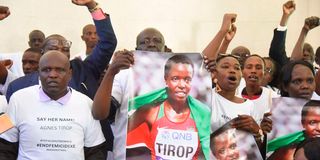
Vincent Tirop second (left), father of the late Agnes Tirop, an international athlete who was allegedly killed by her spouse in Iten, Elgeyo Marakwet County in 2021. A new report says seven in ten female athletes suffer abuse in Kenya.

What you need to know:
- A new study by the Aga Khan University found that 60 per cent of female athletes in East Africa experience GBV, with Kenya leading at 70 per cent.
- The violence causes emotional trauma, poor performance, and forces many women to withdraw from sports entirely, perpetuating male dominance in the sector.
The Graduate School of Media and Communications at The Aga Khan University in Nairobi is certainly carving out a niche in the gender discourse going by its outputs. In April, it released a report on the status of women in the media in East Africa. Soon after, it produced the gender reporting curriculum. Most recently, it has published Sexual and gender-based violence against women in sports: prevalence, impact, and interventions in East Africa.
The study established that 60 per cent of female athletes have gone through one form or another of gender-based violence (GBV), Kenya leading the pack at 70 per cent. The most prevalent forms of GBV were verbal abuse, sexual harassment and emotional abuse, largely perpetrated by fans (32 per cent), coaches (23) and peers (22 per cent) – people in close proximity with and familiar to the athletes. Coaches, team officials and teammates accounted for 55 per cent of notorious perpetrators.


Two categories of female athletes are particularly vulnerable: those at the beginning of their careers (because of naivety, poverty and over-dependence) and those in elite, professional or semi-professional competitions who are also heavily reliant on coaches, officials and administrators for guidance and management. This trend is attributed to gender power relations, inadequate protection mechanisms and low levels of awareness.
The normalisation of the vice is attributed to “entrenched patriarchal norms, leadership and operations that privilege and protect men in positions of authority, weak accountability structures, and a pervasive culture of silence”. The report hints that the conspiracy of silence has senior personalities in the industry quietly tolerating the vice and protecting known perpetrators.
Respondents cited lack of awareness and education, power dynamics between athletes and coaches, authoritarian coaching styles, and deeply rooted gender stereotypes as the key drivers of the vice.
“Coaches and members of the technical bench liberally have sexual relations with their charges”, indicates the report, adding that the behaviour “remains accepted and unchallenged”. The control by the coaches is such that affected athletes often choose silence lest they lose career opportunities or get victimised in other ways such as in training, team selection and apportionment of scholarships.

Participants during the launch of the SGBV in sports report at the Aga Khan University in Nairobi on June 18, 2025.
Major consequences identified are emotional trauma (47 per cent), deteriorating performance (17 per cent) and withdrawal from sports (17 per cent), with long term implications. In fact, the report notes that the trauma makes female athletes who have retired from the sport to completely withdraw and lead obscure lives rather than plough back their knowledge, experience and skills into the industry for the benefit of upcoming ones and growth of the sector. This in turn perpetuates the cycle of male domination of sports and is certainly a huge human resources capacity loss.
Regrettably, a whopping 63 per cent of respondents were not satisfied with the existing redress mechanisms, deeming them insufficient or non-existent. The report, thus, highlights the need for “stricter penalties, policy enforcement, counselling and reporting mechanisms that are open, transparent and predictable” in order to entrench accountability by both deterring the vice and punishing perpetrators.
It also recommends establishment of “independent bodies for reporting and investigating allegations”, anti-SGBV policy frameworks and regular audits to assess compliance. Impliedly, these will require allocation of resources. Other recommendations made are: mandatory education and training programs for all stakeholders in sports; institutional reforms to ensure diversity in the leadership by increasing the portfolio of women; and creation of comprehensive support systems for affected athletes. An increase in the number of women in the leadership and coaching positions would reduce the risk and also enhance surveillance.
This is certainly an eye-opening report, which perhaps confirms what has been known to occur but has not been openly confronted as a problem. It brings to mind the #MeToo movement initiated in 2006 but given impetus in 2017 by the sexual abuse allegations against film producer Harvey Weinstein. However, because the study focused only on GBV against women, it leaves open the question as to whether men in sports are also subjected to any gender-related problems.
The tone of the report suggests the imperative to carry out follow up monitoring to determine implementation of the recommendations by the duty bearers or not and to what effect. It would be futile if follow-up is not done because the report then becomes just another document accumulating dust on the shelves. This calls for partnership by the Graduate School with the various stakeholders targeted by the recommendations to work out action plans to anchor implementation.
Given that the project was undertaken in conjunction with the office of the president’s advisor on women’s rights, the ball lies squarely in her docket to ensure that implementation is initiated, robust monitoring and evaluation done, and results disseminated for public consumption. Not doing so would constitute failure on her part.
The writer is a lecturer in Gender and Development Studies at South Eastern Kenya ([email protected]).


