No milk, no hope: Gaza families feed infants herbs, sand and sesame paste
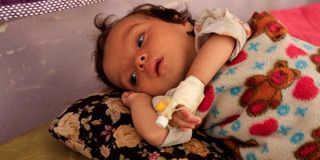
A Palestinian baby, suffering from severe malnutrition, receives treatment in the paediatric ward at Al-Aqsa Martyrs Hospital in Deir al-Balah, Gaza, on July 28. Here, infant formula has nearly run out and baby bottles are often filled with harmful substitutes.

What you need to know:
Aid shortages force Gaza parents into dangerous feeding practices; infant malnutrition and death rates soar.
- With formula vanished and breastfeeding impossible, babies face starvation; families resort to grinding chickpeas, herbs, and leaves for survival.
In a makeshift tent on a Gazan beach, three-month-old Muntaha's grandmother grinds up chickpeas into the tiniest granules she can to form a paste to feed the infant, knowing it will cause her to cry in pain, in a desperate race to keep the baby from starving.
“If the baby could speak, she would scream at us, asking what we are putting into her stomach,” her aunt, Abir Hamouda, said.
Muntaha grimaced and squirmed as her grandmother fed her the paste with a syringe.


Muntaha's family is one of many in Gaza facing dire choices to try to feed babies, especially those below the age of six months who cannot process solid food. Infant formula is scarce after a plummet in aid access to Gaza. Many women cannot breastfeed because of malnourishment, while other babies are separated from their mothers because of displacement, injury or, in Muntaha's case, death.
Her family says the baby's mother was hit by a bullet while pregnant, gave birth prematurely while unconscious in intensive care, and died a few weeks later. The director of the Shifa Hospital described such a case in a Facebook post on April 27, four days after Muntaha was born.
“I’m terrified about the fate of the baby,” said her grandmother, Nemah Hamouda. “We named her after her mother...hoping she can survive and live long, but we are so afraid, we hear children and adults die every day of hunger.”
Muntaha now weighs about 3.5kg, her family said, barely more than half of what a full-term baby her age would normally weigh. She suffers stomach problems like vomiting and diarrhoea after feeding.
Health officials, aid workers and Gazan families said many families are feeding infants herbs and tea boiled in water, or grinding up bread or sesame. Humanitarian agencies also reported cases of parents boiling leaves in water, eating animal feed and grinding sand into flour. Feeding children solids too early can disrupt their nutrition, cause stomach problems, and risk choking, paediatric health experts say.
“It's a desperate move to compensate for the lack of food,” said Unicef spokesperson Salim Oweis. “When mothers can't breastfeed or provide proper infant formula they resort to grinding chickpeas, bread, rice, anything that they can get their hands on to feed their children... it is risking their health because these supplies are not made for infants to feed on.”
Baby bottles without milk
Gaza's spiralling humanitarian crisis prompted the main world hunger monitoring body last week to say a worst-case scenario of famine is unfolding and immediate action is needed to avoid widespread death. Images of emaciated Palestinian children have shocked the world.
Gazan health authorities have reported more and more people dying from hunger-related causes. The total so far stands at 154, among them 89 children, most of whom died in the last few weeks.
With the international furore over Gaza's ordeal growing, Israel announced steps over the weekend to ease aid access. But the UN World Food Programme said it was still not getting the permissions to deliver enough aid.
Israel and the US accuse militant group Hamas of stealing aid—which the militants deny—and the UN of failing to prevent it. The UN says it has not seen evidence of Hamas diverting much aid. Hamas accuses Israel of causing starvation and using aid as a weapon, which the Israeli government denies. Humanitarian agencies say there is almost no infant formula left in Gaza.
The cans available in the market cost over $100 (Sh13,000)—impossible to afford for families like Muntaha’s, whose father has been jobless since the war closed his falafel business and displaced the family from their home.
In the paediatric ward of Al-Aqsa Martyrs Hospital in the central Gaza city of Deir al-Balah, the infant formula supply is mostly depleted. One mother showed how she poured thick tahini sesame paste into a bottle and mixed it with water. “I am using this instead of milk, to compensate her for the milk, but she won't drink it,” said Azhar Imad, 31, the mother of four-month-old Joury. “I also make her fenugreek, anise, caraway, any kind of herbs (mixed with water),” she said, panicked as she described how instead of nourishing her child, these attempts were making her sick.
Medical staff at the hospital spoke of helplessness, watching on as children's health deteriorated with no way to safely feed them. “Now, children are being fed either water or ground hard legumes, and this is harmful for children in Gaza,” said Doctor Khalil Daqran. “If the hunger continues ... within three or four days, if the child doesn't get access to milk immediately, then they will die.”
Unconscious
Meanwhile, Ibrahim al-Najjar said he lost his five-year-old son Naim to malnutrition that is ravaging Gaza. One year later, he is still grieving while scrambling to make sure his other children don't suffer the same fate. “This child will follow him,” the Palestinian former taxi driver said, pointing to his 10-year-old son Farah. “For about a month, he's been falling unconscious. This child was once double the size he is now.”
Najjar, 43, held up a medical certificate that shows Naim died on March 28, 2024. The whole family has been displaced by nearly two years of Israeli air strikes.
The Najjars had been used to eating three meals a day before the war broke out in October 2023—after Hamas-led Palestinian militants attacked Israel—but now they can only dream of even simple foods such as bread, rice, fruit and vegetables. Naim's brother, Adnan, 20, focuses on taking care of his other brothers, rising every morning at 5.30am to wend his way gingerly through Gaza's mountains of rubble to find a soup kitchen as war rages nearby.
“I swear I don’t have salt at home, I swear I beg for a grain of salt,” said Naim's mother Najwa, 40. “People talk about Gaza, Gaza, Gaza. Come see the children of Gaza. Those who do not believe, come see how Gaza’s children are dying. We are not living, we are dying slowly,” she said.
Five more people died of malnutrition and starvation in the Gaza Strip in the previous 24 hours, the enclave's health ministry said on Wednesday, raising the number of deaths from such causes to at least 193 Palestinians, including 96 children, since the war began.
A global hunger monitor has said a famine scenario is unfolding in the Gaza Strip, with starvation spreading, children under five dying of hunger-related causes and humanitarian access to the embattled enclave severely restricted. And the warnings about starvation and malnutrition from aid agencies keep coming.
The United Nations Office for the Coordination of Humanitarian Affairs (Ocha) said food consumption across Gaza has declined to its lowest level since the onset of the war. Eighty-one per cent of households in the tiny, crowded coastal territory of 2.2 million people reported poor food consumption, up from 33 per cent in April.
“Nearly nine out of 10 households resorted to extremely severe coping mechanisms to feed themselves, such as taking significant safety risks to obtain food, and scavenging from the garbage,” Ocha said in a statement.
Even when Palestinians are not too weak to access aid collection points, they are vulnerable to injury or death in the crush to secure food. Between June and July, the number of admissions for malnutrition almost doubled, from 6,344 to 11,877, according to the latest Unicef figures available.
Meanwhile there is no sign of a ceasefire on the horizon, although Israel's military chief has pushed back against Prime Minister Benjamin Netanyahu's plans to seize areas of Gaza it doesn't already control, three Israeli officials said. Netanyahu has vowed no end to the war until the annihilation of Hamas, which killed 1,200 people and took 251 others hostage in its October 7 attack, according to Israeli tallies.
Israel's military response has killed more than 60,000 people, according to Gaza health authorities, and turned Gaza, one of the world's most densely populated areas, into a sea of ruins, with many feared buried underneath.
'The shadow of death'
Holding her emaciated baby Ammar who, she said, is wasting away from malnutrition, Amira Muteir, 32, pleaded with the world to come to the rescue. “The shadow of death is threatening him, because of hunger,” she said, adding he endures 15 or 20 days a month with no milk, so she waits hours at a hospital for a fortified solution. Sometimes he has to drink polluted liquids because of a shortage of clean water, she said.
Muteir and her children and husband rely on a charity soup kitchen that helps them with one small plate of food per day to try and survive. “We eat it throughout the day and until the following day we eat nothing else,” she said.


