Power without popularity: Why influential women trail in Kenya’s presidential polls
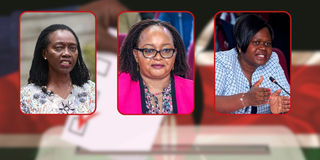
From left: Martha Karua, Ann Waiguru and Gladys Wanga.

What you need to know:
- An analysis of Infotrak polls showing trends in preferred presidential candidates — if elections were held at the time of the surveys — reveals a country still hesitant to support a woman in the highest office.
Women of significant influence in Kenyan politics remain almost unseen by the voters. An analysis of Infotrak polls showing trends in preferred presidential candidates — if elections were held at the time of the surveys — reveals a country still hesitant to support a woman in the highest office.
In September 2024, Martha Karua had just three per cent, while the late Raila Odinga was the second competitor to President William Ruto at 17 per cent, with Ruto at 19 per cent. Ann Waiguru, the Kirinyaga County Governor, had 0.4 per cent, while Babu Owino stood at nine per cent and Fred Matiang'i at six per cent.
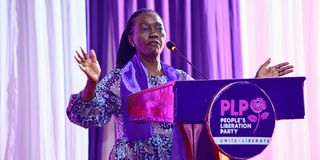
People's Liberation Party (PLP) leader Martha Karua addresses the party's National Delegates Conference at Ufungamano House, Nairobi, on September 26, 2025, where she formally announced her candidacy for the 2027 presidential race.


By August 2025, Matiang'i's popularity had risen to 15 per cent, making him the second competitor, while Ruto's also rose to 21 per cent. Karua dropped to one per cent and Waiguru fell off the list. Gladys Wanga, Homa Bay County Governor and Chairperson of the Orange Democratic Party, entered the polls at a mere 0.4 per cent.
In December 2025, Ruto's popularity further increased to 28 per cent, while Matiang'i's dropped to 13 per cent. Karua and Wanga saw minimal improvement — Karua rose to two per cent and Wanga to one per cent.
While Wanga has been discussed as a potential woman presidential candidate and a possible running mate for Ruto in 2027, Karua remains a presidential brand, having run in 2013 and served as the running mate of the late Raila Odinga in 2022.
Matiang'i more popular than Karua
But why do fresh male hopefuls outpace her? Matiang'i is evidently more popular than Karua, according to these polls. Even in 2013, Mohammed Abduba Dida, a little-known teacher of English Literature and Religious Studies, made headlines when he emerged seemingly out of nowhere to contest the presidency, drawing more votes than veteran politician Karua.
He secured 52,848 votes, surpassing Karua's 43,881, despite her two decades in politics as a four-time Member of Parliament for Gichugu Constituency and Cabinet Minister for Water Resources Management and Development, as well as for Justice, National Cohesion, and Constitutional Affairs.
So, why do women wield influence yet remain invisible in popularity?
Political scientist Stella Cherop says Kenya's patriarchal culture continues to influence society. Despite advances in education and opportunities for women, bias against women leaders persists, and some communities remain reluctant to accept women in positions of authority.
"Kenyan voters often respond emotionally to narratives," she noted. "For instance, in 2022, sympathy for Ruto and his 'hustler' narrative influenced voting."
She highlighted that comparisons to events in neighbouring countries also shape perceptions of women leaders, citing Tanzania's Samia Suluhu.
Tanzania held its general election on 29 October 2025, in which President Samia Suluhu Hassan sought a second term. The vote was held amid controversy after major opposition parties and key rivals were barred from participating, with leading figures either disqualified, jailed, or facing legal barriers to contesting.
On election day, the country experienced a nationwide internet blackout, and reports emerged of protests, clashes with police, and unrest in major cities. Security forces deployed the military and imposed curfews in response to the disturbances as demonstrators rejected a process they viewed as fundamentally unfair.
Later, the Independent National Electoral Commission declared Suluhu the winner with an overwhelming 97.66 per cent of the vote — a landslide result that drew widespread criticism from opposition groups and observers who described it as a "mockery of democracy." Streets in cities such as Dar es Salaam saw protests, some turning violent, and rights groups reported numerous deaths and injuries in the unrest that followed.
Cherop further observed that the current crop of women leaders has not demonstrated the strong leadership seen in pioneers like Julia Ojiambo or Professor Wangari Maathai.
"During key protests or political moments, some women leaders remained silent or engaged in behaviour perceived negatively by the public. Society is unforgiving of women who fail to meet expectations, while men often face less scrutiny," she asserted.
However, Cherop noted hope among younger voters, who increasingly assess leaders based on merit and capability rather than gender.
She also emphasised the role of gender institutions, such as the National Gender Equality Commission and county gender departments, in changing this trend.
"While these offices have a mandate to educate and raise awareness, in practice, they are often seen as performing only affirmative action or box-ticking exercises, rather than driving substantive change," she noted.
"Local Woman Representatives, for example, are sometimes visible only during large events aimed at gaining political points, rather than actively addressing issues like gender-based violence or girls' access to education."
She stressed that women in leadership must take their mandate seriously to shape perceptions and drive change at the grassroots level.
Notably, these perceptions remain deeply anchored in traditional gender roles, which continue to constrain women in society.
Political analyst Wanja Maina noted that Kenyans tend to accept women in caregiving or private roles, but remain uneasy when women occupy visible, public leadership positions.
"Political organising in Kenya often revolves around drama, razzmatazz, and sloganeering," she noted. "Martha Karua is principled and focused on policy, but popularity in Kenya often isn't about policy — it's about visibility and theatrics."
Maina noted that Karua's role in the opposition and her lack of a recent public seat have made her less prominent in the public eye, while generational shifts mean younger voters often see her politics as outdated.
"Karua's party is not among the top five in the country, which further affects her perceived viability," she said.
"Polls can miss nuances — for example, if a survey were done in Gichugu, the results for Karua could be very different. Timing also matters; a candidate's visibility changes depending on events like arrests, returns from abroad, or campaign activity."
Maina highlighted that Karua's steadfast commitment to justice and constitutionalism has, paradoxically, worked against her.
"During the 2022 campaigns, some people viewed her strict adherence to law and fairness as threatening. While principled, this sometimes makes her less 'likeable' to the electorate, who prefer leaders with a more flexible, populist approach," she noted.


