Remembering Nana Konadu Rawlings: The rhetorical power behind Ghana’s women’s movement
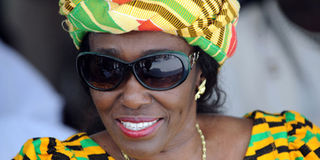
Nana Konadu Agyeman-Rawlings. She died on October 23, 2025.

What you need to know:
- Beyond her activism, Nana Konadu used language as a tool for transformation; her speeches and writings challenged stereotypes about women’s roles, politicised the office of the first lady, and demanded recognition for women in national history.
- While her methods drew criticism, Nana's courage in navigating Ghana’s male-dominated politics and her efforts to “write herself into history” cement her as a transformative figure. Her advocacy for morality, truth, and empowerment continues to inspire.
Tributes for Nana Konadu Agyeman-Rawlings (1948-2025) have been pouring in since her death on October 23. For many Ghanaians, her broad-ranging empowerment work as leader of the 31st December Women’s Movement is deserving of full recognition. The non-governmental organisation started as a women’s political movement and is still active.
Born on November 17, 1948, she became the wife of Jerry John Rawlings, who governed Ghana from 1981 until he handed over power in 2001. Mourners, including Ghana’s President John Dramani Mahama, have referenced Nana’s social welfare interventions through her organisation as evidence of her achievements. These include the provision of credit facilities and advocacy for women’s and children’s rights. She also established daycare centres for children, adult literacy centres and edible oil extraction industries.


A dimension of Agyeman-Rawlings’ politics that has been mainly overlooked, however, is her rhetorical leadership. This refers to the various persuasive means through which she performed her roles as a public figure.
I am a scholar of English who studies how people use language and other communicative forms (such as sound and visuals) to influence public discourse. I have used rhetorical and linguistic methods to study sources on Agyeman-Rawlings, including a personal interview I conducted with her in 2017.
Nana’s speeches and writing reveal her motivations for shifting prevailing ideas about women’s social roles, her complex responses to public anxieties about her power (real or imagined) and her attempt at disrupting the archives by narrating herself into history.
Advocating change
Her rhetorical leadership transformed the role of the first lady in Ghana. In her own words: “A first lady’s work does not end with the collection of flowers and doing some protocols … I’d rather work and be emulated than to sit down and not do anything and not change anybody’s life.”
For this reason, Nana spoke and wrote extensively in national and international contexts. Her rhetoric of empowerment centred the plights of women, children and the poor. For instance, she asserted at Beijing that “for us in Africa, the girl child is a special concern.”
She articulated a cosmopolitan ideology shaped by multiple influences. These include UN rights discourses, the language of mothering (such as nurturing, protecting), liberal feminism with its emphasis on gender reform through legal means, and the populist rhetoric of the Rawlings regime, with its emphasis on people power.
An assessment of Nana’s legacy must recognise that speaking and writing for change involve extensive physical, mental and emotional energy. And for many years, under her husband’s military regime, she performed this role without the professional support of a communications team. The sociologist Mansah Prah describes Nana’s tenure as the era of the “grand feminist illusion” because although her organisations were seemingly pro-woman, their activities did not result in substantial changes in the lives of women.
However, as my research suggests, discussions on the limitations of her advocacy must consider at least two factors. First, the patriarchal postcolonial state always constrains women’s mass efforts at transformation. Second, the discourses that influence her rhetoric are themselves contradictory. For instance, the term “empowerment” is a catchall phrase that means different things to different people. Its vagueness makes it a safe political term. It does not radically shift conversations on gender.
Contesting power
Nana had an intense political life. One could say that through her gendered advocacy and mass mobilisation, she politicised the first lady role. For that reason, she was highly scrutinised during her active political years. In response to efforts to restrain her power, she drew on ambiguous gendered rhetorics, moral values and familial legacy. She was variously accused of being corrupt, power drunk and ostentatious, often with sexist undertones.
People rumoured that she, as first lady, was the real power behind the presidency. When her husband was preparing to leave office, there were stories that she wanted to succeed him. One news report claims that she countered such allegations by saying: “I have never said anywhere that I want to be president” while implying that she could change her mind if her husband said so. It takes a keen rhetorical intellect to navigate the slippery political terrain Agyeman-Rawlings found herself in.
She remained politically active after her tenure as first lady ended. In 2011, she contested against John Evans Atta Mills, Ghana’s president at the time, for the candidacy of the National Democratic Congress, which she helped form. She would later defect from the party to form her own, the National Democratic Party.
In these complex political tussles, she consistently appealed to morality and truth. In one instance, she countered ten years of media “bashing” by claiming that she had been raised right. Her 2016 acceptance speech for the National Democratic Party candidacy centred on “what is right” for the “people”.
My interview with her and other primary sources point to the influence of the calm, ethical and non-ideological pragmatism of Nana’s father, J.O.T. Agyeman, in her appeal to morality. Her father was a technocrat who was connected to Ghanaians belonging to different sides of Ghana’s two main political traditions, the Nkrumahist and the Danquah-Busia traditions.
According to Agyeman-Rawlings, her parents’ home was a space for “spirited” conversations shaped by her father’s emphasis on logical and ethical argumentation rather than parochial political interests. This suggests that examining African first ladies merely in relation to their husbands’ politics, however crucial, would be a limited view.
Disrupting the archive
Nana wrote a memoir, unusually for a Ghanaian woman politician. As the historian Jean Allman suggests, there is a connection between the erasure of women in Ghanaian politics and the absence of autobiographical writings by nationalist women. My studies argue that Nana’s narrative (though incomplete) should be read as a rhetorical disruption of the postcolonial archives. These archives tend to erase or subordinate women’s contributions within a dominant masculine framing of the nation-state.
Nana is not the only woman to have laboured for the nation-state. Other women like pro-independence activist Hannah Kudjoe who were involved in similar social welfare activities have been written out of Ghanaian history. Agyeman-Rawlings understood that despite her extensive work, words still mattered if she was to be remembered.
By asserting that “it takes a woman” to “birth” the strength and future of a nation, she boldly inserts a feminine voice into a postcolonial national allegory that centres men. By so doing, she demands a rereading of “great men” like Ghana’s first president, Kwame Nkrumah, and Jerry Rawlings. And in the absence of a Jerry Rawlings autobiography, Nana’s writing becomes doubly subversive.
Because women have been historically marginalised from the public sphere, a female politician would be scrutinised whether or not she was vocal. Nana chose to be visible and outspoken.
Nancy Henaku is a lecturer at the Department of English, University of Ghana.


