Russia-Ukraine, Kenya's loss: The mitumba women fighting to stay afloat
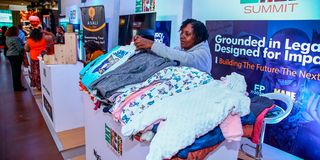
Ngina Njuguna displays her mitumba clothing range during the NXT HER Summit at Mövenpick Hotel, Nairobi, on August 21, 2025. She used to sell five bales weekly and earn six figures monthly—now she struggles to move two as Europe's conflict reshapes Gikomba.

What you need to know:
- The Russia–Ukraine war disrupts shipping routes, raising import costs and pushing up mitumba prices in Kenya, threatening millions of livelihoods and household budgets.
- As global conflict and inflation bite, Kenyan mitumba traders like Ngina Njuguna struggle with higher bale prices, weaker shilling, and shrinking customer demand.
More than 4,000 miles away, Russia and Ukraine are at war. Russia is fighting to keep Ukraine under its influence and prevent it from joining Western alliances, while Ukraine is defending its independence and sovereignty with everything it has.
But here in Kenya, the conflict between these two European nations is quietly reshaping household budgets, particularly through the second-hand clothing trade. At least 91.5 per cent of households in Kenya buy second-hand clothes worth Sh1,000 or less, while 8.5 per cent spend above Sh1,000. This is according to a 2019 study by the Institute of Economic Affairs and the Mitumba Consortium Association of Kenya (MCAK) on the state of second-hand clothing and footwear trade.
The bulk of second-hand garments arriving in Kenya come from the United States, China, and the United Kingdom, followed by Germany and South Korea. Traders, however, prefer shipments from Europe and the US because of their superior quality. So, when the Russia–Ukraine war disrupts shipping routes in Europe, the ripple effects are felt in Gikomba, Toi market, and countless other mitumba stalls across the country. The delays increase importation costs, which are eventually transferred to consumers—ordinary Kenyan households.

According to MCAK chair Teresia Wairimu Njenga, about two million Kenyans earn directly from the second-hand clothing sector, 85 per cent of them women. “Because of this war, a shipment from Europe has to change route,” she explains. “A shipment that previously arrived in Kenya after one-and-a-half months now arrives after three months. That is not just a delay that affects the availability of clothes—it also makes imports costlier. That cost has to be recovered.”
Inflation, fashion trends, and a weakening shilling further complicate matters. “As the shilling weakens, the cost of importation rises, an extra cost that is passed to traders and, finally, to buyers,” she adds. “For clothes whose fashion has passed, they will cost less than the new designs. Even the materials for the new fashion cost more than the old ones, so obviously the price will vary. Poor quality and outdated fashion will be cheaper than high-quality and trendy pieces.”
One trader who has witnessed the highs and lows of the business is Ngina Njuguna, who runs Ngina Baby Shop at Adams Arcade in Nairobi. She has specialised in second-hand baby clothes for 15 years. “My customers prefer UK clothes because of the quality,” she says. “Those from China are small and wide, and the material is poor. My customers don’t like them at all. US is also of high quality, but UK is their favourite.”
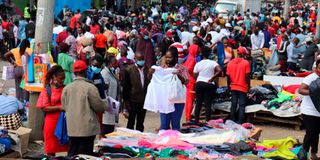
Second-hand clothes buyers and sellers at Gikomba market in Nairobi on June 13, 2021.
Ngina started her business in 2010 after working briefly as a salesperson. She saved up Sh15,000 in capital and opened her stall. Back then, bales of baby clothes cost as little as Sh8,000 to Sh17,000.
Today, the same bales go for Sh28,000 to Sh50,000, depending on the grade and fashion. “Before, we used to sell a lot of clothes. I could move four or five bales in a week. Now, I am lucky to sell one or two. People are buying less because prices are too high,” she explains.
Although rising costs have cut into her profits, Ngina has still managed to employ two young women to help run the shop. She also relies on a rider for deliveries, with customers covering the cost. “I usually market myself through social media—Facebook, TikTok, and WhatsApp status,” she says.
“Some customers say they saw me online, but the biggest number comes from referrals. Baby clothes are marketable because children outgrow them fast. A parent buys today, and in two months, they are back for more.”
Despite the challenges, Ngina remains determined. As a member of a 16-member savings group, she can secure bank loans using the group as collateral—support that helps her keep the business afloat. “When I started, it was easy to make Sh100,000 in a month. Nowadays, even getting that amount feels like a struggle,” she says.
Still, she is not giving up. “This business feeds my children, pays school fees, and keeps many families going. We just need policies that make it easier for us to trade.”